
IPO-RTA Selection Checklist for Issuers and Merchant Bankers
Reviewed on: 23 October 2026. Reviewed by Abhipra RTA Desk.
Choosing a registrar to an issue (RTA) is an issuer-side control decision, not a box-ticking exercise. Start by verifying the prospective provider's current SEBI registration, then assess whether its documented scope, operating model, security controls and escalation approach fit the proposed issue. Registration alone does not establish suitability or guarantee an IPO outcome.

Start with the regulatory screen
SEBI maintains a current register of recognised intermediaries, including Registrars to an Issue and Share Transfer Agents. Record the prospective provider's name, registration number, validity shown in the register and the date of your check. The SEBI RTA Regulations, 2025 and the SEBI Master Circular for RTAs form the central regulatory reference points for this workstream.
For a public issue, the issuer, merchant banker and other intermediaries should also work from the current SEBI ICDR framework and the relevant exchange route. For an SME issue, use the exchange's SME-specific process material; do not assume it applies to a main-board issue.
A practical selection checklist
Use a single controlled evaluation record. It should identify who checked each item, the evidence reviewed, open actions, owner and approval date.
| Evaluation area | Questions to resolve | Evidence to retain |
|---|---|---|
| Regulatory status | Is the provider currently shown in SEBI's recognised-intermediary register? | Dated register extract or controlled reference note |
| Mandate fit | Does the proposed mandate clearly cover the issue structure, interfaces and deliverables? | Scope matrix and draft engagement terms |
| Issue operations | Who is the named issue team and how will application, reconciliation and allotment work be coordinated? | Team map, milestone plan and scenario walkthrough |
| Data and resilience | How are access, investor data, audit trails, backups, incident escalation and business continuity governed? | Control summary, escalation contacts and BCP evidence |
| Accountability | Are hand-offs, exception ownership, reporting cadence and approval gates unambiguous? | RACI, service levels and decision log |
Test the workflow before appointment
Ask the finalist to walk the project team through an issue-specific operating scenario. The purpose is not to seek confidential investor data or to outsource the issuer's judgement; it is to test interfaces, escalation timing and evidence retention before the mandate is finalised.
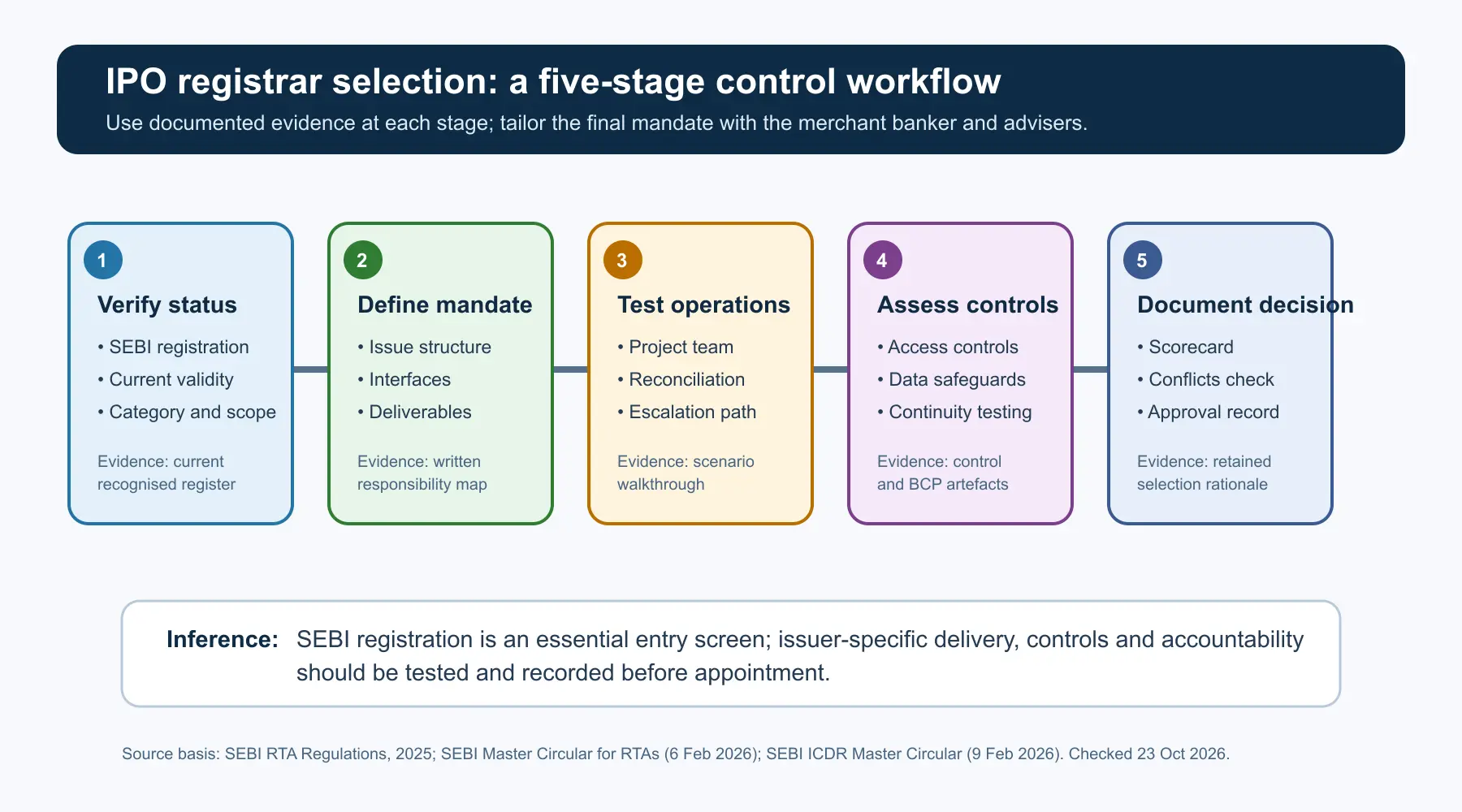
The workflow has no numerical axis: it is a sequential control map. Its inference is deliberately simple—regulatory registration is a necessary entry screen, while service delivery, security and documented accountability must be assessed separately.
Questions for the issuer and merchant banker
- Which milestones require data or approvals from the issuer, merchant banker, bankers, depositories or exchange?
- How will exceptions, duplicate or mismatched application data, investor communications and reconciliation breaks be logged and escalated?
- What information-security and continuity evidence can be reviewed without requesting credentials, unmasked investor records or other sensitive data?
- Which provisions belong in the engagement terms, and which remain subject to the offer document, current SEBI requirements and exchange processes?

Keep the decision auditable
Retain the scoring rationale, conflict checks, approval record and final responsibility map with the transaction file. Recheck regulatory status and operational facts close to appointment because registers, circulars and exchange procedures can change. Do not send passwords, OTPs, unmasked PAN, bank details, signatures or investor files by ordinary email; wait for an approved secure submission channel.
How Abhipra can assist
Abhipra can help issuers organise an RTA-readiness workstream, prepare a controlled information checklist, map issuer–merchant banker–RTA hand-offs and build evidence records for management review. Engagement scope, offer-document responsibilities, applicable exchange requirements and legal conclusions should be confirmed with the issuer's merchant banker, legal advisers and other appointed professionals.
Source links
- SEBI RTA Regulations, 2025 — final regulations published 16 December 2025; the related corrigendum was also checked.
- SEBI Master Circular for Registrars to an Issue and Share Transfer Agents — dated 6 February 2026.
- SEBI Master Circular for Issue of Capital and Disclosure Requirements — dated 9 February 2026.
- SEBI recognised-intermediary register — consulted for current RTA-status verification.
- NSE Emerge requirements and process — platform-specific reference for SME issues.
Disclaimer
This article is general educational information, reviewed on 23 October 2026, and is not legal, regulatory, accounting, merchant-banking, tax or investment advice. Eligibility, appointment terms, responsibilities, timelines and disclosure obligations depend on the issue structure and current law. Obtain transaction-specific advice from appropriately appointed professionals. REQUIRES HUMAN LEGAL AND EDITORIAL REVIEW before publication.