
AIF vs Mutual Fund vs PMS: Understanding Structure, Investor Access and Risk
Reviewed on: 2 November 2026. Reviewed by Abhipra RTA Desk.
An AIF, mutual fund and portfolio management service (PMS) are not interchangeable labels. They use different regulatory structures, documents, access routes, fee models and operational controls. None is automatically safer, more suitable or more likely to outperform; the appropriate choice depends on objectives, risk capacity, liquidity needs, eligibility and the live offer documents.

Begin with the legal structure
Mutual funds operate through SEBI-regulated schemes. PMS is a portfolio-management service under a client agreement, with discretionary, non-discretionary and advisory forms subject to the applicable framework. AIFs are privately pooled vehicles registered under the SEBI AIF Regulations and are classified into regulatory categories. The exact terms come from the current regulations and the product documents—not a marketing comparison.
SEBI’s listed framework now includes Mutual Funds Regulations, 2026, last amended on 10 October 2026. For PMS, SEBI has issued Portfolio Managers Regulations, 2026 with effect from 1 April 2027; until then, an investor should verify the currently applicable 2020 framework, amendments and master circular. The AIF Regulations, 2012 were last amended on 15 October 2026.
Access, pooling and portfolio design
Mutual-fund investors buy units in a scheme and should read its objective, asset-allocation policy, risk disclosures and redemption conditions. A PMS client enters an agreement with a registered portfolio manager; portfolio design and disclosure documents deserve close reading. An AIF investor commits to a privately pooled vehicle and should examine its placement memorandum (PPM), category, investment mandate, drawdown mechanics, transfer restrictions, valuation and exit terms.
| Question | Mutual fund | PMS | AIF |
|---|---|---|---|
| Core arrangement | Pooled scheme units | Client portfolio-management agreement | Privately pooled fund/scheme and PPM |
| Key reader document | Scheme offer and disclosure documents | Agreement and disclosure document | PPM and contribution/transaction documents |
| Main diligence focus | Mandate, risk, costs and liquidity | Mandate, fees, reporting and manager disclosures | Category, strategy, commitment, valuation and exit terms |
| Inference | Structure changes governance and access. It does not promise return, liquidity or suitability. | ||
Risk and disclosure are not the same as a return forecast
All three structures can expose investors to market, credit, concentration, liquidity, valuation and manager risks, in different combinations. Past performance, a familiar brand or a high minimum amount should not substitute for reading the documents. Ask how the product can lose value, how and when investors can exit, what fees apply, who calculates valuations, and how complaints are addressed.
A due-diligence workflow before engagement
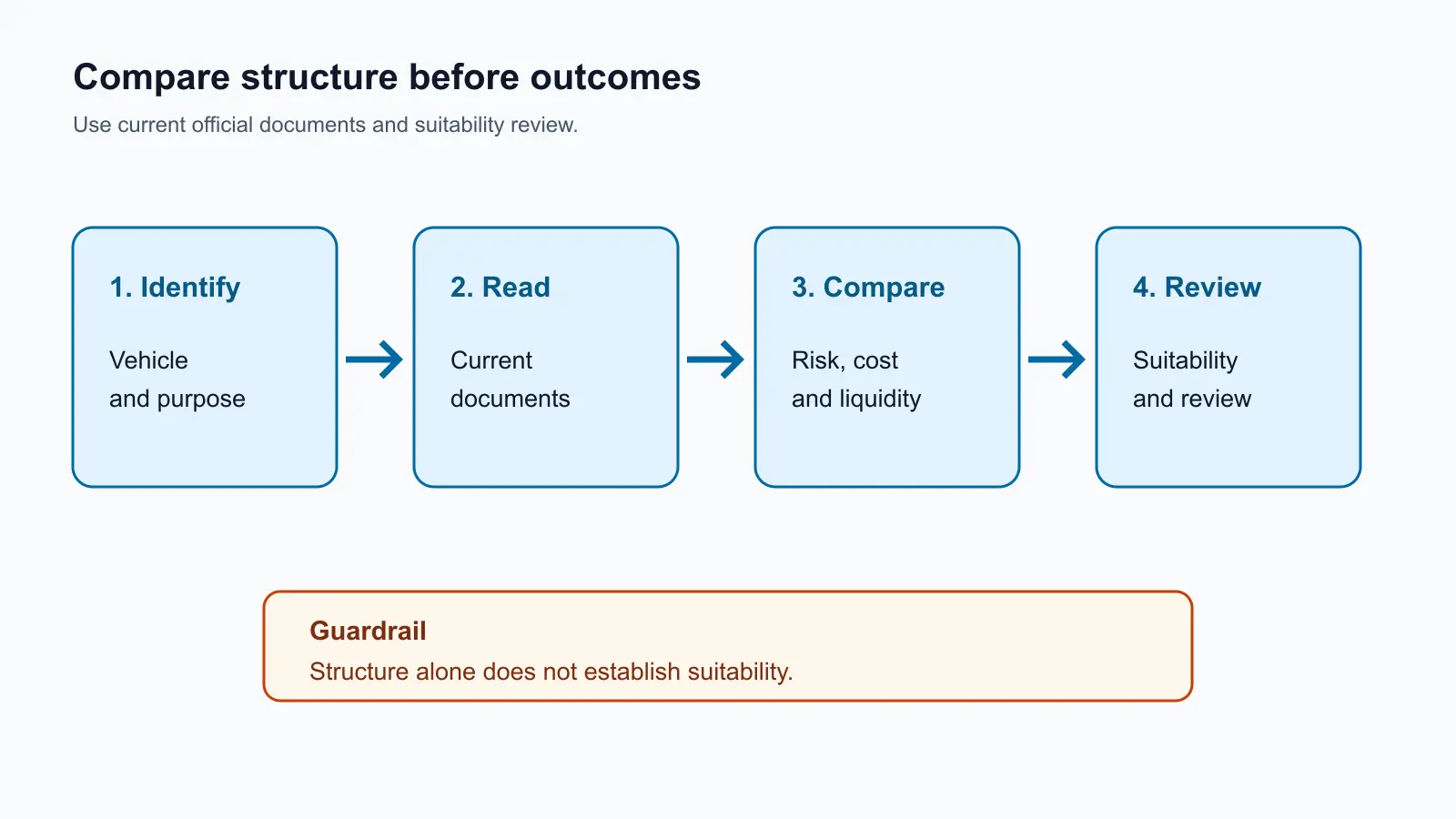
The flow has no numeric axis because it maps legal and operational questions rather than returns. Its inference is explicit: structure affects governance and access, but does not determine investment outcome or suitability. Validate the current regulatory position, disclosures, costs, liquidity, manager credentials and your documented objectives before taking professional advice.
Where RTA and servicing operations may matter
For AIFs, an RTA may support unit-holder records, investor communications, unit workflows and depository-facing processes within its mandate. This does not replace the manager, sponsor, trustee, custodian, valuer, auditor, legal adviser, tax adviser or required approvals. Do not email unmasked PAN, bank details, signatures, passwords or OTPs; wait for a secure document-submission route.

How Abhipra can assist
Setting up or operating an AIF and evaluating RTA, dematerialised-unit, ISIN, depository or unit-holder servicing support? Contact Abhipra RTA Services at rtaservices@abhipra.com, call 011-42390783, or contact +91-9818080700. Share only high-level, non-sensitive details until a secure submission route is confirmed.
Official sources
- SEBI AIF Regulations, 2012—consolidated through 15 October 2026
- SEBI regulations listing: Mutual Funds Regulations, 2026 and Portfolio Managers Regulations, 2026
- SEBI Portfolio Managers Regulations, 2020—last amended 3 September 2025
- SEBI Master Circular for Portfolio Managers, 16 July 2025
Disclaimer
This is general education, not investment, legal, tax, accounting or valuation advice. Product terms, eligibility, regulation, fees, taxation, risks and liquidity can change. Read the current documents and obtain advice from appropriately qualified professionals before acting.