What Is Hedging And Why Investors Use It?
Market risk cannot be removed from investing. It can only be understood, sized and managed. Hedging is one way investors try to reduce the impact of an adverse price movement, but it is often misunderstood as a trading shortcut.

Hedging Means Reducing A Specific Risk
In securities markets, a derivative gets its value from an underlying asset such as an equity share, an index, a commodity or a currency. SEBI's investor education material explains that futures and options are common derivative contracts, and that derivatives are primarily used by investors for hedging positions and minimizing price risk.
That definition matters. A hedge should begin with an existing exposure. For example, an investor who owns a broad equity portfolio may worry about a sharp short-term market fall before a planned cash requirement. A properly sized hedge can be considered to reduce part of that downside. It is not meant to convert a long-term portfolio into a daily speculation account.
How Investors Commonly Think About Hedges
The practical question is not "Which option can make money?" It is "Which risk am I trying to reduce, for how long, and at what cost?"
| Situation | Possible Risk | Hedging Thought Process |
|---|---|---|
| Long-term equity investor with near-term market anxiety | Portfolio drawdown before a planned goal | Consider whether a limited, short-duration hedge is cheaper and cleaner than selling quality holdings in panic. |
| Business or HNI with concentrated listed-equity exposure | Too much wealth linked to one share or sector | Review diversification first; derivatives should not hide a structurally concentrated portfolio. |
| Investor with cash needed soon | Market fall before withdrawal | Reducing equity exposure may be simpler than using derivatives. |
| Trader using F&O without an underlying exposure | Speculation, leverage and transaction-cost drag | This is not hedging; it is a directional trade and requires strict risk capital discipline. |
Why Hedging Is Different From Speculation
Hedging usually has three limits: it is linked to an exposure, it has a defined time frame, and it has a cost the investor accepts in advance. Speculation often starts with a market view and then searches for leverage.
That difference is important in India because retail F&O outcomes have been weak at the aggregate level. SEBI's July 2025 study on equity derivatives reported that individual traders' net losses were Rs 1,05,603 crore in FY25, up about 41% from Rs 74,812 crore in FY24, with over 91% of individual traders incurring net losses. SEBI's September 2024 analysis for FY22 to FY24 had also found that 93% of individual traders in equity derivatives incurred net losses.

The visual shows hedging as a portfolio conversation: first identify the exposure, then decide what amount and period needs protection, and only then evaluate whether a derivative position is suitable. The protection object is deliberately small because hedging should not dominate the portfolio plan.
What The SEBI Data Shows
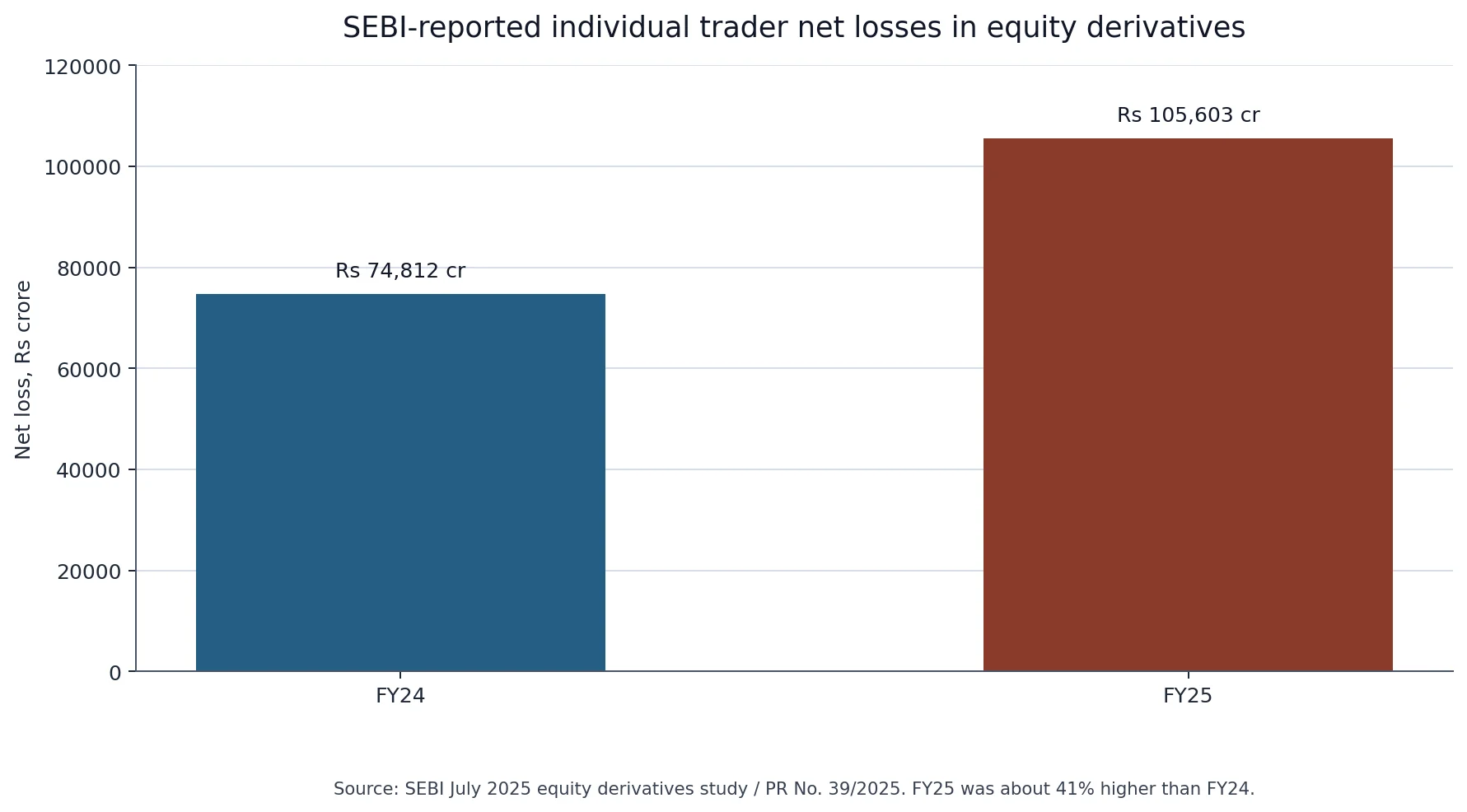
The chart compares SEBI-reported net losses of individual traders in the equity derivatives segment. The data is not a prediction for any one investor, but it is a strong warning that F&O participation without a written risk purpose, position sizing and exit rule can become expensive.
| SEBI-reported metric | FY24 | FY25 |
|---|---|---|
| Individual trader net loss in equity derivatives | Rs 74,812 crore | Rs 1,05,603 crore |
| Change in net loss | - | About 41% increase |
| Share of individual traders with net losses | 91.1% | Over 91% |
A Sensible Hedging Checklist
- Name the exposure before choosing an instrument.
- Decide whether the risk should be reduced by asset allocation, cash planning or diversification before using derivatives.
- Define the hedge amount, period, maximum acceptable cost and exit trigger.
- Avoid selling options without fully understanding unlimited or large-loss scenarios, margin requirements and mark-to-market pressure.
- Keep F&O activity within risk capital and avoid borrowing or using emergency funds.
- Review tax, brokerage, STT, exchange charges and slippage because transaction costs affect the final outcome.
- Record the reason for every hedge so it can be audited later.
Common Mistakes
The most common mistake is calling every F&O position a hedge. A naked option trade, an oversized futures position or a weekly expiry bet without an offsetting portfolio exposure is not a hedge.
Another mistake is hedging after fear has already taken over. If a portfolio is too aggressive for the investor's risk appetite, the better answer may be asset allocation review, not a complex derivative layer.
Investor Checklist Before Using F&O For Hedging
- Do I already own the asset or portfolio I am trying to protect?
- Is my hedge smaller than the exposure, or has it become a separate trade?
- Can I explain the loss scenario without looking at an app?
- Do I know the margin and liquidity requirement?
- Have I considered simpler alternatives such as rebalancing, cash allocation or diversification?
- Am I prepared for the hedge to cost money even if it reduces stress?
Source Links
- SEBI Investor: Understanding derivatives
- SEBI press release, July 7, 2025: comparative study of growth in equity derivatives segment
- SEBI press release, September 23, 2024: updated study on individual F&O trader losses between FY22 and FY24
- SEBI research, September 2024: analysis of profits and losses in the equity derivatives segment, FY22-FY24
- SEBI research, January 2023: analysis of profit and loss of individual traders dealing in equity F&O segment
- NSE: About equity derivatives
- NSE: Equity derivatives margins
- NSE: Equity derivatives clearing and settlement
Disclaimer
This article is for investor education only and is not investment advice, trading advice, research recommendation or a solicitation to buy, sell or hold any security or derivative contract. Futures and options involve leverage, margin requirements and the possibility of substantial losses. Investors should evaluate suitability, risk capacity, taxation and costs, and consult a qualified adviser before acting. Reviewed by Abhipra Research / Compliance Team.