
Stop Loss And Position Sizing: Risk Control Before The Trade

A stop loss is often treated like a trading shortcut: place an order, limit the damage, move on. In reality, a stop loss works only when it is paired with position sizing. The stop decides where a trade idea is wrong. Position sizing decides how much money is at risk if that stop is reached.
For equity, futures and options traders, this pairing matters more than prediction. A good entry can still fail. A disciplined risk plan limits how much one failed idea can hurt the overall capital.
Stop Loss Is An Exit Rule, Not A Guarantee
NSE explains that a stop-loss order enters the order book only after the market reaches the specified trigger price. That means the trigger is not the same as an assured execution price. In fast-moving, illiquid or gap-down markets, the final execution can be different from the level an investor had in mind.
This is why a stop loss should be written as a risk rule, not as comfort language. Before entering a trade, the investor should know:
- the entry price;
- the stop-loss trigger and limit logic;
- the maximum rupee loss if the order is executed near the planned level;
- the quantity that keeps the loss within the risk budget;
- the action plan if the price gaps beyond the stop.
Position Sizing Makes The Stop Useful
Position sizing starts with capital at risk, not market excitement. A simple framework is:
Maximum trade quantity = acceptable rupee risk per trade / rupee risk per share or unit
If an investor has Rs 1,00,000 trading capital and decides that one trade should not risk more than 1%, the risk budget is Rs 1,000. If the entry is Rs 250 and stop is Rs 240, the risk per share is Rs 10. In that case, the position size is 100 shares before brokerage, taxes, slippage and liquidity impact.
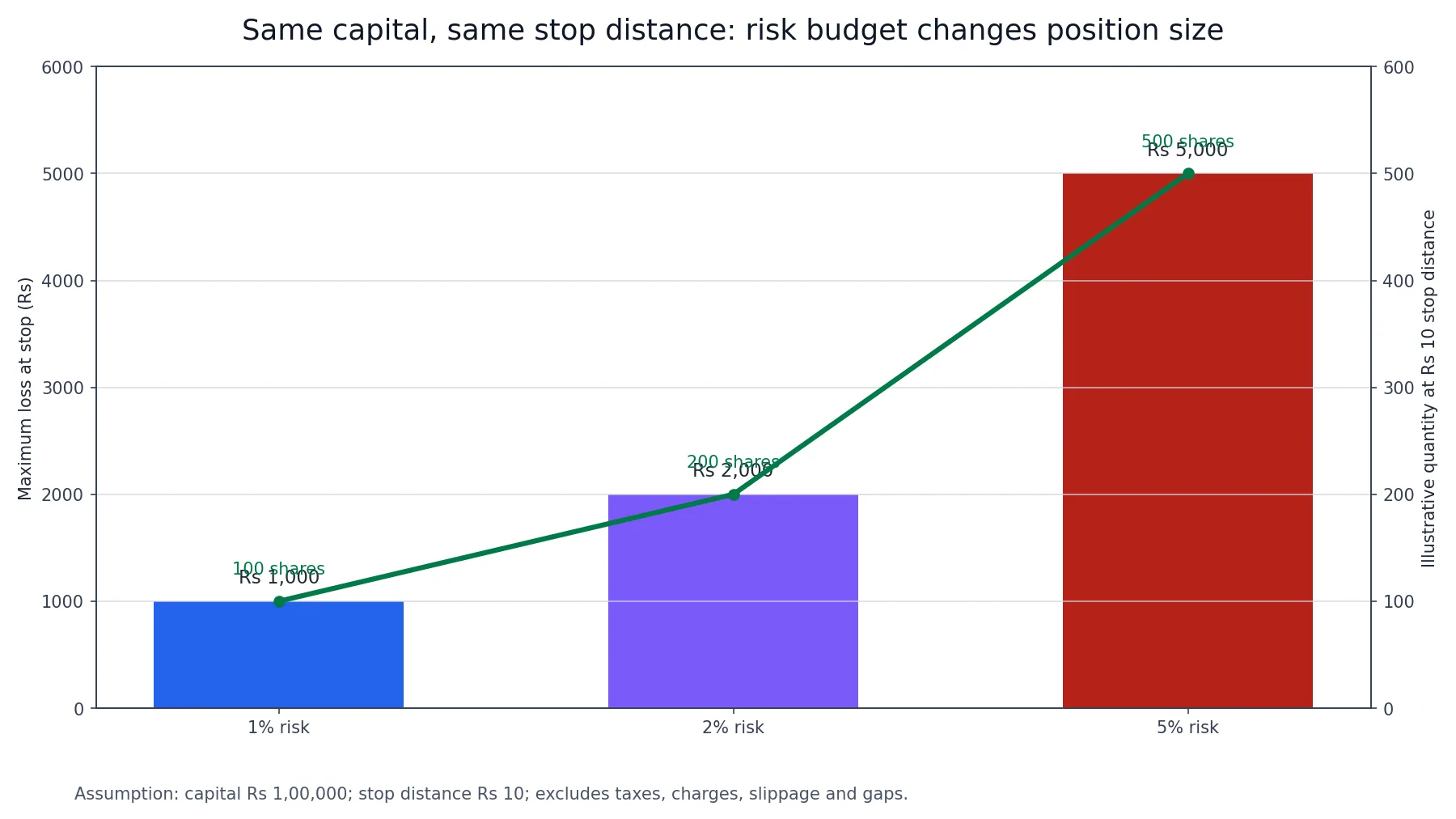
| Trading capital | Risk budget | Rupee risk allowed | Stop distance | Illustrative quantity |
|---|---|---|---|---|
| Rs 1,00,000 | 1% | Rs 1,000 | Rs 10 | 100 shares |
| Rs 1,00,000 | 2% | Rs 2,000 | Rs 10 | 200 shares |
| Rs 1,00,000 | 5% | Rs 5,000 | Rs 10 | 500 shares |
The table shows why the same stop can create very different outcomes. The technical level did not change. The risk came from the quantity.
Why This Matters In F&O
In futures and options, the risk can move faster because contracts are standardised and margins are dynamic. NSE Clearing describes margin and risk-management frameworks for equity derivatives, and NSE publishes contract information and position-limit material for market participants. These controls exist because leverage can magnify both profit and loss.
SEBI's updated study in September 2024 found that 93% of individual traders incurred losses in equity F&O between FY22 and FY24. SEBI's July 2025 update reported a net loss of Rs 1,05,603 crore by individual traders in equity derivatives in FY25, with over 91% of individual traders incurring net losses.
These figures are not a reason to avoid learning. They are a reason to avoid oversized trades, averaging losses blindly, and treating stop-loss orders as a substitute for risk planning.

A Practical Pre-Trade Checklist
Before placing a trade, write down:
- Why this trade exists: The setup, timeframe and invalidation point.
- Where the trade is wrong: The stop level and whether it is technically and financially reasonable.
- How much can be lost: The rupee risk after quantity, stop distance, costs and possible slippage.
- Whether liquidity supports the plan: Thinly traded stocks and options can widen execution gaps.
- Whether F&O exposure matches capital: Lot size, margin and mark-to-market pressure can make a small-looking trade large.
- When the plan will be reviewed: A trade should not become an investment merely because the stop was ignored.
Common Mistakes
The first mistake is deciding quantity before deciding risk. The second is moving the stop farther away after the trade turns negative. The third is using the same quantity for every trade even when stop distance and volatility are different.
A fourth mistake is using stop loss only as a broker order and not as a written discipline rule. If the investor cannot accept the planned loss, the trade size is too large.
Bottom Line
Stop loss answers the question, "Where am I wrong?" Position sizing answers, "How much can I afford to lose if I am wrong?" Both questions should be answered before the trade is placed.
For serious investors and traders, risk management is not a defensive afterthought. It is the first decision.
Source Links
- NSE: Trading System, including stop-loss order conditions
- NSE: Equity Derivatives Contract Information
- NSE Clearing: Equity Derivatives Risk Management
- NSE: Position Limits
- SEBI Investor: Understanding Derivatives
- SEBI press release, 7 July 2025: Comparative study of growth in equity derivatives segment
- SEBI press release, 23 September 2024: Updated study on individual traders in equity F&O
Disclaimer
This article is for investor education only and is not investment advice, trading advice, research recommendation, solicitation or an offer to buy or sell securities or derivatives. Stop-loss and position-sizing examples are illustrative and do not remove market, liquidity, gap, margin, taxation or execution risk. Equity derivatives are high-risk products and may not be suitable for all investors. Please consult a SEBI-registered investment adviser or other qualified professional before taking investment or trading decisions. Reviewed by Abhipra Research / Compliance Team.