SME IPO Eligibility Under the Current SEBI ICDR Framework: What Companies Should Check First
Reviewed on 25 September 2026. Prepared by Abhipra RTA Desk for editorial and compliance review.
SME IPO eligibility is assessed under the SEBI ICDR framework together with the current requirements of the SME exchange where the company proposes to list. The exchange-specific screens differ, so a company should first select its platform, then check the applicable rules against audited and restated records. NSE Emerge, for example, currently lists operating-profit, positive-net-worth and free-cash-flow tests; these are NSE platform criteria, not a universal summary of every SME exchange’s rules.

Start with the legal framework and the chosen exchange
SEBI’s Issue of Capital and Disclosure Requirements Regulations (ICDR), 2018 contain the regulatory framework for public issues, including a chapter for issuers seeking listing on the SME exchange. The consolidated SEBI text was last amended on 21 March 2026 when checked for this article. Issuer eligibility must be read with the current exchange criteria, the offer-document process and other applicable laws. NSE states that its review does not replace approvals required under other laws.
NSE Emerge’s eligibility page, updated 4 August 2026, says criteria apply at filing of the public offer document with NSE and when the document is filed with the Registrar of Companies and SEBI. The page includes a post-issue paid-up capital limit, a three-year track-record route, promoter experience and holding conditions, positive net worth, operating-profit and FCFE tests, and limits on offer-for-sale. It also lists disqualifying circumstances. Recheck every condition against the live exchange page before making a transaction decision. BSE SME maintains its own eligibility criteria; do not transfer NSE thresholds to a BSE application.
Screen the financial tests without treating them as approval
For NSE Emerge, the current published financial screens include operating profit (EBITDA) of at least ₹1 crore from operations in any two of the preceding three financial years, positive net worth, and positive free cash flow to equity (FCFE) in at least two of those three years. Calculate these from the financial statements and definitions accepted for the filing, with auditors and the lead manager. The two-of-three tests are separate; passing one does not satisfy the other.
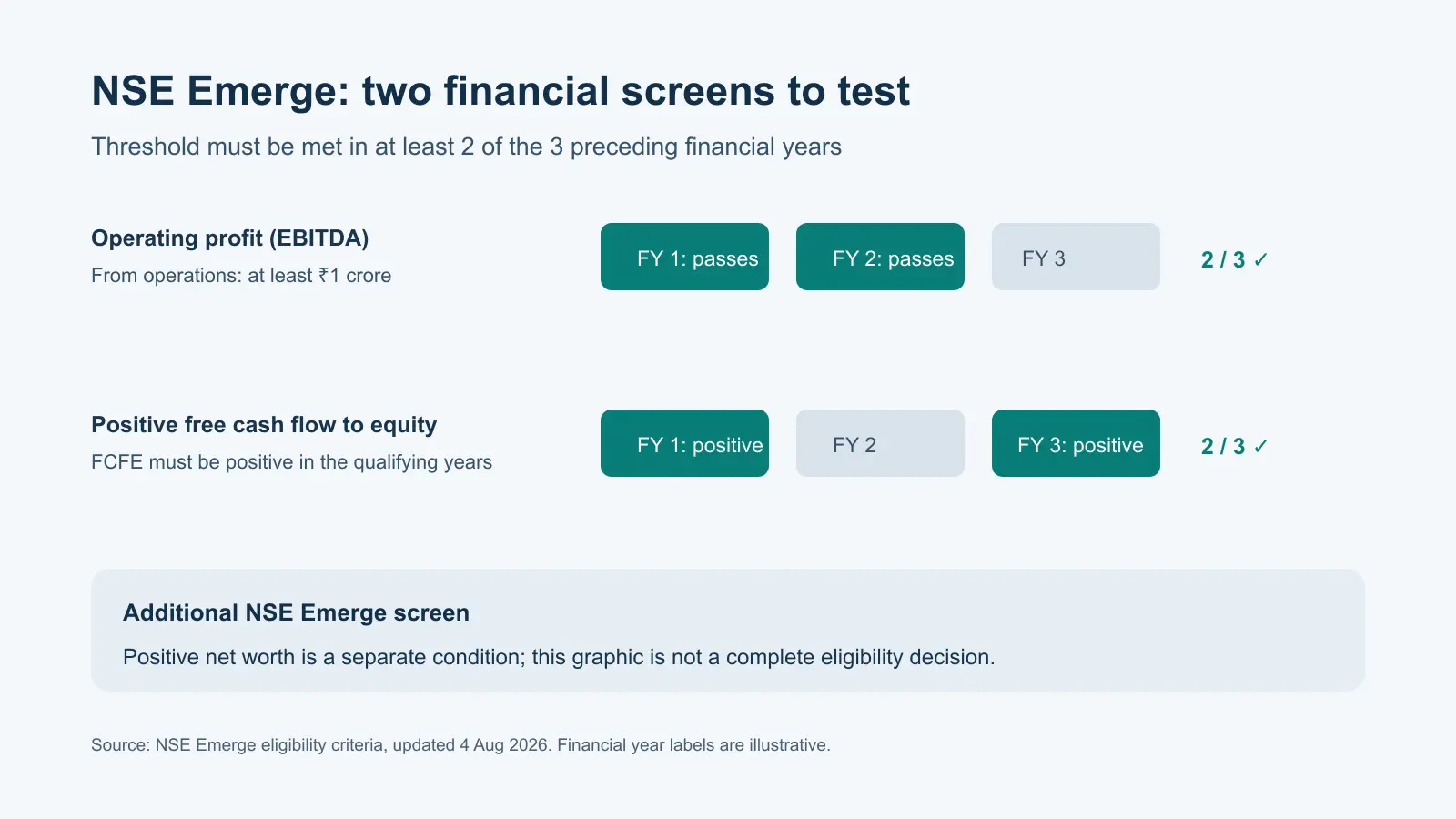
In the chart, each row represents a separate NSE Emerge financial condition and the three cells represent the preceding financial years. At least two qualifying years are required for each two-of-three screen. The example years are illustrative, not actual company results. Positive net worth is an additional screen and is shown separately. Meeting these financial conditions alone does not establish eligibility.
| NSE Emerge screen (as published 4 Aug 2026) | What to verify |
|---|---|
| Operating profit | At least ₹1 crore from operations in any two of the preceding three financial years |
| Free cash flow to equity | Positive FCFE in at least two of the preceding three financial years |
| Net worth | Positive net worth under the applicable exchange assessment |
| Capital and operating track record | Post-issue paid-up capital, issuer/promoter track record, experience and holding requirements |
| Issue structure and eligibility | OFS limits, disqualifications and permitted use of issue proceeds |
The table summarizes selected NSE Emerge tests for orientation; use the full current criteria and consult the appointed lead manager for applicability.
Check the company, promoters and issue structure
A practical screen should also document: (1) the issuer’s legal form and track record; (2) promoter experience in the same line of business and the post-issue holding condition; (3) the paid-up capital after the issue; (4) insolvency, winding-up or other listed disqualification checks; and (5) proposed issue proceeds and any offer-for-sale. NSE’s rules include specific limits for offer-for-sale and restrict certain uses of issue proceeds. The full wording and any exceptions matter.
Do not assume an exchange checklist answers every SEBI ICDR, Companies Act, tax, litigation or sector-licensing question. Eligibility also does not predict subscription, valuation, allotment or listing performance.
Reconcile share capital and promoter encumbrances early
Before moving toward a filing, reconcile the register of members, statutory returns, allotment and transfer records, corporate actions, depository statements and issued capital. Confirm that each security class and its ISIN, if applicable, matches corporate approvals and the capitalisation records.

Identify pledges and other encumbrances early, and have the issuer, lender, depository participants and advisers assess any required lock-in arrangements and disclosures. SEBI’s 8 April 2026 circular introduced a mechanism for recording specified pledged shares as non-transferable during lock-in when a lock-in could not be created; the circular and depository operating framework should be checked for the transaction’s facts.
Move from screening to professional diligence
- Select the intended SME platform and save a dated copy of its live criteria.
- Map each SEBI ICDR and exchange criterion to an owner, evidence item and reviewer.
- Have the finance team and auditors reconcile restated financial data, EBITDA, FCFE and net worth.
- Validate promoter, director, litigation, insolvency, capital and shareholding records.
- Reconcile demat and physical records, ISINs, pledges, lock-in planning and corporate actions.
- Appoint the lead manager and registrar and proceed through the exchange’s filing and review process.
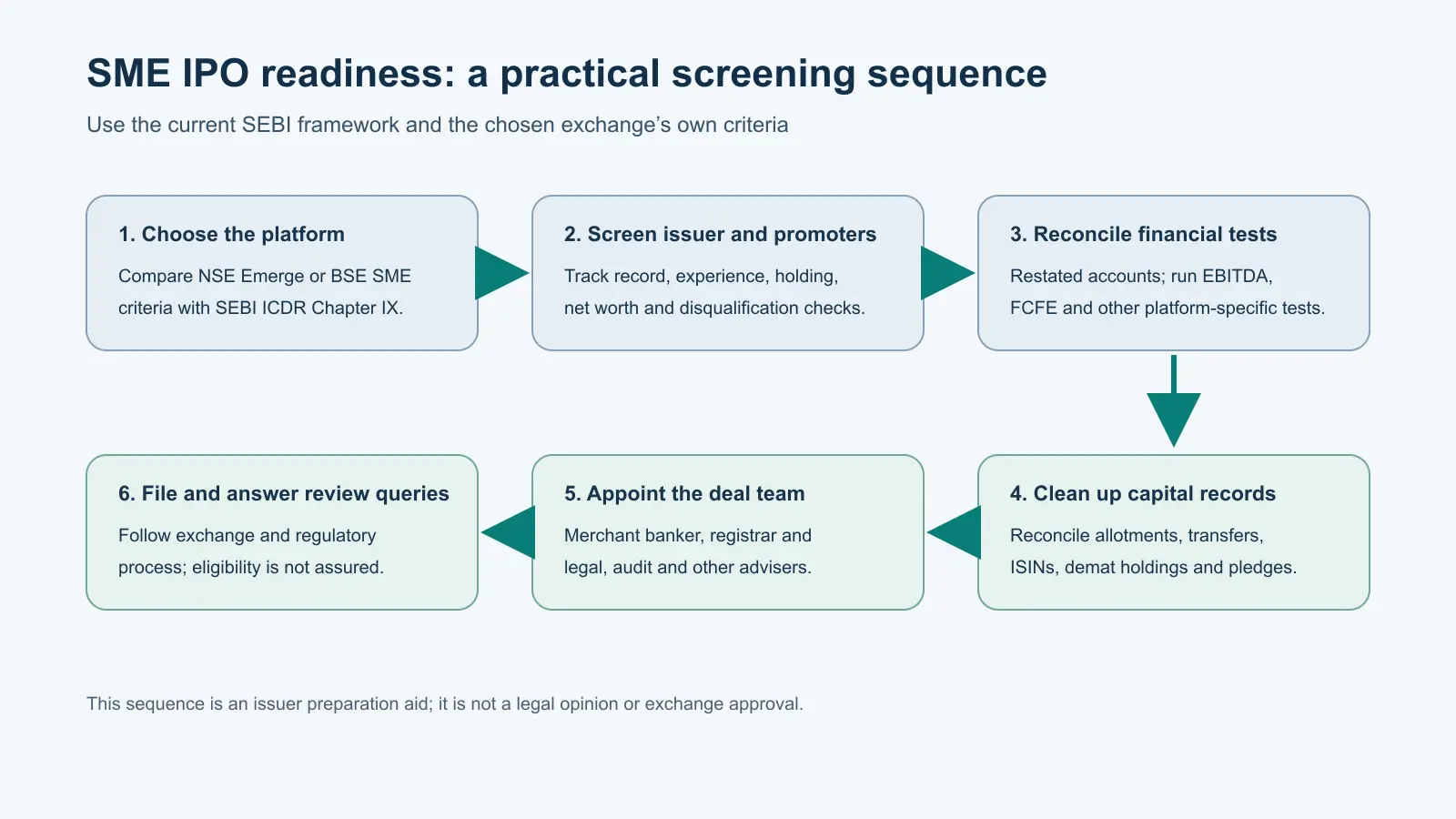
This workflow is an issuer preparation sequence. The company’s lead manager and legal advisers should determine which tests apply and how evidence should be presented. The exchange and regulators retain their review roles; using a checklist does not guarantee approval or listing.
How Abhipra can assist
Abhipra’s RTA team can discuss registrar and issuer-support workstreams, including shareholder-data and capital-record reconciliation, dematerialisation coordination and issue-related registrar processes, within the scope of an agreed engagement. For an initial discussion, a company can share its name, proposed listing platform, latest audited financial year, capital structure, approximate shareholder count, existing ISINs and target issue timeline. Do not send passwords, OTPs, unmasked PAN, bank details, signatures or sensitive KYC documents by email or an unsecured channel; wait for a secure submission method.
Official sources
- SEBI Issue of Capital and Disclosure Requirements Regulations, 2018 (consolidated; last amended 21 March 2026)
- NSE Emerge eligibility criteria (updated 4 August 2026)
- NSE Emerge requirements and process (updated 29 April 2026)
- BSE SME eligibility criteria
- SEBI circular dated 8 April 2026 on lock-in of pledged shares under ICDR
Disclaimer
This article is for general educational information and does not constitute legal, tax, investment or transaction advice. Applicability depends on the company's and investor's facts and on the law, circulars and depository instructions in force on the relevant date.