Operating Performance, Net Worth and Other Financial Tests in SME IPO Eligibility
Reviewed on 25 September 2026. Prepared by Abhipra RTA Desk for editorial and compliance review.
An SME IPO financial screen is not a single profit number. The company must test the conditions of its chosen SME exchange and the applicable SEBI ICDR framework using the required financial statements. For issuers filing a DRHP on NSE Emerge, an NSE circular dated 20 April 2026 revised the FCFE calculation with immediate effect and published detailed instructions for the inputs. The method is NSE-specific; do not apply it automatically to a BSE SME filing.

What the NSE Emerge financial screen checks
NSE Emerge’s currently published criteria ask for operating profit (EBITDA) of at least ₹1 crore from operations in any two of the preceding three financial years, positive net worth, and positive free cash flow to equity (FCFE) in at least two of those three years. These are separate conditions. A positive FCFE result does not replace the operating-profit or net-worth checks, and satisfying these selected tests does not establish overall listing eligibility. The exchange also lists capital, track-record, promoter, offer-for-sale and other conditions. Recheck the live criteria for the intended filing.
Revised NSE FCFE method: what changed
NSE Circular NSE/SME/73818 dated 20 April 2026 revised the FCFE method for all DRHPs filed on NSE Emerge, with immediate effect. It added proceeds from issuance of capital to the calculation. The circular includes equity and preference share capital and other instruments classified under share capital, including securities premium on issue. It says all other criteria remain unchanged until further orders.
In simplified form, the revised calculation is: net cash from operating activities, less purchases of fixed assets, plus qualifying proceeds from capital issuance, plus net borrowings, less after-tax interest as specified by the circular. The circular defines asset purchases to cover PPE, capital work in progress and intangible assets, adjusted for relevant asset-sale proceeds and capital advances. Net borrowings include long- and short-term borrowing proceeds less repayments. The detailed definition and FAQ govern; the summary here is not a replacement for them.
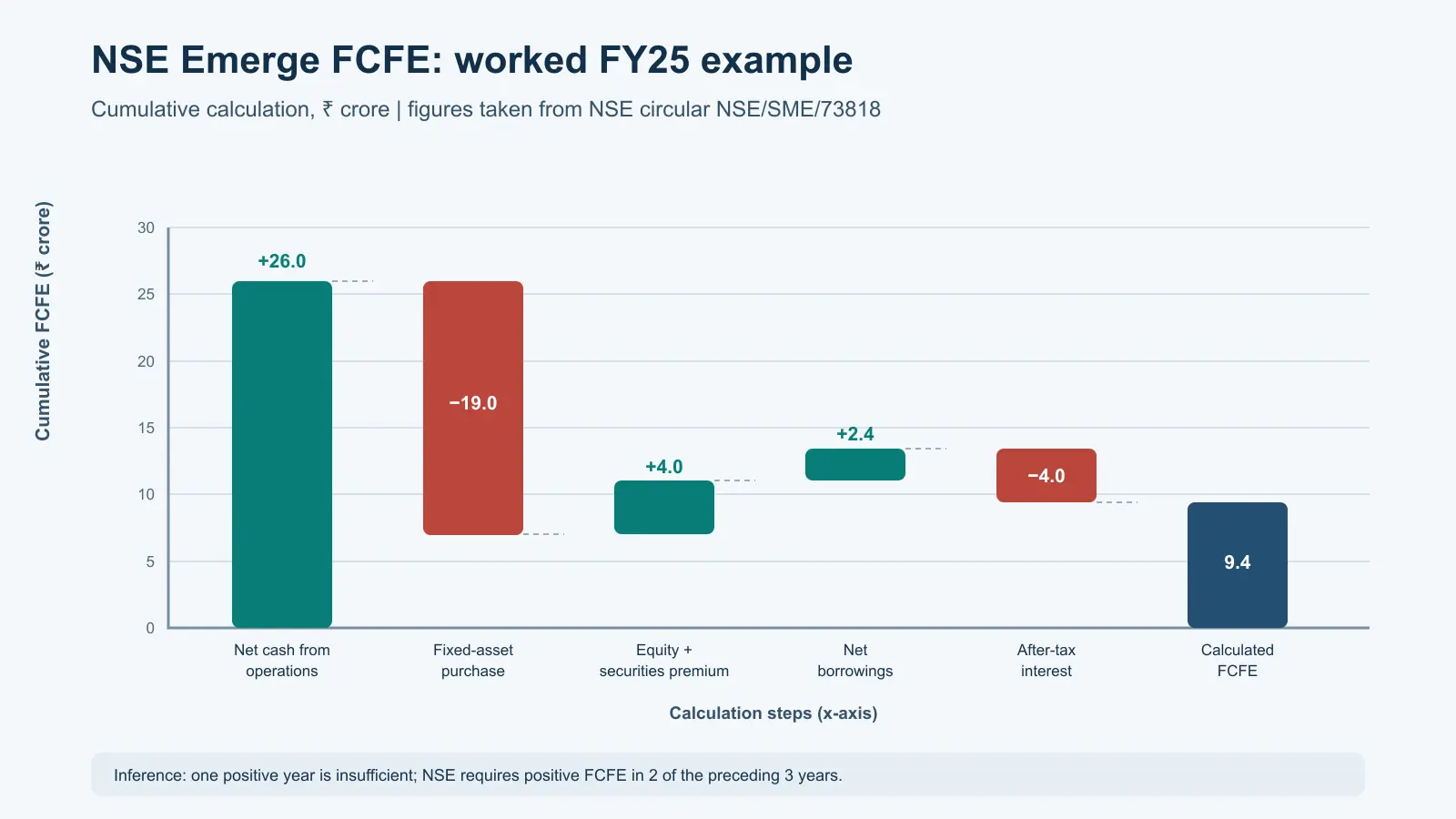
The chart’s x-axis lists calculation components; its y-axis shows the running FCFE subtotal in ₹ crore. The worked example starts with ₹26 crore of net cash from operations, subtracts ₹19 crore of fixed-asset purchases, adds ₹1 crore of equity capital and ₹3 crore of securities premium, adds ₹2.4 crore of net borrowings, and subtracts ₹4 crore of post-tax interest to arrive at ₹9.4 crore. This is NSE’s illustrative FY25 example, not a company’s actual performance. Its positive single-year result does not satisfy the separate two-of-three-years FCFE criterion by itself.
| Worked example component | Amount (₹ crore) | Treatment |
|---|---|---|
| Net cash from operating activities | 26.0 | Add |
| Purchase of fixed assets | 19.0 | Subtract |
| Equity share capital issued | 1.0 | Add |
| Securities premium on issue | 3.0 | Add |
| Net borrowings (12.4 proceeds less 7.3 long-term repayment and 2.7 short-term decrease) | 2.4 | Add |
| Post-tax interest | 4.0 | Subtract |
| FCFE in NSE's example | 9.4 | Calculated result |
Which records and periods should feed the calculation?

NSE’s circular FAQ says FCFE must be calculated from restated financial statements furnished in the offer document, not estimates or projections. Use the preceding three years; stub-period financial statements are not considered for this test. Where consolidated financial statements are available, NSE says to use them; where they are unavailable or not required, use standalone statements.
The FAQ also cautions against double counting short-term borrowings: where they are already reflected in cash from operations, do not include them again in cash flow from financing. It states that intangible-asset purchases belong in fixed-asset purchases, and gives classifications for interest and convertible instruments. Classification should follow the restated financial statements and applicable accounting treatment; resolve uncertain items with the auditor and lead manager.
Because qualifying capital-issuance proceeds are included in NSE’s revised formula, a positive FCFE figure can reflect those proceeds as well as other cash flows. This is an arithmetic implication of the exchange formula, not a conclusion that operating cash generation is strong or sustainable. Keep a component-by-component reconciliation beside the annual result.
Check performance, net worth and filing-stage consistency
Prepare a separate three-year schedule for each test: EBITDA from operations, net worth and NSE FCFE. Record the year, statement basis, source line, adjustment, preparer and reviewer. Reconcile the schedule to the restated statements in the offer document. NSE’s FAQ says applicable criteria, including FCFE, must be satisfied at in-principle approval at DRHP filing and again at RHP and prospectus stages.
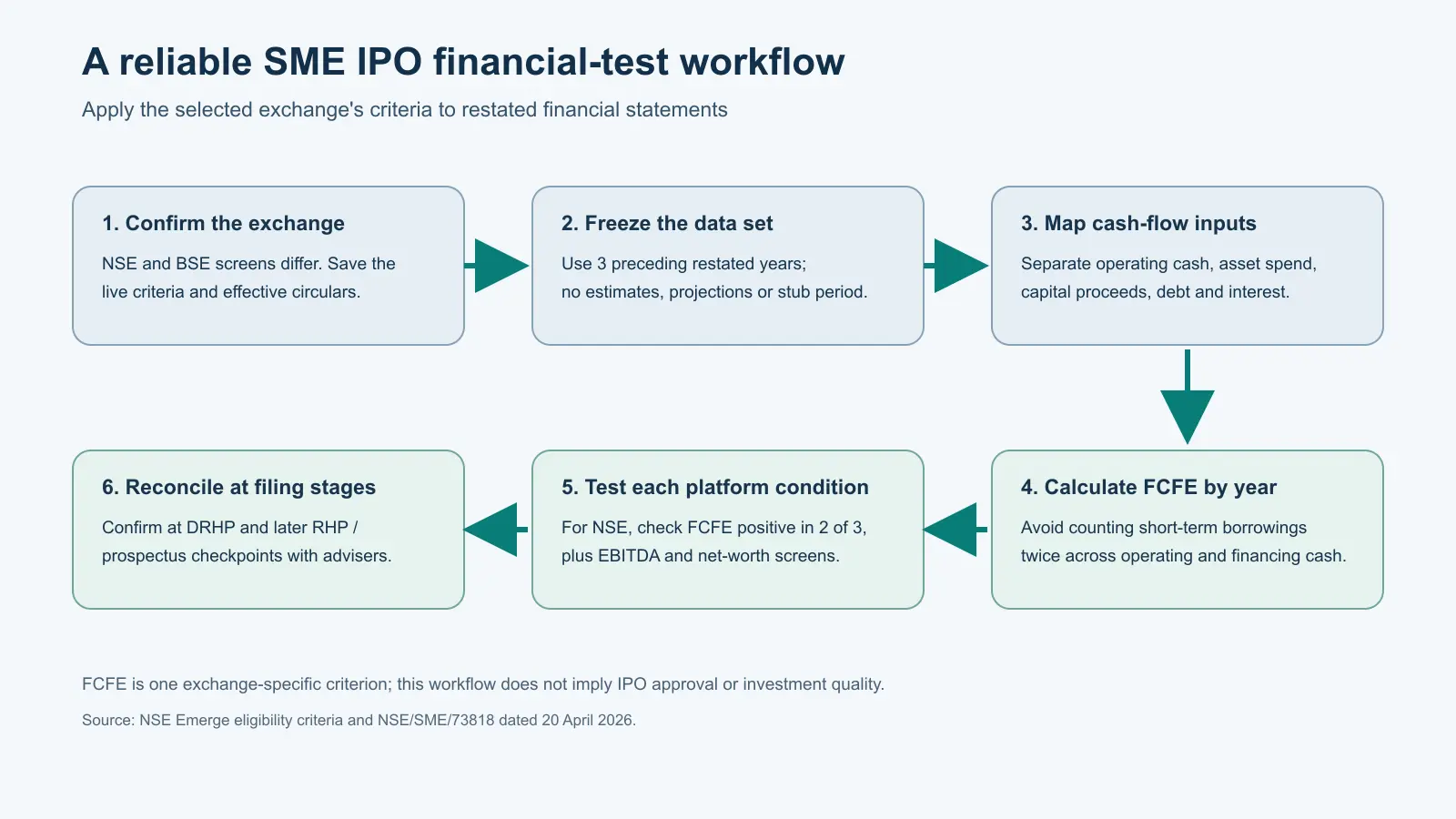
The workflow moves from choosing the exchange and criteria to preparing restated information, mapping formula inputs, calculating and checking the separate financial tests, and reconciling results at required filing checkpoints. A good calculation file improves traceability; it does not guarantee exchange approval or listing.
Common calculation and eligibility errors
- Using the formula from an older source instead of NSE’s 20 April 2026 revised method for an NSE Emerge DRHP.
- Treating the new capital-issuance line as applicable to every SME exchange without checking that exchange’s instructions.
- Calculating FCFE from estimates, projections or a stub period instead of the required restated annual statements.
- Counting a short-term borrowing both in operating cash flow and again in financing cash flow.
- Excluding capital advances or intangible-asset purchases without checking NSE’s definitions.
- Concluding that a positive FCFE in one year, or a positive FCFE test alone, proves overall IPO eligibility.
How Abhipra can assist
Abhipra’s RTA team can discuss issuer-record and shareholder-data readiness workstreams, dematerialisation coordination and registrar processes within the scope of an agreed engagement. For an initial discussion, a company may share its name, intended SME exchange, latest audited financial year, capital structure, approximate shareholder count, existing ISINs and target issue timeline. Do not send passwords, OTPs, unmasked PAN, bank details, signatures or sensitive KYC documents by email or an unsecured channel; wait for a secure submission method.
Official sources
- NSE Circular NSE/SME/73818 dated 20 April 2026: revised FCFE methodology and FAQ
- NSE Emerge eligibility criteria (page updated 4 August 2026)
- NSE Emerge requirements and process (page updated 29 April 2026)
- BSE SME eligibility criteria
- SEBI ICDR Regulations, 2018 consolidated text (last amended 21 March 2026)
Disclaimer
This article is for general educational information and does not constitute legal, tax, investment or transaction advice. Applicability depends on the company's and investor's facts and on the law, circulars and depository instructions in force on the relevant date.