SME IPO Application Lots, Investor Categories and Allocation Rules: What Issuers Should Understand
Reviewed on: 5 October 2026. Reviewed by Abhipra RTA Team.
SME IPO application size, investor classification and allotment depend on the issue structure and the offer document. Under the current SEBI ICDR framework, the minimum application is two lots with an application value above ₹2 lakh; book-built and fixed-price SME issues then follow different allocation rules.

Start with the issue route and the offer document
An issuer should settle the issue route, lot size, price mechanics and proposed categories with its lead manager before opening the issue. The prospectus or red herring prospectus sets the issue-specific application terms. A familiar allocation summary should never replace those offer documents or the current exchange circulars.
The SEBI (Issue of Capital and Disclosure Requirements) Regulations, 2018 (ICDR), last amended on 21 March 2026, contain the SME-specific allocation and application provisions in Regulations 253, 267 and 268. The 2025 amendment removed the word “retail” from the relevant individual-investor allocation language and set the minimum application value rule; the amendment took effect on 8 March 2025.
Lots, rupee value and investor categories
Regulation 267 requires a minimum application of two lots, and the application value must be above ₹2 lakh. Further applications are in multiples of the issue’s lot size. Since lot size and issue price vary, the rupee value represented by two lots is issue-specific. The above-₹2-lakh test refers to application value calculated with the issue price; it is not the amount payable on application. The regulation separately specifies the minimum amount payable per security and a different rule for an offer for sale.
NSE’s e-IPO FAQ, last updated 1 August 2025, operationally explains that an application for exactly two lots is classified as an Individual Investor application, while an application above two lots falls in the NII–Individual category. Treat this as an exchange-process aid: the applicable circular, issue platform, offer document and current instructions for the particular SME IPO govern. Issuers should confirm the classification mapping with the exchange and lead manager before finalising bid configuration.
Allocation differs between book-built and fixed-price issues
For a book-built SME IPO, Regulation 253 allocates at least 35% of the net offer to individual investors applying for the minimum application size, at least 15% to non-institutional investors (NII), and no more than 50% to qualified institutional buyers (QIBs). Five per cent of the QIB portion is allocated to mutual funds; mutual funds may also receive securities from the remaining QIB balance. An unsubscribed portion in the individual or NII categories may be allocated to another category under the regulation.
Within the NII portion of a book-built SME IPO, one-third is reserved for applications above two lots and up to the number of lots equivalent to an application size of no more than ₹10 lakh. The remaining two-thirds is reserved for applications above ₹10 lakh. If either NII subcategory is undersubscribed, its unsubscribed portion may be allocated to the other NII subcategory.
For an issue other than through book building, the regulation instead provides for a minimum 50% of the net offer to individual investors applying for the minimum application size. The balance is available to other individual applicants applying at the minimum application size and to other investors, including corporate bodies or institutions, irrespective of the number of securities applied for, subject to the regulation and the offer document. Do not apply the book-built NII one-third/two-thirds split to this route.
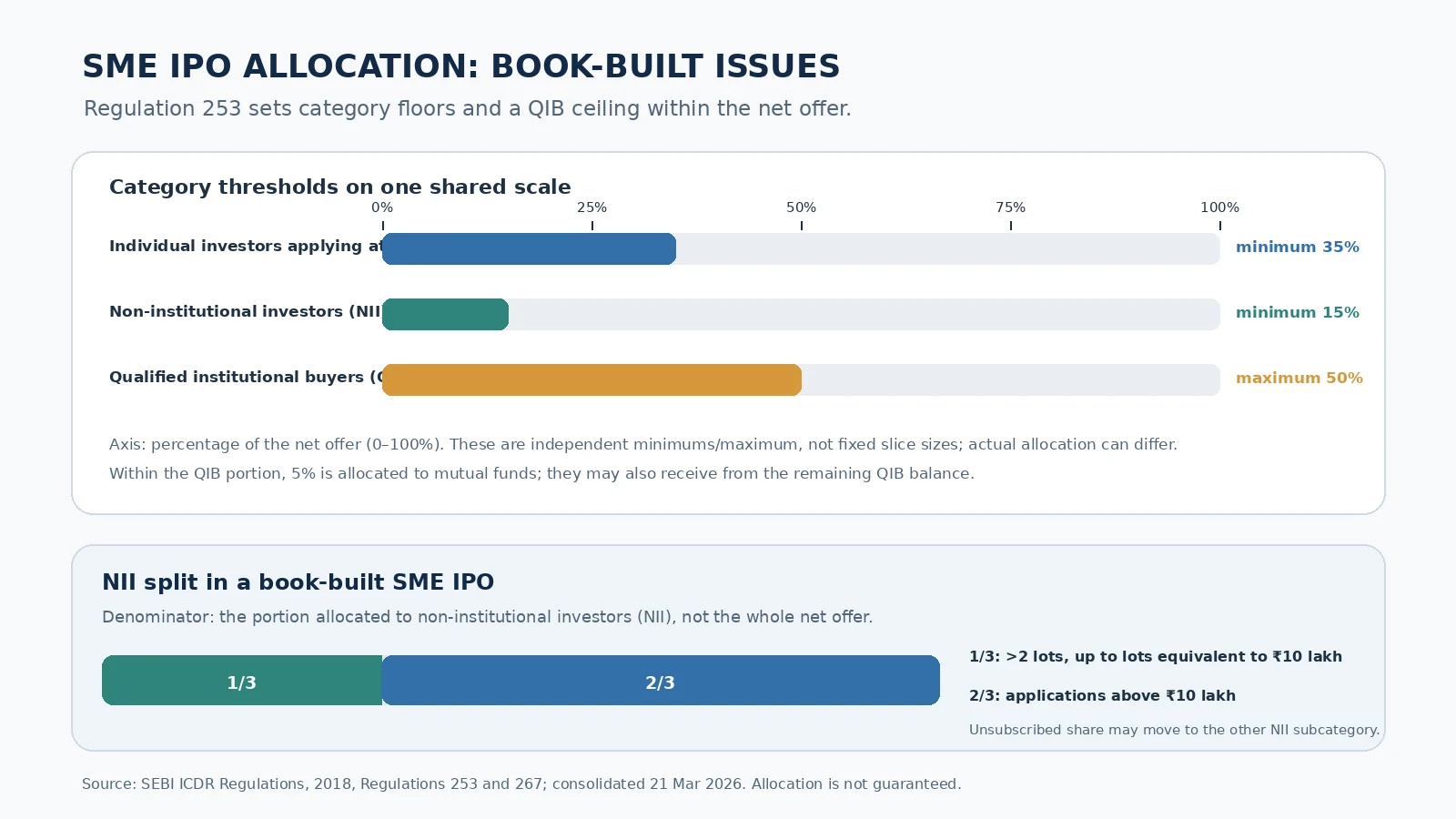
The upper chart’s horizontal axis is percentage of the net offer, from 0% to 100%. It marks the 35% individual-investor minimum, 15% NII minimum and 50% QIB maximum independently. These do not form fixed slices: the first two are minimums and the QIB figure is a ceiling; actual allocations and permitted spillovers depend on the issue. The lower bar uses a different denominator: the NII portion only, split one-third/two-thirds by application size. The proportions describe regulatory allocation design, not subscription levels, allotment odds or a promise of shares.
Issuer and registrar workflow
Before launch, the issuer and its advisers should map the bid categories and lot-size rules to the selected route, issue documents, exchange platform and registrar reconciliation process. After bidding closes, valid applications and payment or mandate status are reconciled before the basis of allotment is finalised. SEBI ICDR Regulation 268 bars an IPO allotment if the total number of allottees is below 200. This is a whole-issue threshold; it does not guarantee an allotment to any particular applicant.
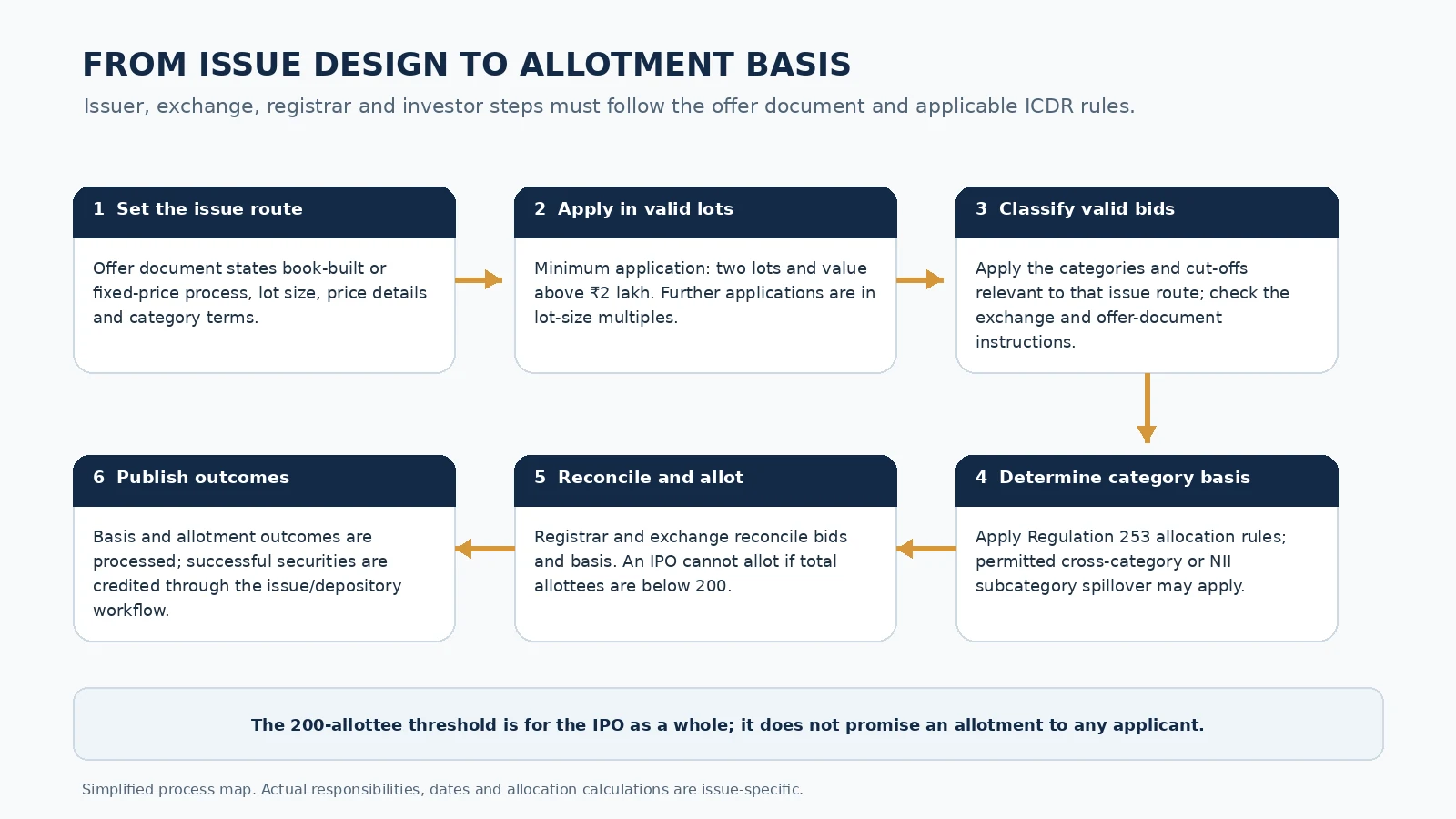
The workflow runs from issue-route and offer-document design, through valid lot applications and category classification, to applying the route-specific allocation basis, reconciling valid bids and publishing outcomes. The issuer, lead manager, exchange, registrar, banks and depositories have distinct responsibilities set by the issue process. The RTA supports issue administration and reconciliation within its appointed scope; it does not set investor demand or guarantee an allotment.

Issuer readiness checks
- Confirm the current SEBI ICDR text and relevant exchange circulars at filing and again before the issue opens.
- Make the lot size, minimum application and price-based application value consistent across offer documents, exchange setup and registrar processing rules.
- Test category mapping at exactly two lots, above two lots, the ₹10 lakh NII subcategory boundary and any permitted reservations or spillovers applicable to the issue.
- Validate bid, payment/UPI mandate, depository and PAN data reconciliation procedures with the relevant participants.
- Keep a documented approval trail for category configuration, basis-of-allotment calculations, exchange consultation and final reconciliation.
How Abhipra can assist
Preparing for an SME IPO or main-board IPO and need a Registrar-to-an-Issue/RTA workstream?
Contact Abhipra RTA Services at rtaservices@abhipra.com, call 011-42390783, or contact +91-9818080700.
Share the company name, current company type, proposed listing platform, latest audited financial year, capital structure, shareholder count, existing ISINs and target issue timeline for an initial operational discussion. Eligibility, merchant-banker advice and regulatory approvals remain subject to the applicable framework.
Official source links
- SEBI ICDR Regulations, 2018, last amended 21 March 2026 — Regulations 253, 267 and 268.
- SEBI ICDR Amendment Regulations, 2025 — amendment published 4 March 2025; relevant SME application and individual-investor changes effective 8 March 2025 as reflected in the current consolidation.
- SEBI Master Circular for ICDR, 9 February 2026.
- NSE e-IPO FAQs — SME application classification and issue-processing guidance; page says updated 1 August 2025 and notes that circulars prevail if inconsistent.
- NSE Emerge public-issue requirements and process — issuer-side process reference.
Disclaimer
This article is for general educational information and does not constitute legal, tax, investment or transaction advice. Applicability depends on the company's and investor's facts and on the law, circulars and depository instructions in force on the relevant date.