Fresh Issue vs Offer for Sale in an SME IPO: Purpose, Limits and Disclosure Questions
Reviewed on: 2 October 2026. Prepared by Abhipra RTA Desk for professional review.
A fresh issue raises new capital for the issuing company. An offer for sale (OFS) lets existing shareholders sell eligible shares in the public offer, with the proceeds going to those sellers. An SME IPO may combine the two, subject to the selected exchange’s current criteria, SEBI’s ICDR framework and complete offer-document disclosures.

What each part of the offer does
| Component | Who receives the proceeds? | What readers should look for |
|---|---|---|
| Fresh issue | The issuing company, after applicable issue expenses and settlement | The stated objects, amount proposed for each purpose, implementation plan and risks |
| Offer for sale | The named selling shareholders | Each seller, number of shares offered, post-offer holding and the seller-specific disclosures |
In a fresh issue, the company issues new shares. That increases the number of shares outstanding and dilutes existing ownership percentages if holders do not participate proportionately. In an OFS, existing shares change hands; the issuer does not receive the sale proceeds. A combined offer has both effects, so investors should read the components separately instead of treating the headline issue size as cash raised by the company.

The current SEBI ICDR Regulations, 2018, consolidated through 21 March 2026 provide the regulatory framework for public issues and offer documents. The lead manager has due-diligence responsibilities; an RTA’s operational role does not replace legal, merchant-banker, exchange or SEBI review.
Limits depend on the SME platform
Exchange criteria are not interchangeable. As checked on 2 October 2026, NSE’s Emerge eligibility page, updated 4 August 2026, states that an SME IPO’s OFS cannot exceed 20% of total issue size and selling shareholders cannot sell more than 50% of their respective holdings. Treat these as NSE Emerge listing criteria, not a universal cap for all SME exchanges or a substitute for reading the current regulations and exchange requirements.
For a proposed BSE SME listing, verify the current BSE SME eligibility criteria and applicable BSE requirements directly. The issuer and its advisers should confirm the live version and any circulars before fixing the issue mix. A company’s eligibility for an SME platform is also a separate question from whether its proposed offer structure and disclosures meet all requirements.
A ₹100 crore illustration
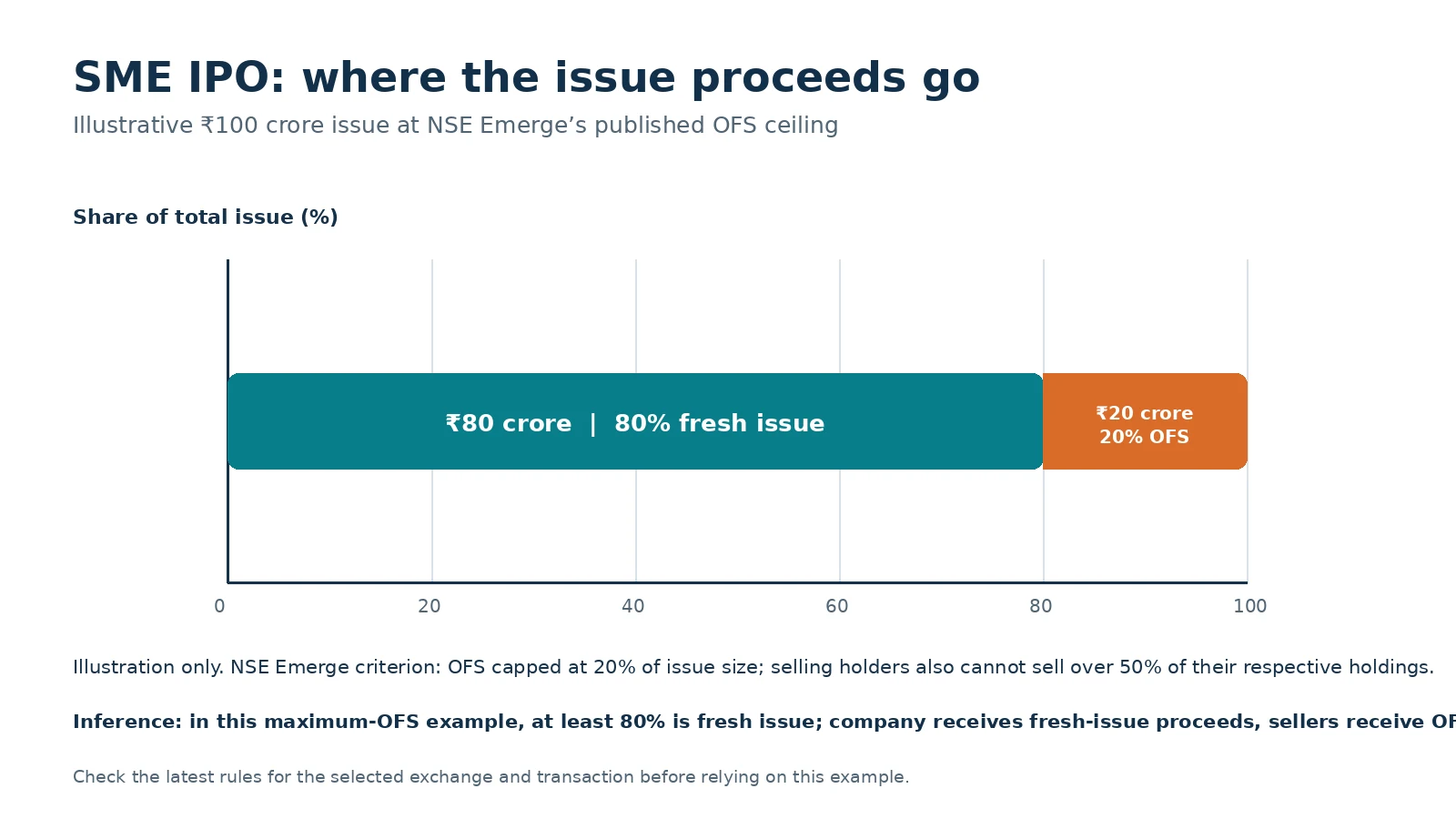
The chart’s horizontal axis is the share of the total issue, from 0% to 100%. In this illustrative ₹100 crore offer, ₹80 crore is a fresh issue and ₹20 crore is OFS. Under NSE Emerge’s stated 20% ceiling, this is the maximum OFS share represented in the example; it also assumes seller-specific holding limits are met. The inference is that at least 80% would be a fresh issue if OFS were exactly at that ceiling. This is an example, not an eligibility determination or recommendation. Actual issue values, pricing, costs and exchange rules may differ.
Questions to resolve before fixing the mix
- What funding does the company need? Tie the fresh-issue amount to specific, supportable objects and a realistic schedule. Explain material assumptions and risks.
- Who proposes to sell? Confirm the identity and authority of each selling shareholder, the number of shares proposed, and the applicable eligibility and holding constraints.
- What does the selected exchange require? Verify current SME-platform conditions, including any OFS ceiling, seller holding limit and other issue criteria.
- How does the structure affect ownership? Model post-issue share capital, dilution, promoter holding and public shareholding using the final proposed terms.
- Do corporate records agree? Reconcile the register, allotments, transfers, capital history, beneficial ownership and depository records. Resolve differences before drafting.
- Are the disclosures consistent? Align board and shareholder approvals, offer documents, objects of the issue, selling-holder details, capitalisation tables and risk factors.
Issue-structure workflow
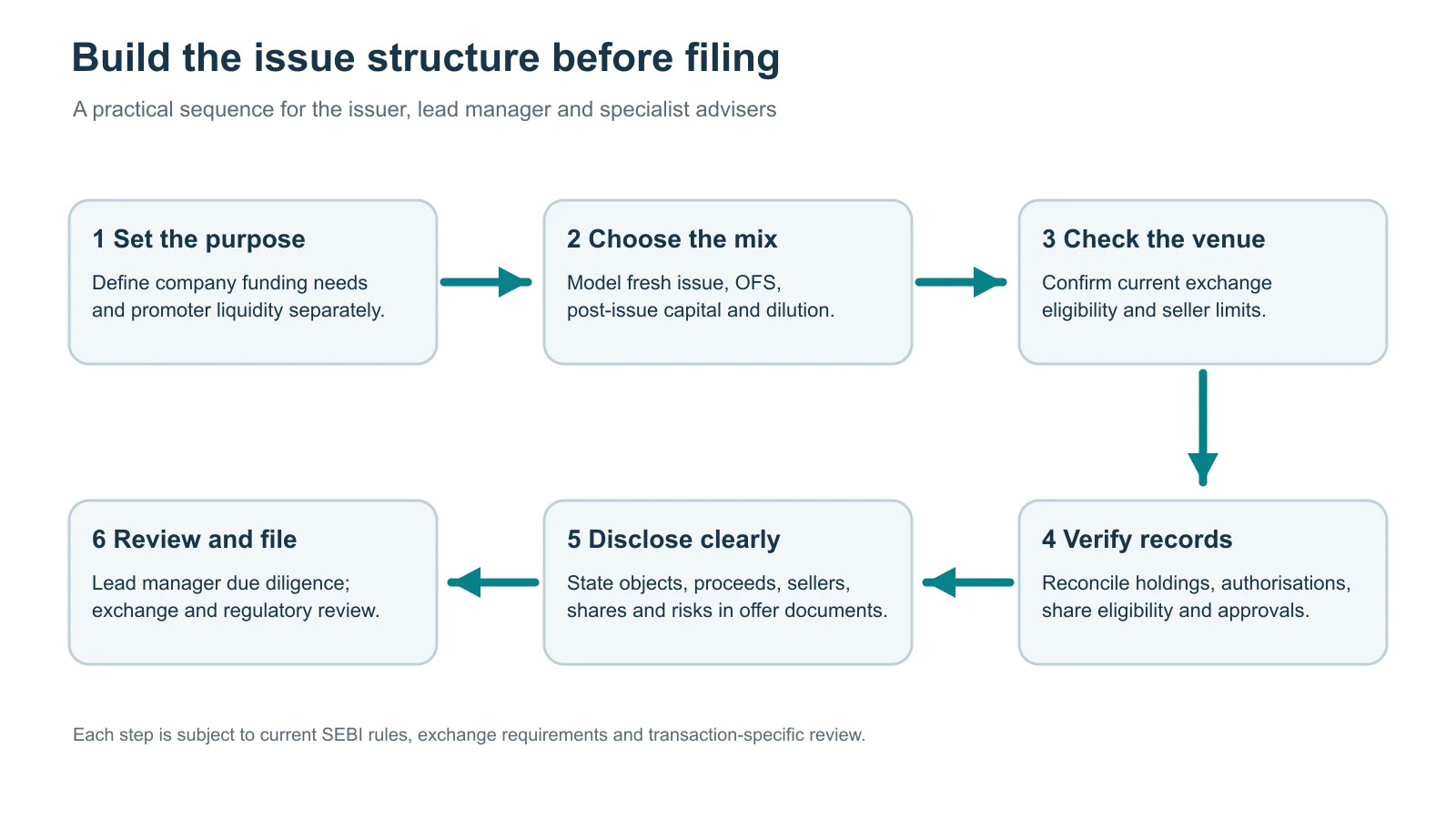
The sequence starts by separating the company’s capital requirement from any shareholder liquidity objective. After selecting a provisional mix, the issuer and its advisers check the relevant venue’s criteria, reconcile shares and approvals, prepare consistent disclosures, and proceed through due diligence and review. A registrar can support issue and shareholder-data operations within its appointed scope; eligibility, pricing, offer structure and regulatory advice belong with the issuer and its appropriately appointed advisers.
Common errors to avoid
- Describing the full offer size as money the company will receive when part of it is an OFS.
- Applying NSE Emerge’s OFS limit to another exchange without checking its current criteria.
- Showing an OFS amount without identifying sellers, verifying their holdings or checking seller-level limits.
- Stating issue objectives that do not reconcile with board approvals, budgets and the offer document.
- Using unreconciled share capital, inconsistent shareholder names or outdated depository records.
- Treating an exchange eligibility screen as automatic approval of an issue.
How Abhipra can assist
Preparing for an SME IPO or main-board IPO and need a Registrar-to-an-Issue/RTA workstream? Contact Abhipra RTA Services at rtaservices@abhipra.com, call 011-42390783, or contact +91-9818080700.
Share the company name, current company type, proposed listing platform, latest audited financial year, capital structure, shareholder count, existing ISINs and target issue timeline for an initial operational discussion. Eligibility, merchant-banker advice and regulatory approvals remain subject to the applicable framework.
Source links
- SEBI ICDR Regulations, 2018 (last amended 21 March 2026) — checked 2 October 2026.
- NSE Emerge eligibility criteria — page updated 4 August 2026; checked 2 October 2026.
- BSE SME eligibility criteria — official exchange document; its currently applicable status should be confirmed with BSE for a live transaction.
Disclaimer
This article is general educational information, not legal, investment, tax, accounting or merchant-banker advice and not an offer or solicitation. Regulations, exchange criteria and transaction facts can change. Obtain current professional advice and verify applicable primary documents before acting. No listing outcome or approval is assured.