Salaried and New to NPS? Choose the Right Account Route Before Your First Contribution
For a salaried employee, the first NPS question is not always about how much to contribute. It is often whether the employer already offers Corporate NPS or whether the employee should begin through the individual subscriber route. Clarifying that route first can make payroll, documentation and later servicing easier to understand.

Begin with one question for HR or payroll
Ask whether your employer has adopted Corporate NPS and whether you are eligible under its policy. The Corporate Model is an employer-enabled retirement-benefit arrangement; the individual route is for a subscriber who joins independently. Both routes need accurate onboarding records and an understanding of the applicable process.
Do not assume that a new job means a new retirement identity. NPS uses a unique PRAN for each subscriber, and the account is designed to be portable across employment and location changes. If you already have a PRAN, ask how it should be reflected in the new arrangement before completing fresh paperwork.
Follow the route that fits the workplace arrangement
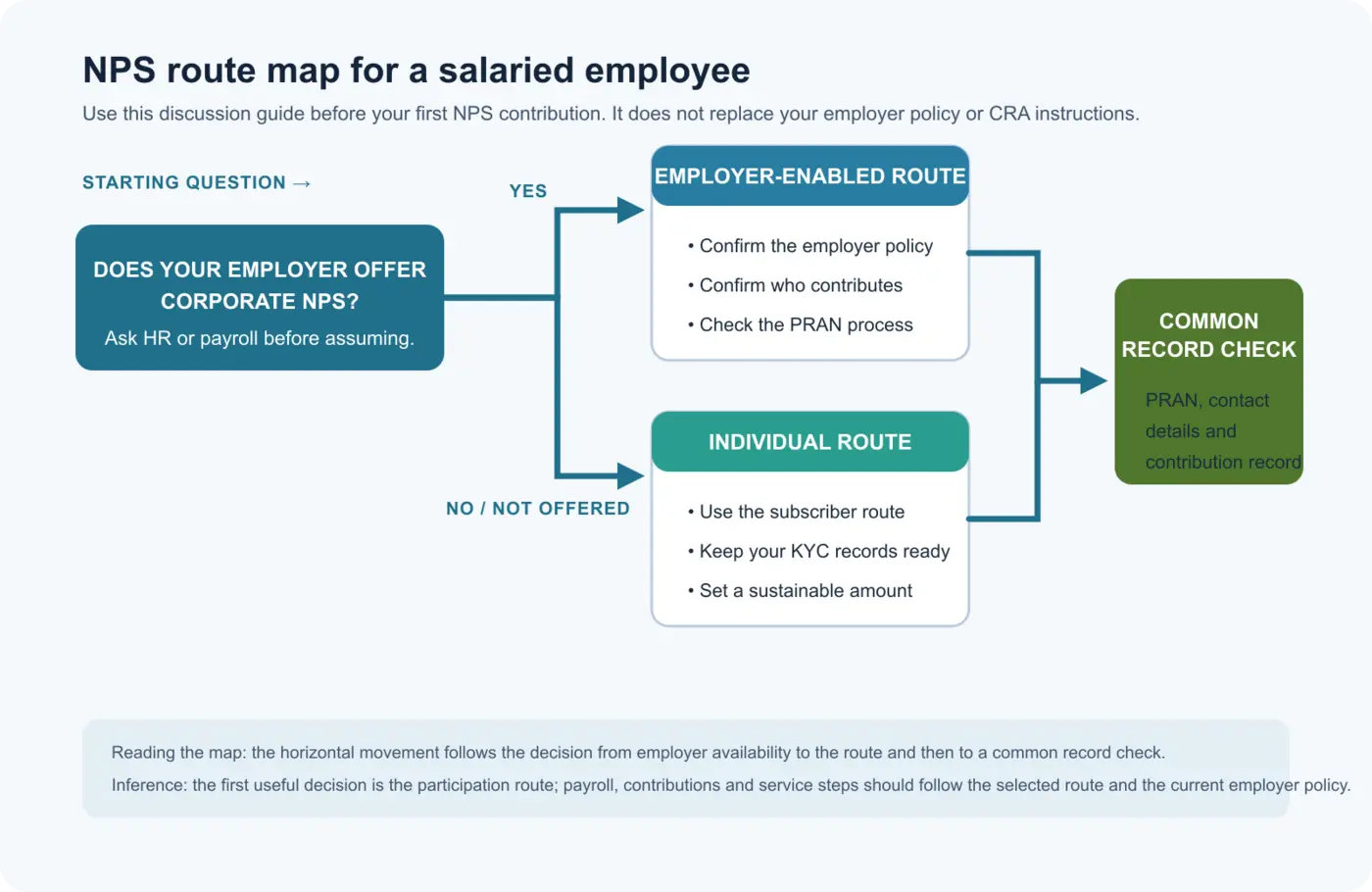
The graphic reads left to right. The opening question is whether Corporate NPS is available through the employer. The upper route is employer-enabled; the lower route is individual participation. Both meet at the same record check for PRAN, contact details and contributions. The inference is that a clear participation route should come before payroll assumptions or contribution instructions.
If Corporate NPS is offered
- Ask HR or payroll whether enrolment is voluntary under the employer policy and what information is needed from you.
- Understand whether the contribution is from the employer, the employee or both, and how it will appear in payroll records.
- Confirm the onboarding and service process with the employer and the CRA before relying on an expected contribution date.
If Corporate NPS is not offered
- An eligible individual can examine the All Citizen Model and open an NPS account through the approved Abhipra route.
- Keep KYC and bank details ready, and choose a contribution amount that fits your long-term cash flow after essential expenses and emergency savings.
- Remember that NPS is a market-linked retirement arrangement. It may be suitable only after considering your horizon, risk capacity, liquidity needs and other retirement resources.
Keep the account record separate from the employment record
Whether the route is employer-enabled or individual, save the PRAN securely, maintain the registered mobile number and email, and review the contribution record in the CRA account. Your employer's payroll record and your NPS account record serve different purposes. Review both if a contribution or service request appears inconsistent.
Abhipra has acted as a Point of Presence for 17 years. We can help employees and organisations understand NPS service steps, Corporate NPS documentation and the account-opening process. Visit Abhipra NPS and pension services, explore Corporate NPS through Abhipra, or use Abhipra's NPS account-opening route when the individual route is appropriate.
Three checks before you act
- Confirm the current employer policy and subscriber category; organisations can have different operational steps.
- Check whether you already have a PRAN before submitting a new registration request.
- Read the current CRA and PFRDA instructions before acting on a tax, payroll or service assumption.
Source links and disclaimer
This article is for investor education. NPS rules, employer policies, payroll handling and service processes can change. Verify the current official process and evaluate suitability before acting.