Protective Put: Insurance For Your Stock Portfolio
A protective put is often described as portfolio insurance because it can help define a floor for part of an equity position. That phrase is useful only if investors also understand the cost, expiry, liquidity and risk of using options.

What A Protective Put Is
SEBI explains that derivatives derive their value from an underlying asset, and that options give the buyer a right while creating an obligation for the seller. A put option gives the buyer the right to sell the underlying at the strike price, subject to the contract terms.
A protective put combines two parts:
| Part | Purpose | Investor question |
|---|---|---|
| Existing stock or portfolio exposure | Participates in upside and downside of the underlying holding. | Do I want to keep the holding through a short risk period? |
| Bought put option | May reduce loss below the selected strike, after considering premium and costs. | Is the protection worth the premium, expiry risk and transaction cost? |
This is different from buying a put as a standalone market bet. A protective put starts with an exposure the investor already owns or plans to retain.
Why It Is Not Free Protection
The put premium is the price of the protection. If the stock rises or stays above the strike, the option may expire worthless, and the premium reduces the investor's net return. If the stock falls sharply, the put may help limit part of the downside, but the final result still depends on strike selection, premium, liquidity, taxes, brokerage, STT, exchange charges and slippage.
NSE's equity derivatives information and NSE Clearing's risk-management material show that exchange-traded derivatives operate under standardized contracts, margining and clearing frameworks. These controls reduce some market infrastructure risks, but they do not make an unsuitable option trade safe for every investor.

The visual shows the practical sequence: review the stock exposure first, check whether a cash buffer or asset-allocation change is simpler, and then decide whether a put option is suitable for a defined period.
What The Payoff Can Look Like
The chart below is only an illustration. It assumes a stock bought at Rs 100, one protective put with strike Rs 95 and put premium of Rs 3, before taxes and transaction charges. It is not a recommendation for any security, strike or expiry.
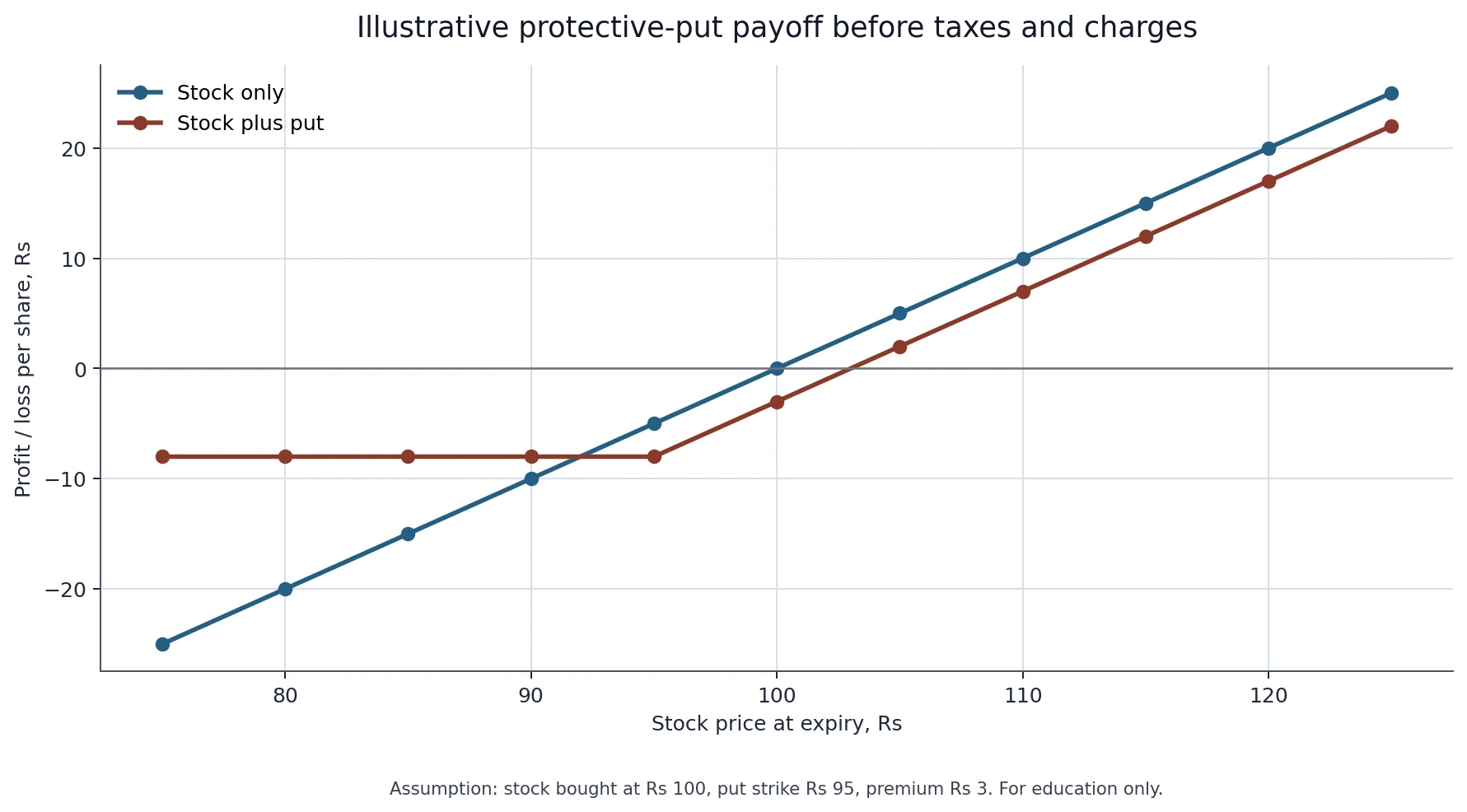
| Stock price at expiry | Stock-only profit or loss | Protective-put profit or loss |
|---|---|---|
| Rs 80 | -Rs 20 | -Rs 8 |
| Rs 95 | -Rs 5 | -Rs 8 |
| Rs 110 | Rs 10 | Rs 7 |
The table shows the trade-off. The put can reduce the damage from a large fall, but the premium lowers the result when the stock does not fall below the strike.
Why The Risk Warning Still Matters
Protective puts are more conservative than naked option selling, but they still belong to the F&O market. SEBI's July 2025 study on equity derivatives reported that individual traders' net losses were Rs 1,05,603 crore in FY25, about 41% higher than Rs 74,812 crore in FY24, with over 91% of individual traders incurring net losses. SEBI's September 2024 study also reported that 93% of individual traders incurred losses in equity F&O between FY22 and FY24.
The lesson is not that hedging is bad. The lesson is that investors should separate genuine risk reduction from speculative F&O activity.
Investor Checklist Before Buying A Protective Put
- Identify the exact holding or portfolio risk being protected.
- Check whether selling part of the exposure, rebalancing or holding more cash is simpler.
- Define the time period: event risk, results season, goal withdrawal date or market stress window.
- Compare the put premium with the loss the investor is trying to reduce.
- Check contract liquidity, lot size, expiry, strike availability and bid-ask spread.
- Understand that the option can expire worthless.
- Record the hedge reason and exit rule before placing the order.
Common Mistakes
One mistake is buying puts repeatedly without tracking the cost. Protection that is bought too often can steadily reduce returns.
Another mistake is using a protective-put article as permission to trade options casually. A hedge should be smaller than, and connected to, the exposure it protects.
Source Links
- SEBI Investor: Understanding derivatives
- SEBI press release, July 7, 2025: comparative study of growth in equity derivatives segment
- SEBI press release, September 23, 2024: updated study on individual F&O trader losses between FY22 and FY24
- NSE: About equity derivatives
- NSE: Equity derivatives contract information
- NSE Clearing: equity derivatives risk management
Disclaimer
This article is for investor education only and is not investment advice, trading advice, research recommendation or a solicitation to buy, sell or hold any security or derivative contract. Futures and options involve leverage, expiry risk, premium loss, margin rules and the possibility of substantial losses. Investors should evaluate suitability, risk capacity, taxation and costs, and consult a qualified adviser before acting. Reviewed by Abhipra Research / Compliance Team.