Professional Indemnity Insurance: Review the Work You Do Before You Review the Policy
A client engagement can involve advice, a calculation, a filing, a design decision or a professional opinion. If a client alleges that an error or omission in that work caused a loss, the question is not simply whether a firm has professional indemnity (PI) insurance. It is whether the policy, proposal disclosures, limit and reporting terms fit the work actually undertaken.

PI insurance is not a substitute for careful professional practice, engagement letters, review controls or record retention. It is also not a promise that every complaint, loss or legal expense will be paid. The policy wording, schedule, endorsements and facts of the matter govern the result.
Start with the service, not the premium
Professional services are not identical across an accountancy practice, consultant, architect, technology adviser, insurance intermediary or legal professional. Before comparing quotes, write down:
- the services delivered and the client types served;
- who gives advice, signs work or supervises subcontractors;
- the contract terms, including any liability caps or indemnities promised to clients;
- the largest plausible loss scenario from an error in the service; and
- past complaints, circumstances, claims or known issues that may need disclosure.
For a useful real-world reference, ICAI’s current member materials describe a PI facility for members in practice and CA firms. They explain that cover can relate to errors and omissions in professional services and that defence costs, retroactive benefits and an extended reporting period are subject to the policy’s terms, conditions and overall limit. That is an illustration of why the schedule and wording matter; it is not a universal description of every PI policy. Read ICAI’s current professional-indemnity information and its member terms and conditions.
Five policy questions that deserve a written answer
| Question | Why it matters | Record to check |
|---|---|---|
| What professional services are defined? | A new advisory, technology or outsourced activity may sit outside an old description. | Policy schedule, proposal form and engagement letters. |
| Is the limit per claim, in aggregate, or both? | Several matters and defence costs can affect the amount remaining, depending on the wording. | Schedule, limits clause and defence-cost treatment. |
| What is the retroactive date and continuity requirement? | A claims-made policy may depend on when the act occurred, when the claim is made and uninterrupted cover. | Schedule, prior-acts clause and renewal history. |
| What must be notified, and by when? | Late or incomplete notification can create avoidable disputes. Do not wait for a demand if the wording requires notification of circumstances. | Claims conditions and internal escalation procedure. |
| Which exclusions, deductible and territorial terms apply? | These can materially change the retained exposure, especially for cross-border, subcontracted or specialist work. | Exclusions, endorsements, deductible and jurisdiction clauses. |
Claims-made wording needs disciplined reporting
Many PI policies are written on a claims-made basis, but terminology and conditions vary. That is why the firm should not assume that an incident will be dealt with like a property-loss policy. A practical internal rule is to preserve the client communication and working papers, stop informal admissions, and promptly route the matter to the authorised insurance contact for a wording-based decision.
IRDAI’s 2021 guidelines establish a standard PI-policy framework for specified insurance-distribution entities such as insurance brokers, corporate agents, web aggregators and insurance marketing firms. They are specific to that regulated context, not a template for every profession, but they reinforce the importance of regulated policy terms and appropriate cover. See IRDAI’s guideline listing and distribution-development page.
A practical review workflow for a professional firm
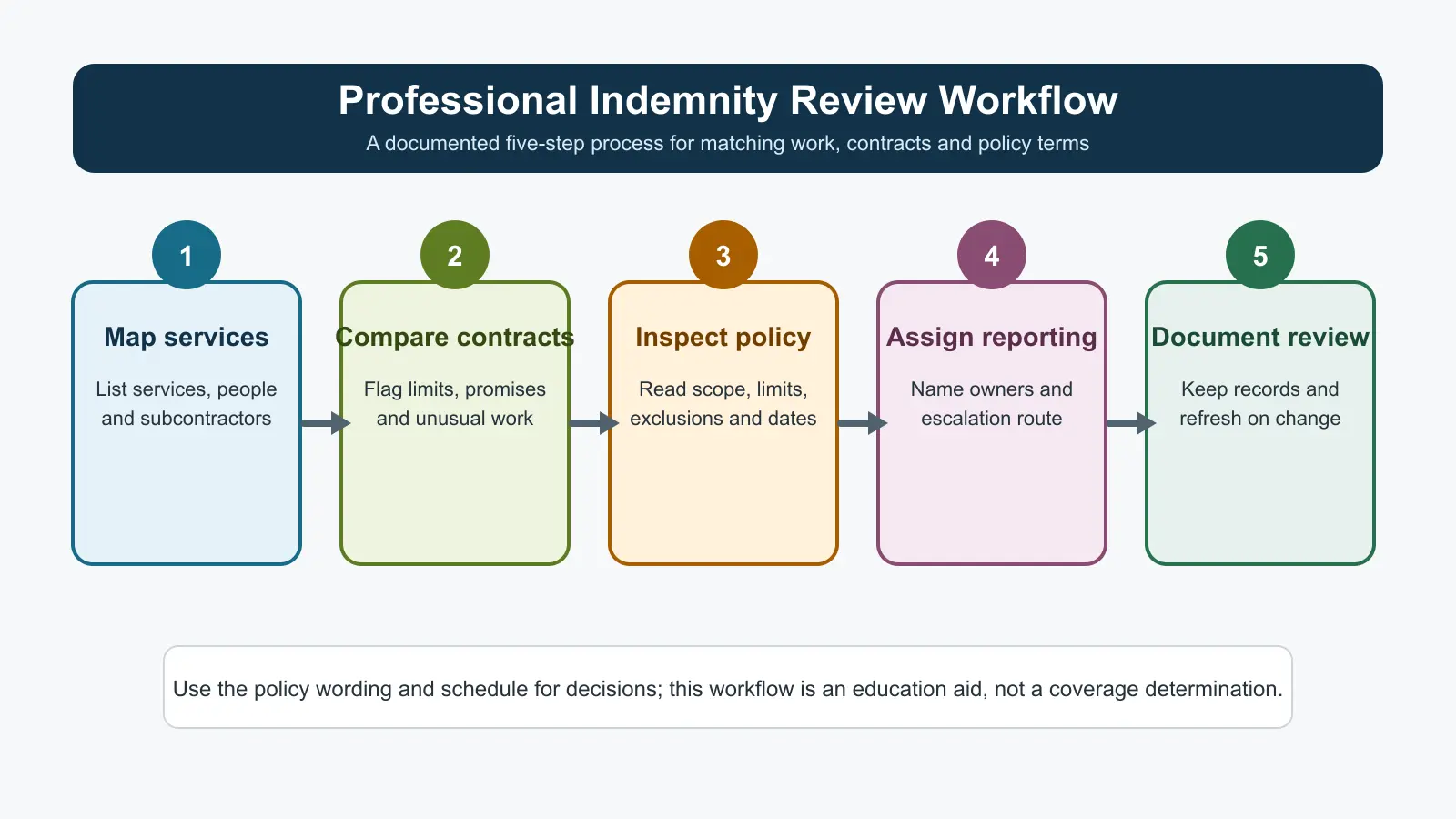
This is a qualitative workflow, not a numerical chart: it has no axes and does not rank products. Its inference is simple—coverage review becomes more reliable when the firm connects the work it performs, the contracts it signs, the insurance wording it buys and the people responsible for reporting. Each step should produce a dated record.
- Map services: List each service, who performs it, and whether employees, partners or subcontractors are involved.
- Compare contracts: Flag liability promises, client-required limits, cross-border work and unusual deliverables for review.
- Inspect the policy: Read definitions, limits, deductible, retroactive date, exclusions, defence-cost treatment and claims conditions together with endorsements.
- Assign reporting ownership: Name a primary and backup contact; keep the insurer/broker contact route and escalation procedure accessible to the relevant leaders.
- Document and refresh: Keep the signed proposal, policy schedule, endorsements, renewal record and review notes. Revisit them when services, clients or contracts change.

Common mistakes to avoid
- Treating a broad product name as proof that every service or allegation is covered.
- Choosing a limit only because it matches a client’s minimum requirement, without considering aggregate exposure and contractual commitments.
- Failing to disclose a changed service, a known circumstance or a previous complaint when the proposal asks for it.
- Letting a renewal lapse without understanding the effect on prior acts or continuous-cover requirements.
- Handling a client allegation informally before checking the policy’s notification and consent conditions.
Investor and business-owner checklist
Before buying or renewing, obtain the complete policy wording and schedule. Ask the insurer or licensed intermediary to explain the proposed scope, key exclusions, deductible, limit structure, reporting conditions and any profession-specific requirements in writing. Seek legal or specialist advice for contractual liability, disputed claims or regulated-profession obligations.
Source links
- IRDAI: guidelines on the standard professional indemnity policy for specified insurance-distribution entities
- ICAI: professional indemnity insurance information for members in practice and CA firms
- ICAI: professional indemnity terms and conditions
- India Code: Indian Contract Act, 1872
Disclaimer
This article is for general education only and is not insurance, legal, tax or investment advice. Insurance is subject to the policy wording, schedule, endorsements, exclusions, eligibility, underwriting and applicable law. Read all documents carefully and assess suitability with appropriately qualified advisers. Reviewed by Abhipra Research / Compliance Team.