Directors and Officers Liability Insurance: Start With Governance, Then Read the Wording
Board decisions can be challenged long after a meeting ends. Directors and officers (D&O) liability insurance is designed for specified claims alleging wrongful acts in an insured capacity, but it is not a replacement for sound governance, accurate disclosures, documented deliberation or legal compliance.

The useful question is not “Does the company have D&O insurance?” It is whether the policy’s insured persons, claims trigger, limit, exclusions, defence-cost treatment and reporting conditions fit the company’s real governance profile.
The regulatory context is narrower than a universal mandate
SEBI’s current LODR regulations say the top 1,000 listed entities by market capitalisation must undertake D&O insurance for all their independent directors, with the board determining the quantum and risks. This is a specific listed-entity requirement; it does not mean every Indian company has the same regulatory obligation. Read the current SEBI LODR text.
The Companies Act also limits the circumstances in which an independent director or a non-executive director who is not a promoter or KMP is liable: section 149(12) links liability to knowledge through board processes, consent or connivance, or failure to act diligently. It is a statutory provision, not an insurance coverage decision. See section 149(12) in India Code.
| Context | What the primary source says | Practical inference |
|---|---|---|
| Top 1,000 listed entities | LODR regulation 25(10) requires D&O insurance for all independent directors; the board determines quantum and risks. | Record the board’s risk assessment and the policy decision. |
| Independent and certain non-executive directors | Companies Act section 149(12) sets a liability threshold tied to knowledge, consent/connivance or diligence. | Keep board materials, conflicts records and deliberation evidence organised. |
| All policyholders | Actual cover depends on the proposal, schedule, wording and endorsements. | Do not infer scope from the product name or another company’s policy. |
Five questions to put before the board or renewal team
- Who is insured? Check the definition of insured persons, former directors, officers, committee members and subsidiaries rather than assuming every role is included.
- What is a claim and when must it be reported? Many D&O wordings are claims-made. Notice provisions and any discovery or extended-reporting period must be read exactly as written.
- How is the limit shared? Confirm whether defence costs erode the limit, whether it is aggregate, and whether separate protections or sub-limits apply.
- Which exclusions and conduct provisions apply? Fraud, personal profit, prior knowledge, insured-versus-insured and professional-services issues can be wording-sensitive. A legal allegation is not itself a coverage conclusion.
- What changed since renewal? New subsidiaries, fundraising, cross-border operations, investigations, claims, regulatory correspondence or changes in board composition may require disclosure or review.
Governance-to-policy workflow
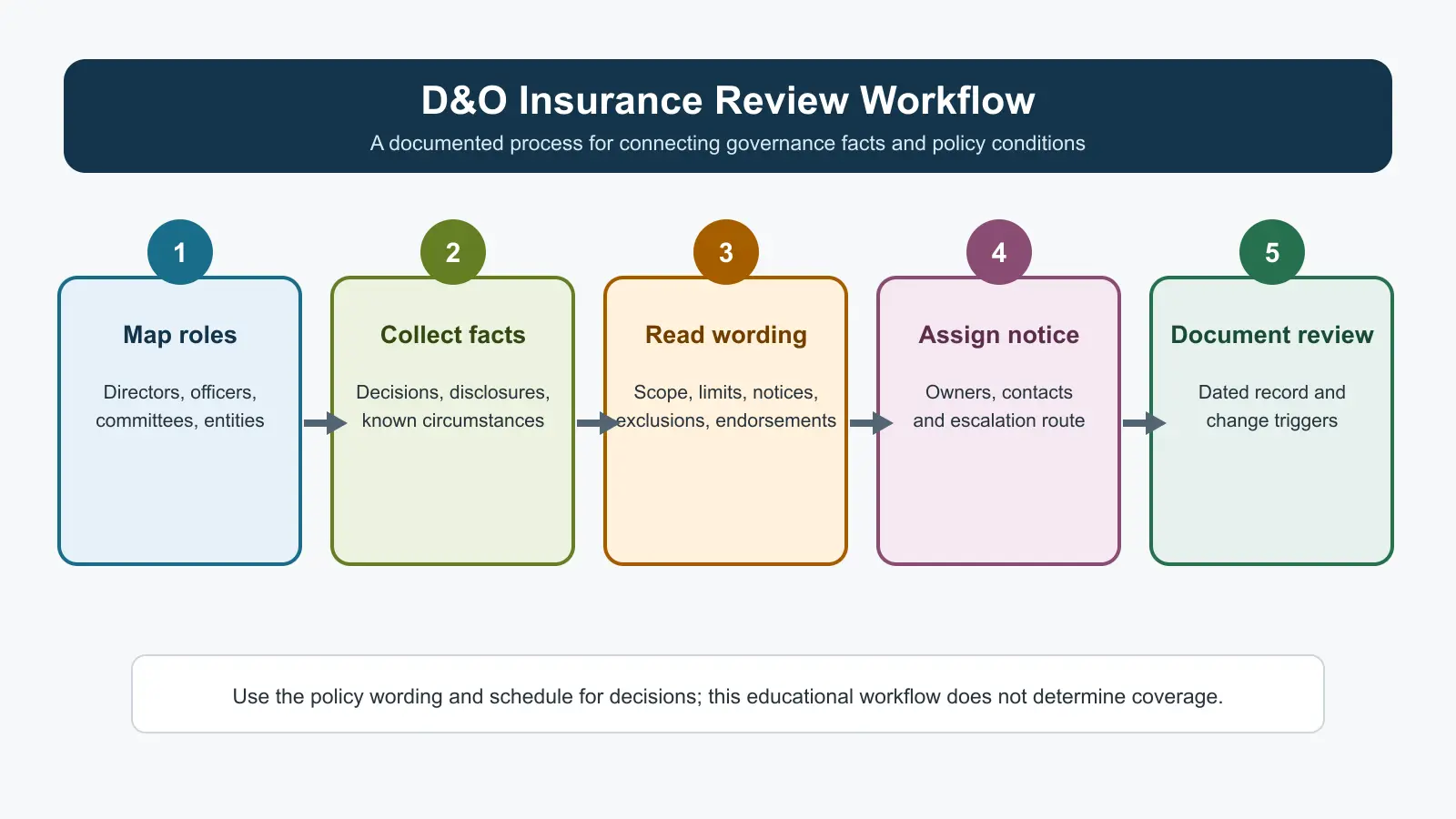
This is a qualitative process diagram, not a data chart: it has no axes and does not rate insurers or predict claims. Its inference is that a policy review is stronger when governance facts, board documentation and insurance conditions are checked together.
- Map director, officer, committee and subsidiary roles.
- Collect board decisions, disclosures, material contracts and known circumstances.
- Compare the facts with the policy schedule, definitions, limits, exclusions and endorsements.
- Assign a primary and backup owner for insurer/broker communication and legal escalation.
- Keep dated review records and revisit the file after material change.

Common mistakes
- Treating D&O insurance as a substitute for meeting minutes, conflict management or disclosure controls.
- Assuming independent-director protections under company law decide an insurer’s response.
- Renewing without checking changes in roles, subsidiaries, financing, investigations or claims history.
- Waiting for a formal lawsuit before checking the policy’s notification language.
- Relying on a summary, broker presentation or certificate instead of the schedule, wording and endorsements.
Board-ready checklist
Obtain the complete policy wording and schedule. Ask the insurer or licensed intermediary to explain, in writing, the insured-person definition, limit structure, defence-cost treatment, deductible, claims-notification conditions, exclusions, territorial terms and any run-off or discovery provisions. For an allegation, investigation or disputed coverage question, take prompt legal and insurance advice based on the actual documents.
Source links
- SEBI LODR Regulations, current text — regulation 25(10) and the top-1,000 listed-entity D&O requirement.
- SEBI master circular for listed-entity LODR compliance — current consolidated compliance context.
- Companies Act, 2013, India Code — section 149(12) liability context.
- IRDAI product archive: Directors & Officers Liability Insurance — product-archive context; product terms remain insurer-specific.
Disclaimer
This article is general business and insurance education, not legal, insurance, tax or investment advice and not a recommendation to buy a policy. Cover, eligibility, pricing, limits, exclusions, claims handling and outcomes depend on the policy wording, schedule, endorsements, facts, underwriting and applicable law. Reviewed by Abhipra Research / Compliance Team.