
Old Tax Regime vs New Tax Regime: Where Does NPS Fit?
NPS can be a retirement-planning tool irrespective of the tax regime. But the tax treatment of a contribution depends on who contributes and which regime applies. For AY 2026-27, the new regime is the default; eligible taxpayers can opt for the old regime subject to the applicable choice rules. A tax deduction should not be the only reason to select a regime.

Start with the contribution type
The most useful distinction is not simply “old versus new”. It is whether the amount is your own Tier I contribution or an eligible employer contribution.
- Under the old regime, self-contribution can fall within the combined Rs. 1.5 lakh limit for section 80C, 80CCC and 80CCD(1), subject to the applicable conditions. Section 80CCD(1B) can provide an additional deduction of up to Rs. 50,000 for eligible NPS contribution, beyond the amount claimed under 80CCD(1).
- Under the new regime, common Chapter VIA deductions such as 80CCD(1) and 80CCD(1B) are generally unavailable. The Income Tax Department’s AY 2026-27 filing guidance continues to show employer contribution under section 80CCD(2) as an available NPS-related deduction, subject to conditions and limits.
- Employer contribution is a separate payroll-and-tax question. Do not assume that a self-funded contribution and an employer-funded contribution receive the same treatment.
A chart that shows the decision structure, not your tax saving
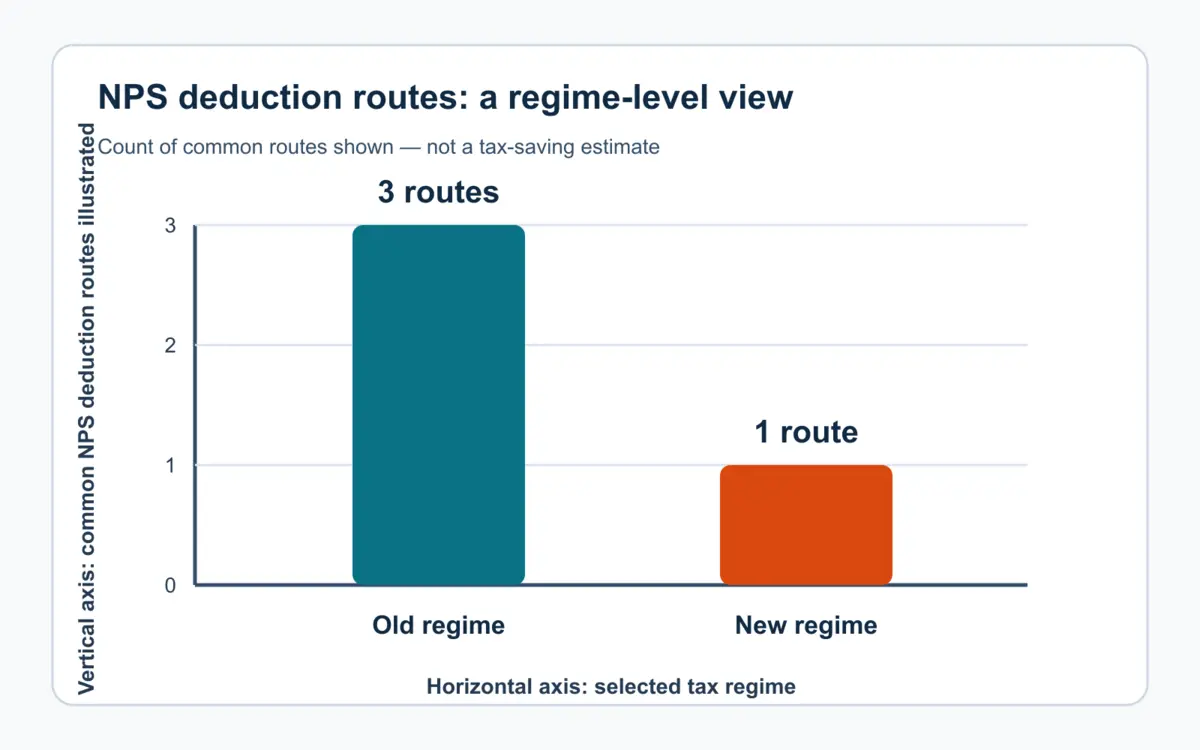
The horizontal axis compares the selected regime. The vertical axis counts the common NPS deduction routes illustrated: self-contribution under 80CCD(1), the additional 80CCD(1B) route and employer contribution under 80CCD(2). The chart’s inference is narrow: the old regime presents more of these familiar NPS routes, while the new regime keeps the eligible employer-contribution route. It does not calculate which regime produces a lower final tax liability.
Compare the full picture before choosing
| Question | Why it matters |
|---|---|
| Is the contribution from you or your employer? | The relevant provision and deduction availability can differ. |
| What other deductions and exemptions can you legitimately claim? | A regime decision should reflect the full return, not only NPS. |
| Does the contribution fit your retirement cash flow? | NPS is market-linked and designed for retirement; keep an emergency buffer separate. |
| Are your records complete? | The filing guidance asks for contribution details and PRAN when claiming 80CCD(1) or 80CCD(1B). |
A four-step review before filing or changing payroll choices
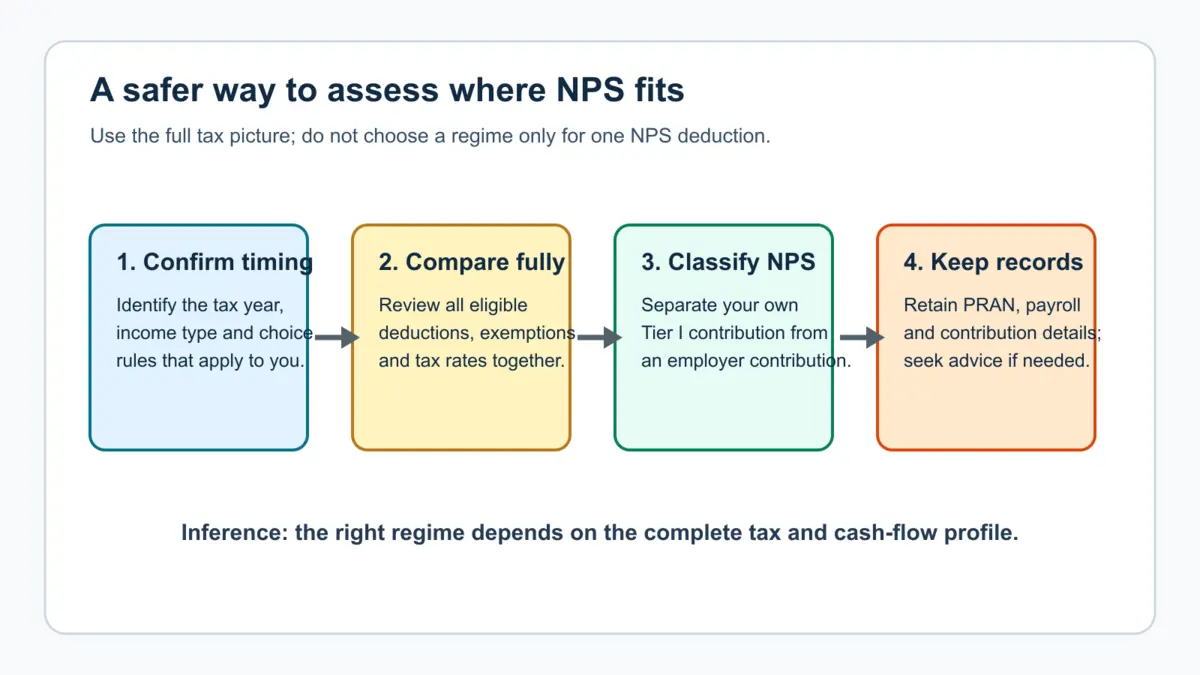
- Confirm the relevant tax year, income type and regime-choice rules. People with business or professional income can have different option mechanics from those without it.
- Compare all legitimate deductions, exemptions and tax rates—not just one NPS benefit.
- Classify the NPS amount correctly: personal Tier I contribution or employer contribution.
- Retain your PRAN, contribution record and salary documents. If your facts are complex, obtain advice from a qualified tax professional before filing.
Keep retirement planning separate from the annual tax decision
NPS involves market risk and typically has retirement-oriented withdrawal and annuity features. A contribution may suit an investor seeking disciplined long-term retirement savings even when it does not create the deduction they expected under a selected regime. Conversely, a tax deduction alone does not establish suitability.
For account or servicing help, see Abhipra’s NPS & Pension services. Abhipra has acted as a Point of Presence for 17 years. Investors who decide NPS is suitable can use Abhipra’s NPS account-opening route or NPS SIP route.
FAQs
Can I claim the additional Rs. 50,000 under 80CCD(1B) in the new regime?
The Income Tax Department’s new-regime guidance says Chapter VIA deductions are generally unavailable except specified provisions, including 80CCD(2). Check the regime selected for the relevant tax year and your return instructions before claiming anything.
Does employer NPS contribution remain relevant in the new regime?
The AY 2026-27 filing guidance identifies section 80CCD(2), employer contribution to a Tier I NPS account, among the deductions visible if the old regime is not selected. Limits and employment facts matter, so review payroll records and the official instructions.
Is NPS right only if it reduces tax?
No. NPS suitability depends on retirement horizon, liquidity needs, risk tolerance and cash-flow capacity. Tax is one part of the decision.
Source Links / Disclaimer
- Income Tax Department: salaried individuals, AY 2026-27
- Income Tax Department: FAQs on the new versus old tax regime
- Income Tax Department: ITR-4 online user manual
- Income Tax Department: transition FAQs for the Income-tax Act, 2025
This article is general investor education, not tax, legal or investment advice. Tax rules, return forms and personal outcomes can change; verify the position for the relevant year and consult a qualified professional where needed.