
NPS PoP Charges and Multiple NAVs: How to Read the Cost Effect
An NPS statement is not always a simple “money in, fee debited, balance out” record. From 1 April 2026, the NPS multiple-NAV framework has allowed the same scheme to carry different NAV treatments for different subscriber categories and routes. That makes a like-for-like comparison more important than ever.

Why the NAV can differ
NAV is the per-unit value of a scheme. PFRDA introduced the multiple-NAV framework to operationalise differentiated investment-management fees and PoP charge treatment for Government and non-Government subscribers, including PoP and e-NPS routes. A different NAV should not be read as an individual charge entry or as a standalone verdict on fund performance.
For applicable All Citizen common-scheme accounts, including NPS Vatsalya and NPS Lite, the 10 March 2026 charge circular sets a one-time onboarding charge of Rs. 200 per new account and annual charges of 0.20% of AUM, adjusted through NAV and paid quarterly. GST or other applicable taxes are additional. The circular also notes that a fully digital, non-face-to-face PoP onboarding route may have a Rs. 100 onboarding charge where determined by PFRDA.
The exact applicability depends on the account category, service route and current charge disclosure. Subscribers onboarded through e-NPS and making subsequent contributions through e-NPS or D-Remit are not liable for PoP charges under that circular; a subscriber onboarded through a PoP may remain liable even when a subsequent contribution is made through e-NPS or D-Remit.
A simple illustration of the annual rate
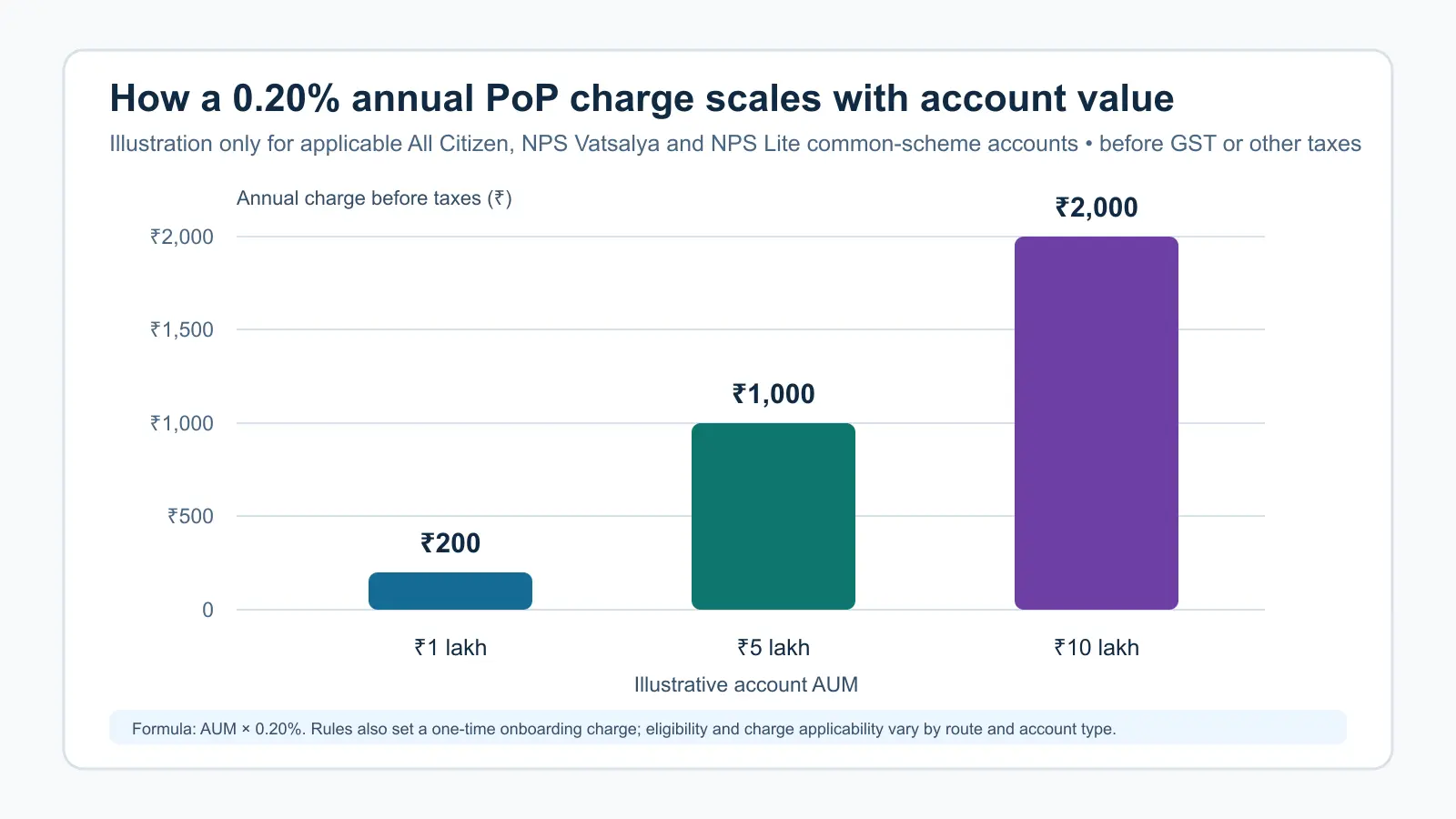
The horizontal axis shows three illustrative account AUM values: Rs. 1 lakh, Rs. 5 lakh and Rs. 10 lakh. The vertical axis shows the annual charge before applicable taxes at 0.20%: Rs. 200, Rs. 1,000 and Rs. 2,000 respectively. The inference is proportional rather than predictive—at a fixed percentage rate, the rupee charge rises with AUM. It is not a return forecast and does not establish the charge for every NPS account.
Read the record before comparing performance
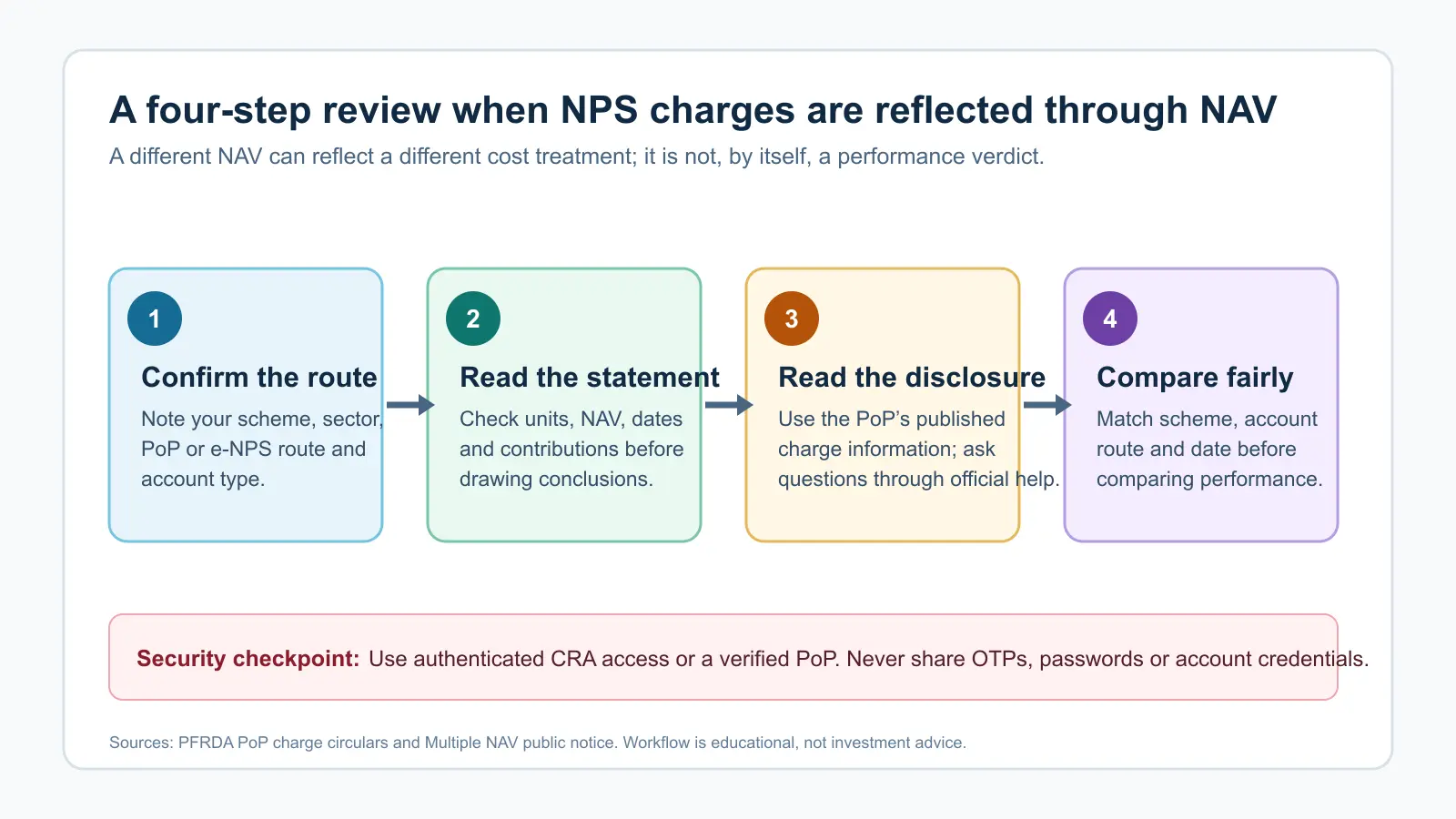
- Confirm the account route. Identify the scheme, sector, PoP or e-NPS route, and account type.
- Read the statement. Check units, NAV date and contribution dates before interpreting a value change.
- Use the published disclosure. PoPs are required to display their updated charge structure and present it during the transaction or digital-onboarding journey. Ask questions through a verified official channel.
- Compare like with like. Match the scheme, subscriber category, service route and valuation date before comparing NAVs or returns.
The workflow’s key point is that a comparison without the route and date can be misleading. Do not share OTPs, passwords or CRA credentials with anyone offering to “correct” an NAV or statement.
A practical subscriber checklist
- Keep the contribution receipt and review the subsequent Statement of Transactions.
- Treat the charge disclosure, scheme type and account route as part of the record—not as fine print to ignore.
- Check whether an account is dormant before assuming annual-charge treatment. The March circular defines a dormant account as one with no contribution for four consecutive quarters after a contribution in a quarter.
- Raise a query through your authenticated CRA access or PoP if the record does not reconcile. Preserve the acknowledgement.
Abhipra has acted as a Point of Presence for 17 years. For NPS service and account-support information, visit Abhipra NPS & Pension services. Eligible readers exploring NPS can use Abhipra’s NPS account-opening route or Abhipra’s NPS SIP route.
Source links and disclaimer
- PFRDA active circulars — includes the current 26 October 2026 PoP charge-structure circular.
- PFRDA: PoP charges for All Citizen, NPS Vatsalya and NPS Lite — charge framework, route qualification and disclosure requirements.
- PFRDA: Multiple NAV implementation notice — rationale and effective date for the framework.
Rules and charges may change. Check the current official disclosure for your account before acting. NPS investments are market-linked; this article is educational and not individual investment advice.