
NPS PoP Audit Reports: What They Tell You About Subscriber Safeguards
When an NPS service request, contribution or account update passes through a Point of Presence (PoP), the important question is not whether an audit guarantees an outcome. It does not. The useful question is whether the provider has documented controls around the work it performs. PFRDA’s 2026 audit framework gives a practical answer: it tests the provider’s processes, records and safeguards.

What an NPS PoP audit covers
The audit is carried out by an independent external chartered accountant or audit firm under the prescribed framework. Its scope includes subscriber onboarding, KYC/AML processes, contributions, reconciliation and audit trail, service requests, grievance handling, exits, charge compliance, data security and fraud-risk controls. It also checks whether earlier PFRDA inspection observations have been closed.
This is a provider-level control review. It is not a return forecast, an investment recommendation or a promise that an individual service request will be processed automatically.
How the audit frequency is set
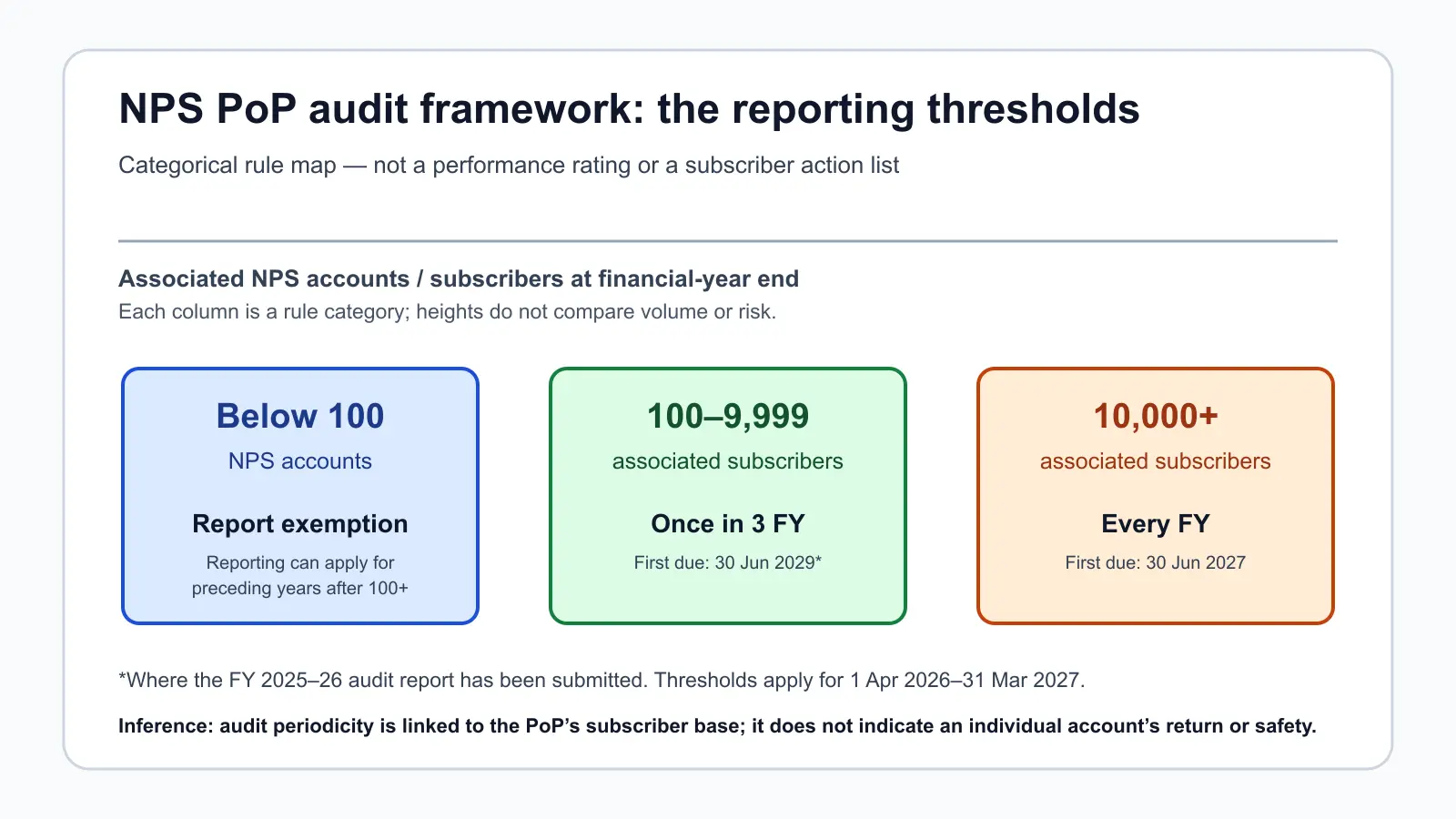
The chart’s horizontal categories are the PoP’s associated NPS accounts or subscribers at the end of a financial year; the vertical treatment is a rule category, not a value scale. For 1 April 2026 to 31 March 2027, the framework says:
| PoP size | Audit-report treatment |
|---|---|
| Below 100 NPS accounts | Exempt from submitting an audit report. If the PoP later reaches 100 or more subscribers, it must submit reports for all preceding financial years. |
| 100 to 9,999 associated subscribers | Once in three financial years. Where the FY 2025–26 report was submitted, the first report is due by 30 June 2029. |
| 10,000 or more associated subscribers | Every financial year; the first report is due by 30 June 2027. |
The inference is simple: the reporting periodicity varies with the PoP’s subscriber base. It does not rank providers, calculate investment performance or show the safety of any particular account.
How an audit report moves from review to accountability
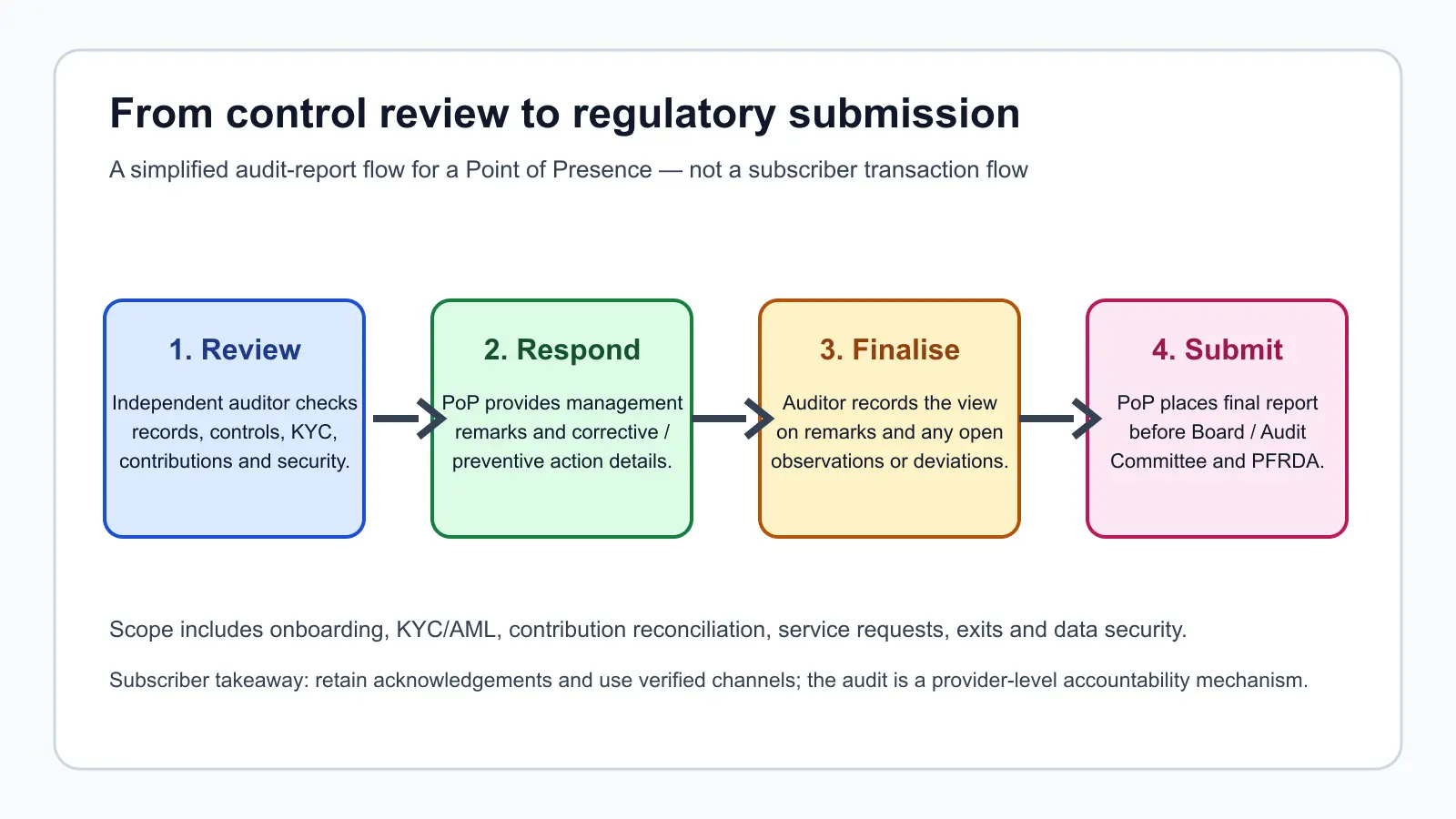
- Review: the auditor examines prescribed controls, records and operating processes.
- Respond: the PoP gives management remarks and describes corrective or preventive action for deviations.
- Finalise: the auditor records observations, including its view on management remarks.
- Submit: the PoP places the final report before its Board or Audit Committee and submits it to PFRDA.
The workflow is an accountability sequence, not a subscriber transaction path. The framework also allows PFRDA to arrange an audit where a PoP does not submit the report in time.
Three practical subscriber habits
- Keep contribution receipts and service acknowledgements; reconcile them with your statement or account record.
- Use authenticated CRA or verified PoP routes for service requests. Never share an OTP, password or login credential with someone offering to fix an NPS record.
- If a contribution, contact change, nomination, exit request or grievance does not reconcile, raise a query through an official channel and retain the acknowledgement.
Abhipra has acted as a Point of Presence for 17 years. For service information, visit Abhipra NPS & Pension services. Eligible readers exploring NPS can use Abhipra’s NPS account-opening route or Abhipra’s NPS SIP route.
Source links and disclaimer
- PFRDA: Audit of PoPs performing NPS activities, including NPS Vatsalya — audit frequency, thresholds, scope and report process.
- PFRDA: frequency of exception and audit reports by PoPs — 6 October 2026 reporting communication.
- PFRDA: PoP operational guidelines for NPS and NPS Vatsalya — operational framework.
Rules and service processes can change. This article is investor education, not individual investment, tax, legal or cybersecurity advice. NPS investments are market-linked.