NPS for Self-Employed Professionals: A Cash-Flow and Risk Check Before You Start
For a consultant, proprietor, freelancer or practice owner, retirement saving has to coexist with variable receipts, taxes, business expenses and an emergency reserve. NPS may suit someone seeking a long-horizon, market-linked retirement account, but it should not be funded with money needed for the next business cycle.

Start with eligibility and account structure
Under the All Citizen Model, an Indian citizen (resident or non-resident) or an OCI aged 18 to 85 can voluntarily subscribe, subject to KYC. HUFs and Persons of Indian Origin are not eligible, and an NPS account is an individual account—not one that can be opened for someone else.
For a resident applicant, the current PFRDA page lists a recent photograph, PAN card and proof of address among the enrolment documents. Check the current registration form and the authorised channel for the complete acceptable-document list before applying.
Tier I is the retirement-focused individual pension account. Its withdrawals follow applicable exit and withdrawal rules. Tier II is optional, requires an active Tier I account and has no withdrawal restriction, but the current PFRDA page says it does not carry tax benefits. Do not use a long-term retirement allocation as a substitute for a business contingency reserve.
A practical contribution rule for variable income
The All Citizen Model page permits unlimited contributions with no upper amount limit. That flexibility can be useful after a strong invoice month, but it does not make every surplus available for retirement. A simple order of operations is:
- Set aside operating costs, taxes and near-term liabilities.
- Maintain a separate emergency reserve suited to your household and business volatility.
- Decide a contribution amount you can sustain without borrowing or interrupting essential cover.
- Keep the acknowledgement and reconcile the contribution in your NPS account record.
NPS investments are market-linked. The size of a future corpus and pension can depend on contributions, investment performance and the portion used for annuity; neither a contribution frequency nor an equity allocation guarantees an outcome.
Investment choice: understand the ceiling and the risk
The chart compares two maximum equity allocations stated on PFRDA’s All Citizen Model page. Its horizontal axis identifies the investment framework and its vertical axis shows maximum permitted equity allocation as a percentage. Under Active Choice in common schemes, equity can be selected up to 75%. In a high-risk scheme under the Multiple Scheme Framework (where offered), equity exposure can be up to 100%.
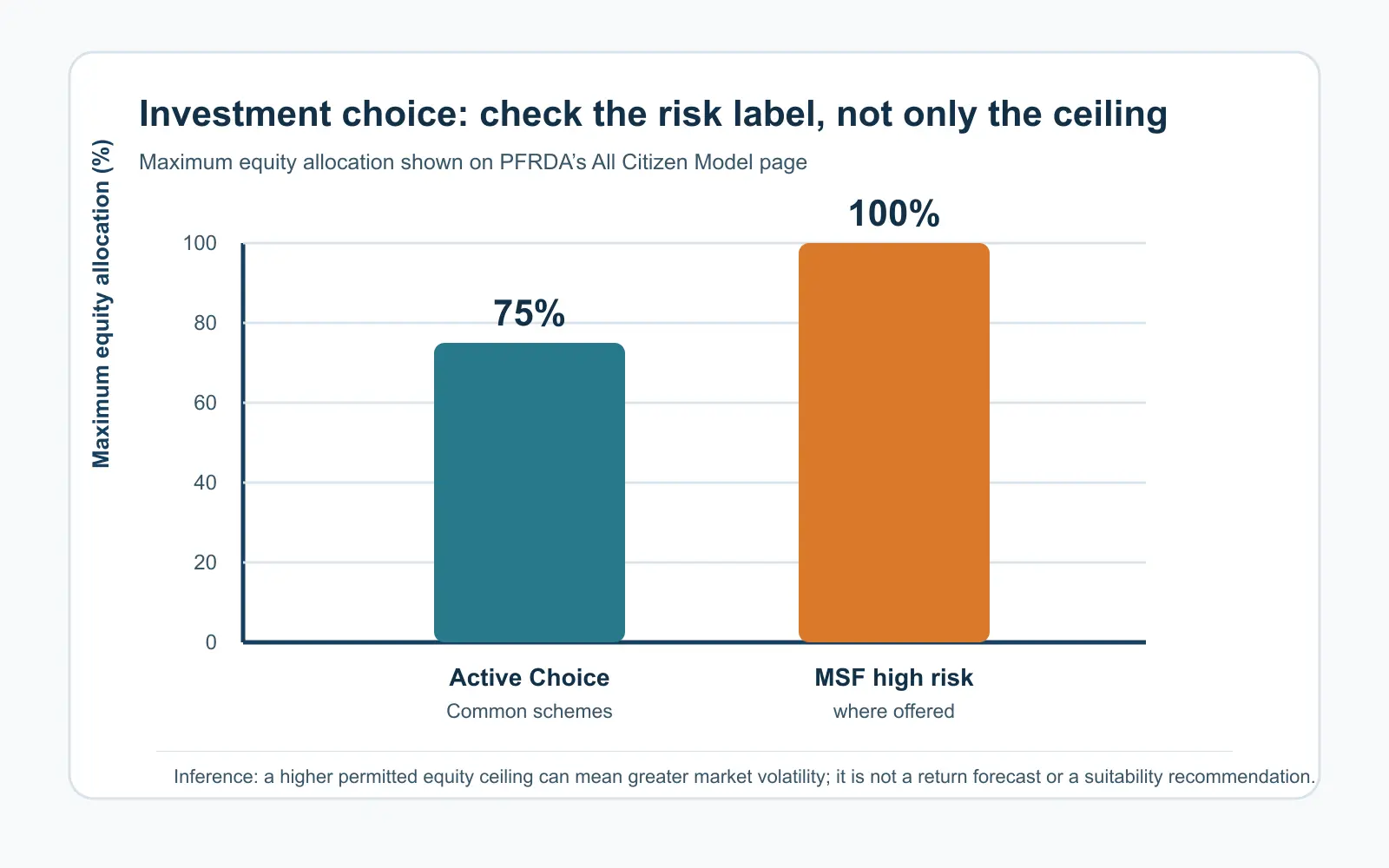
The inference is not that one option is better. A higher equity ceiling can bring greater market volatility. Consider time horizon, the reliability of future contributions, other retirement assets and your ability to stay invested through market falls. Check the scheme risk label and current terms before selecting or changing a choice.
The four checks before a contribution commitment
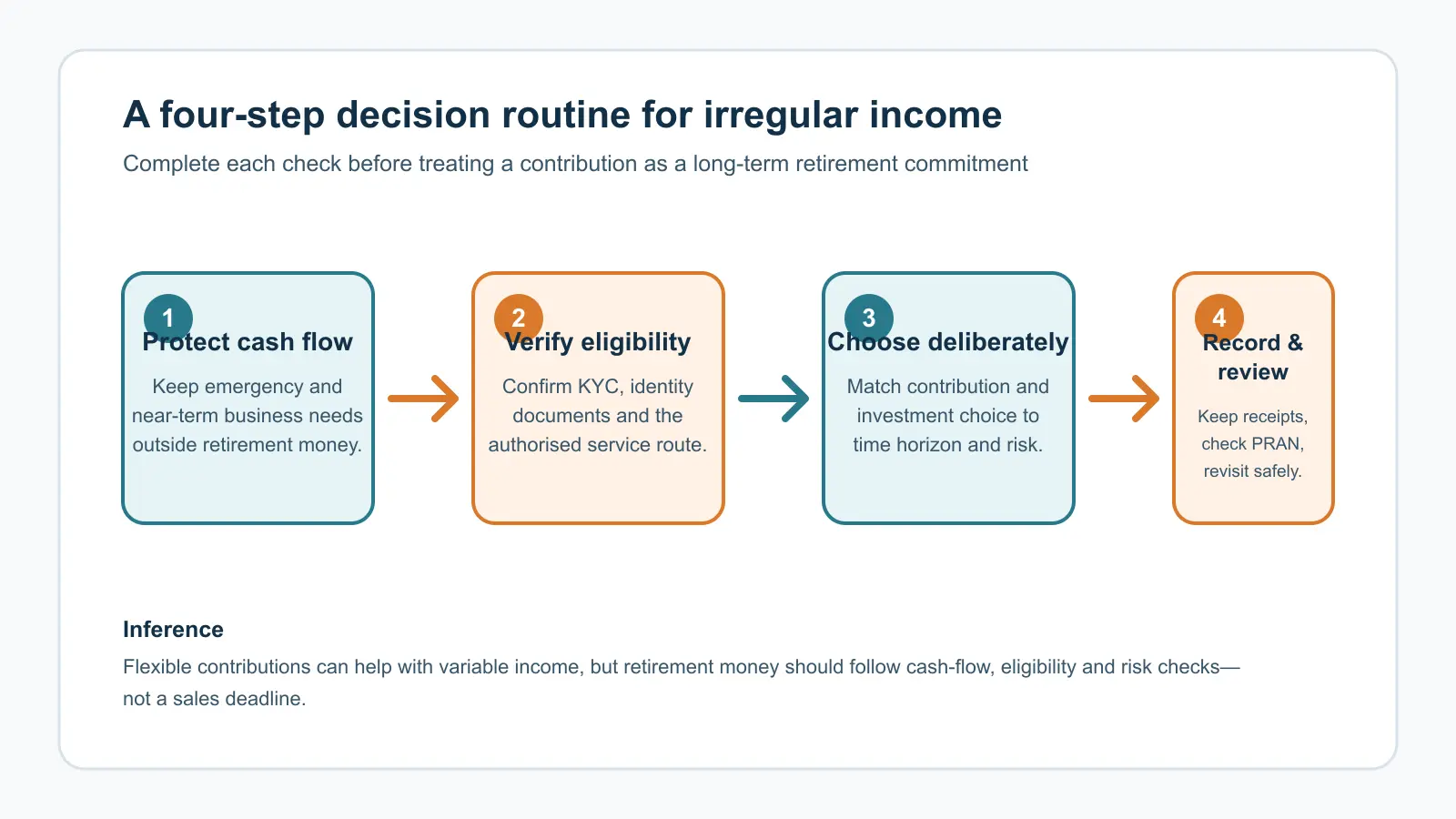
The workflow is a sequence, not a return projection. First protect near-term cash flow; then confirm eligibility, KYC and the authorised service route; next choose a contribution and investment approach that fits your time horizon and risk tolerance; finally retain receipts, verify the PRAN record and review periodically. The inference is that flexible contributions help only when they follow these controls—not when they are driven by a sales deadline.
When NPS may—and may not—fit
NPS may be worth evaluating if you have a retirement horizon, can separate long-term money from business liquidity, and understand that values can move with markets. It may need to sit alongside—not replace—an emergency reserve, appropriate insurance and other goal-based savings.
Pause and obtain personalised tax, legal or financial advice if your income is unstable, you expect to need the money soon, or you are choosing an allocation only because of a recent return. Tax treatment, contribution rules, exit conditions and scheme availability can change.
How Abhipra can help
Abhipra has acted as a Point of Presence for 17 years. You can start with Abhipra NPS & Pension services to understand the account and servicing route. When you are ready, use Abhipra’s approved NPS account-opening route. A recurring contribution can be considered through Abhipra’s approved NPS SIP route after you have assessed whether it is sustainable.
Source links / disclaimer
- PFRDA: NPS All Citizen Model—eligibility, documents, contributions, accounts and investment choices
- PFRDA: NPS All Citizen Model FAQs—market-linked nature, portability and account information
- NPS Trust: All Citizen Model FAQ—portability and market-linked pension context
This article is for investor education, not investment, tax, legal or retirement-planning advice. NPS is market-linked and subject to applicable PFRDA rules, investment risks, tax provisions and withdrawal conditions. Verify current requirements and evaluate your goals, risk tolerance, time horizon and tax situation before acting.