Migration From SME Exchange to Main Board: Readiness, Approvals and Continuing Compliance
Reviewed on: 6 October 2026. Reviewed by Abhipra RTA Team.
An SME-company migration to a main board is a listing-transition project, not an automatic reward for growth. The route depends on the issuer’s capital position, shareholder approval, current exchange eligibility, application quality and the continuing obligations that follow migration.

Start with the applicable migration route
SEBI’s ICDR framework contains SME migration provisions in Regulation 280. The current framework should be read alongside the applicable stock-exchange policy and checklist. For a further issue likely to take an SME issuer’s post-issue paid-up capital beyond ₹25 crore, Regulation 280 requires migration and main-board listing of the proposed securities, subject to the applicable eligibility criteria. The regulation also contains an alternative undertaking-based path tied to compliance with main-board LODR requirements; legal and exchange confirmation is essential for the actual transaction.
For a voluntary migration, companies should not rely on a capital threshold alone. The exchange’s current migration criteria, record of listing, financial and liquidity conditions, governance readiness, disclosures and documentary package all matter. BSE announced strengthened migration norms in September 2025, including a three-year operating-profitability requirement stated in its release. Requirements can differ between exchanges and change over time.
Approval and shareholder decision controls
The company should document the board’s assessment of the route, advisers, readiness gaps and proposed shareholder resolution. Where Regulation 280 calls for it, shareholders approve migration by special resolution through postal ballot; the regulation includes a non-promoter voting condition requiring votes in favour to be at least twice the votes against. The specific notice, voting process, disclosures and timelines must follow the applicable law, LODR requirements and exchange directions.
The issuer should then use the current exchange checklist. NSE’s migration page supplies a downloadable checklist and records 165 companies migrated from NSE Emerge to the main board as at the page checked on 6 October 2026. That total is useful evidence that the route is used; it does not establish that any individual issuer qualifies or will receive approval.
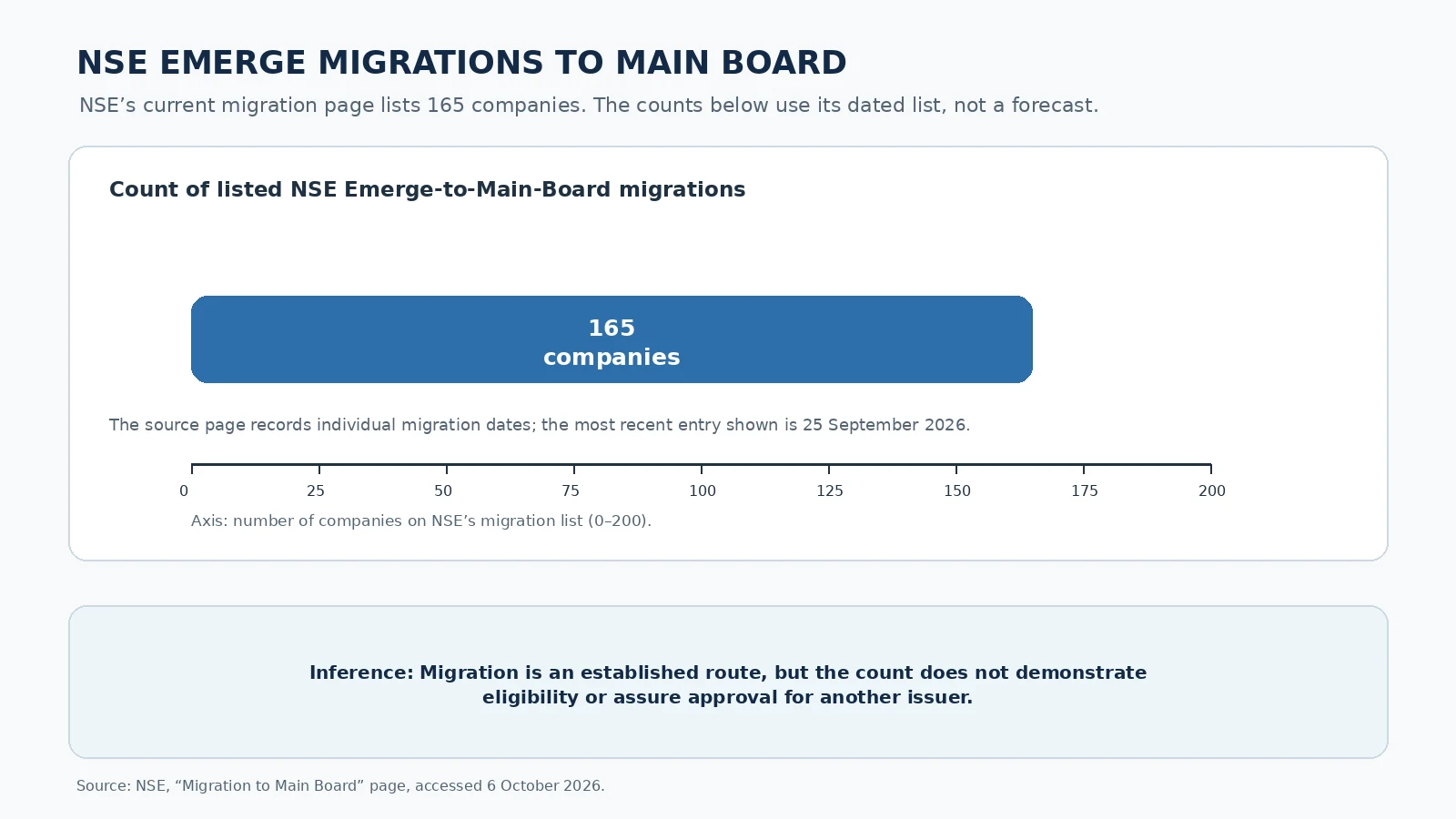
The chart’s horizontal axis is the number of companies appearing on NSE’s migration list, from 0 to 200. It records 165 listed migrations. It is not a chart of applications, approvals, investor returns or migration probability. The inference is limited: issuers should plan a controlled transition, then assess their own exchange-specific eligibility.
Continuing main-board compliance needs early planning
Migration affects more than the trading platform. A recent NSE approval letter for a migrated company states that trading on the SME platform is suspended from the main-board effective date and points to main-board financial-results and electronic-filing requirements. This illustrates why finance, company secretarial, investor-relations, RTA and technology teams should rehearse the handover before the effective date.
Key readiness work usually includes:
- confirming capital structure, ISIN, shareholder records, corporate-action history and reconciliations;
- mapping disclosure, financial-reporting and event-based filing responsibilities to the main-board calendar;
- validating investor-contact, registrar and depository operating procedures;
- preparing board, shareholder and exchange records with version control and approval evidence; and
- agreeing an escalation path for data exceptions, late filings and transition-day operational issues.
Controlled transition from application to main-board trading
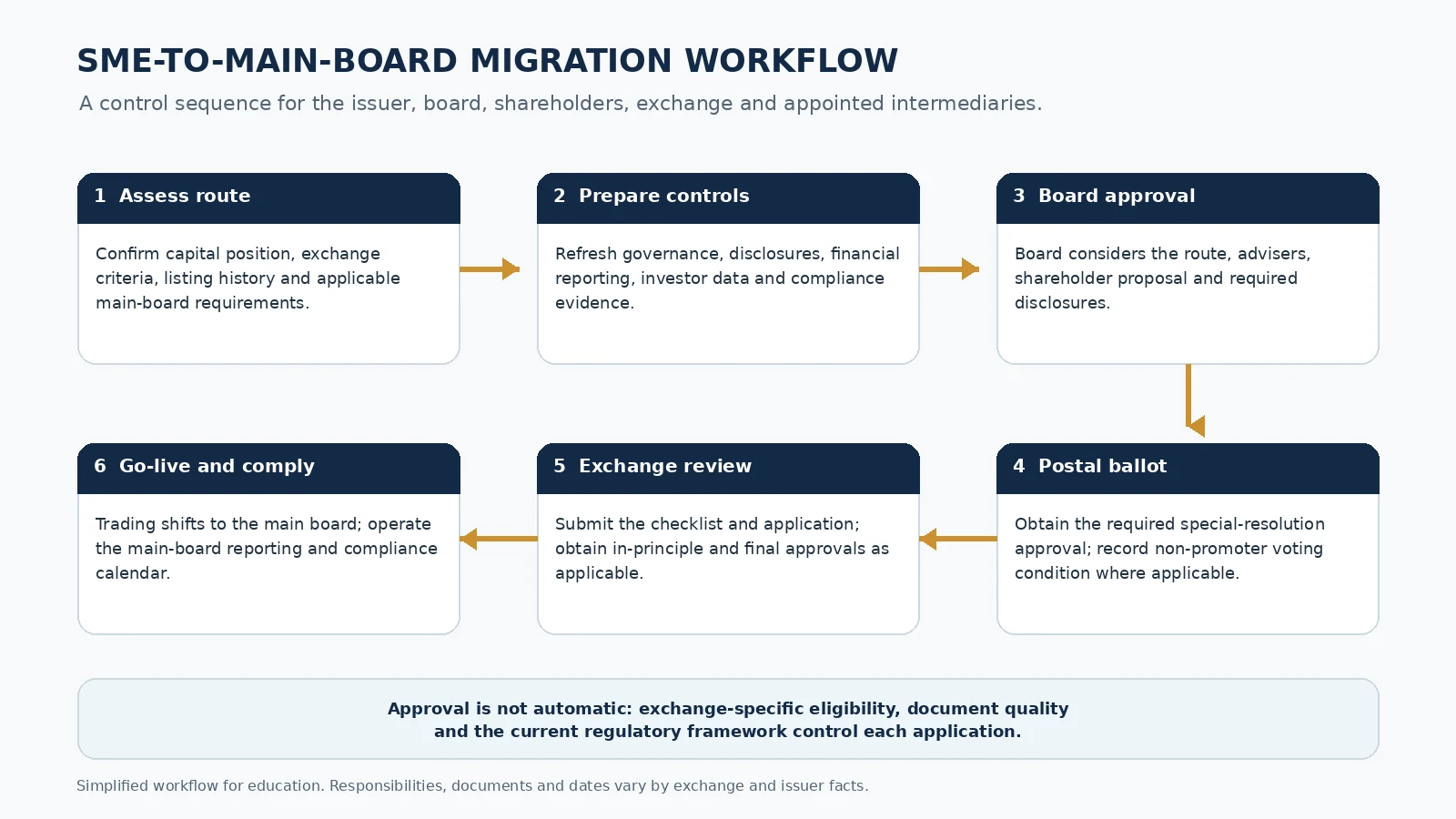
The workflow moves from route assessment to control preparation, board and shareholder approvals, exchange review, and then transition-day reporting. The final step is ongoing: migration changes the operating baseline, so the company should implement main-board obligations and evidence them rather than treating admission as the end of the project.
How Abhipra can assist
Preparing for an SME IPO or main-board IPO and need a Registrar-to-an-Issue/RTA workstream?
Contact Abhipra RTA Services at rtaservices@abhipra.com, call 011-42390783, or contact +91-9818080700.
Share the company name, current company type, proposed listing platform, latest audited financial year, capital structure, shareholder count, existing ISINs and target issue timeline for an initial operational discussion. Eligibility, merchant-banker advice and regulatory approvals remain subject to the applicable framework.
Official source links
- SEBI ICDR Regulations, 2018, last amended 21 March 2026 — see the SME chapter and Regulation 280.
- NSE Emerge migration to main board page — migration checklist and current list of migrated companies.
- NSE migration approval example, QMS Medical Allied Services — main-board effective-date and filing illustration, dated 16 June 2026.
- BSE release on strengthened SME migration framework — exchange policy update published 11 September 2025.
- NSE compliance information and checklists — current main-board and Emerge compliance resource.
Disclaimer
This article is for general educational information and does not constitute legal, tax, investment or transaction advice. Applicability depends on the company's and investor's facts and on the law, circulars and depository instructions in force on the relevant date.