
Look-Ahead Bias in Backtests: How Future Data Can Mislead Results
A backtest is meant to ask a historical question: what could a rule have done using only the information available at each decision point? Look-ahead bias appears when the test accidentally lets the rule see information from the future. The result may look cleaner than any process that could actually have been followed in real time.

The timing question behind every historical test
For each input, ask: when was it first available to the strategy? A price may be known at a particular timestamp, but a corporate result, index constituent change, restated dataset or revised economic series can become available later. Using the final version of that information at an earlier date can change the apparent entry, exit or ranking decision.
NSE’s algorithmic-trading curriculum explicitly covers system architecture, risk management, audit and compliance—not just strategy logic. See the NSE Algorithmic Trading Module.

Common ways future information leaks backwards
Look-ahead bias can arise from using today’s index membership for an older period, applying financial results before their publication time, using revised data without retaining its original vintage, or entering a trade at a price that became known only after the signal would have been calculated. A calendar field alone is not enough: timestamps, publication delays, exchange holidays, corrections and data-feed behaviour matter.
SEBI’s technology-control guidance calls for attention to information/data feeds, audit trails and preserved records of control parameters, orders, traders and data from trades. Those controls do not make a backtest valid by themselves, but they reinforce the need to know where data came from and when it was available. Read SEBI’s trading-software technology guidance.
An illustrative chart: axes and inference
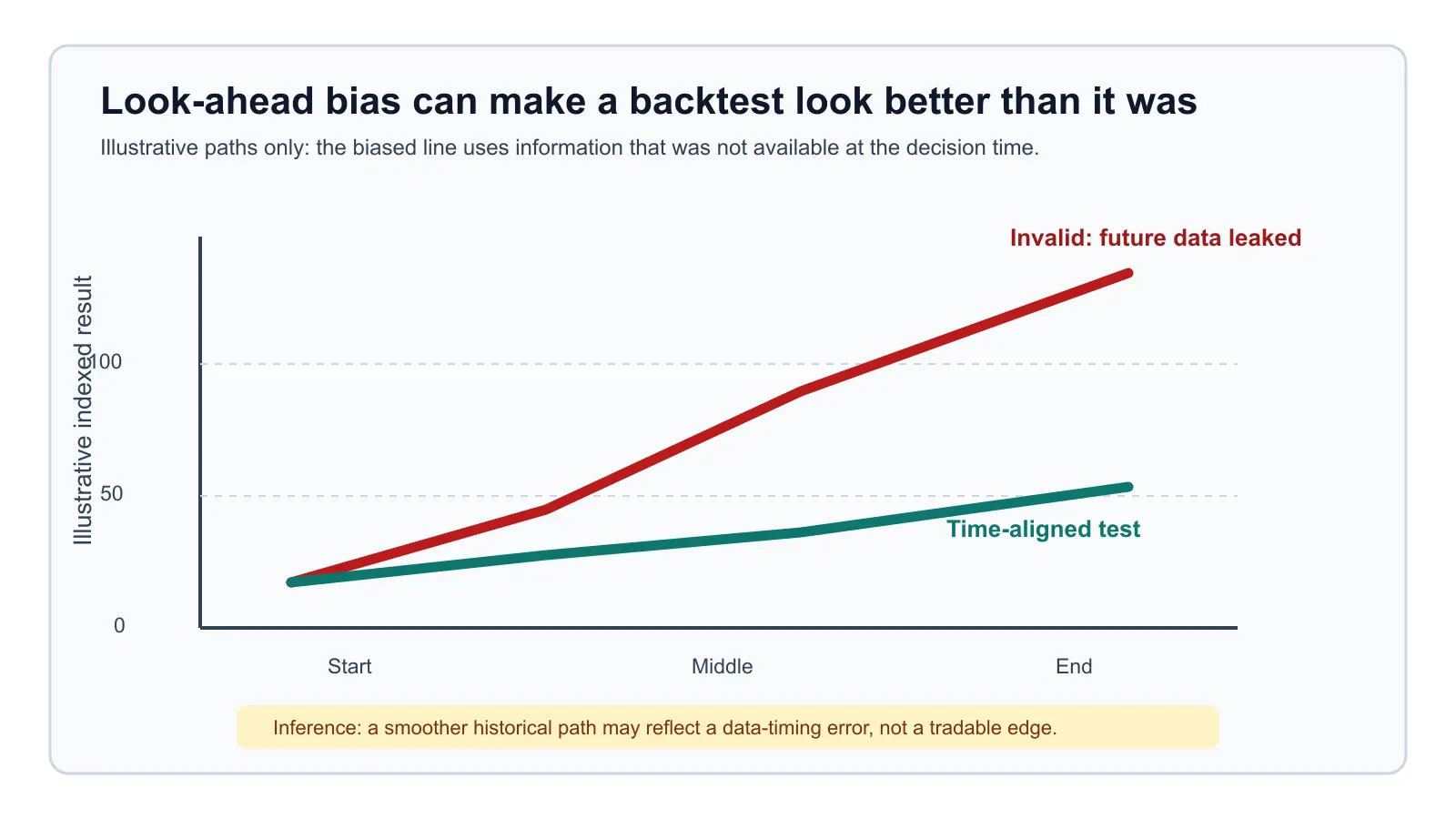
The horizontal axis is time and the vertical axis is an illustrative indexed result, not a market price or return series. The red line represents an invalid backtest where later information leaked into earlier decisions. The teal line represents a test constrained to information available at the relevant time. The inference is not that a flatter line is correct or unprofitable; it is that an unusually smooth historical result should trigger a data-timing review before it is interpreted.
| Input | Availability question |
|---|---|
| Company financials | Was the figure published and accessible before the model’s decision time, and has it since been restated? |
| Index universe | Does the historical universe include constituents that were actually eligible at that time, including removals and delistings? |
| Prices and corporate actions | Are adjustments, timestamps and execution assumptions consistent with information known at the intended order time? |
A time-aligned validation workflow
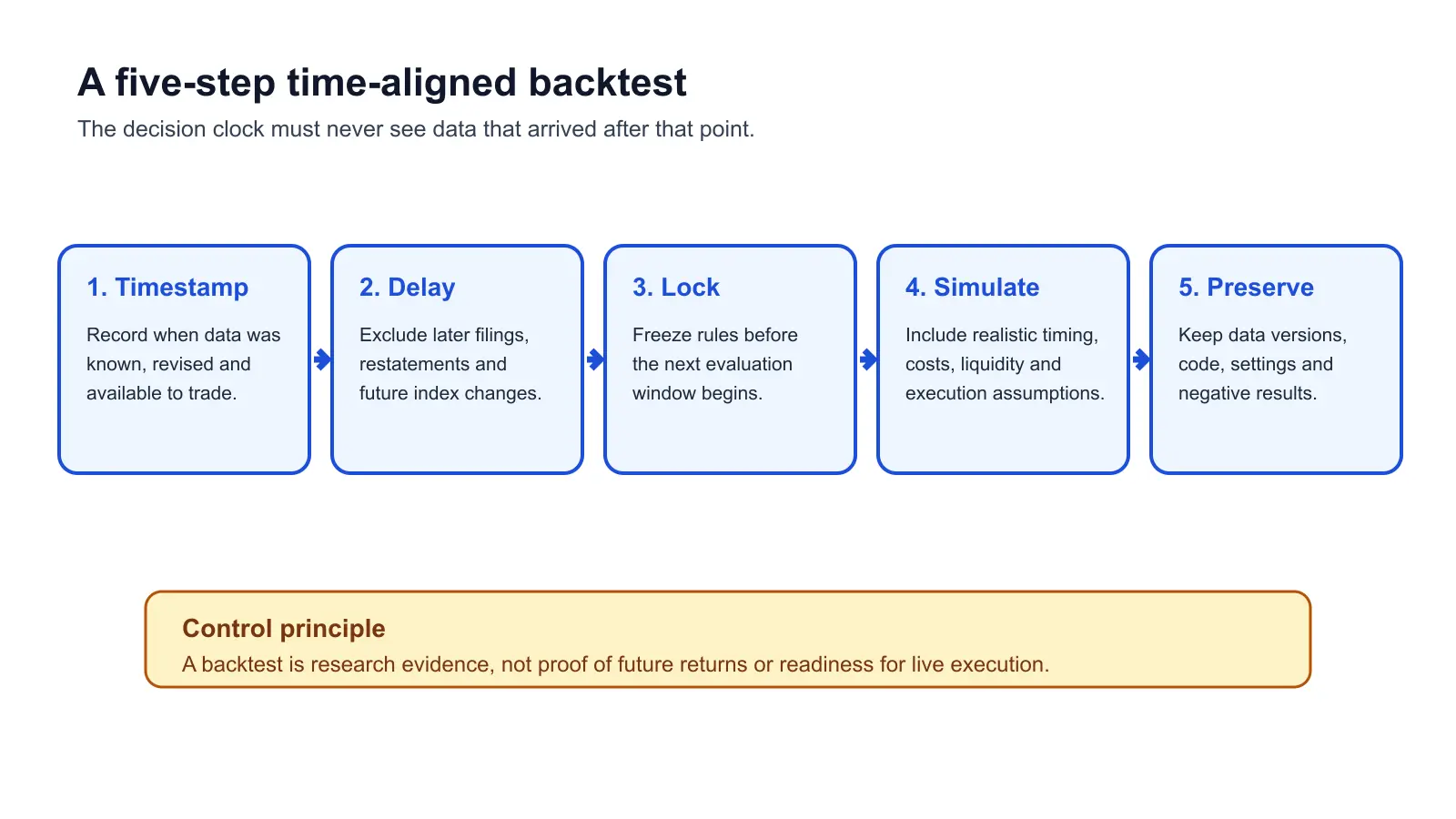
- Record data source, version, publication time and first usable timestamp.
- Delay later filings, corrections, restatements and future universe changes until they were genuinely available.
- Freeze the rule set before the next evaluation window begins.
- Include realistic order timing, costs, liquidity and execution assumptions.
- Preserve data versions, code, parameters, negative results and reviewer notes.
Why operational controls still matter
SEBI’s 2025 retail-algorithmic-trading framework is designed around safer participation through brokers and stakeholder responsibilities. Live execution introduces separate concerns—authorisation, access controls, monitoring, kill switches, audit trails and incident handling—that historical research cannot prove away. Read SEBI’s retail-algo circular.
Common mistakes
- Ranking past securities using financial results that were published later.
- Removing delisted or unsuccessful securities from a historical universe.
- Applying adjusted prices without documenting the adjustment timing and method.
- Selecting parameters after viewing the full test period.
- Treating a clean backtest as a readiness signal for live deployment.
Investor checklist
- Does every input have a documented source and “known at” timestamp?
- Are revisions, restatements, index changes and delistings handled explicitly?
- Were rules fixed before the later test period was reviewed?
- Are costs, liquidity and order timing modelled conservatively?
- Are access, logging, limits and human oversight in place before any live use?
For related learning, see Walk-Forward Testing: A Simple Check Against Overfitting, Algo Trading for Retail Investors: What to Know Before You Automate, and Why Risk Management Beats Prediction.
Source Links
- SEBI: Safer participation of retail investors in algorithmic trading
- SEBI: Trading Software Technology and BCP guidance
- NSE: Algorithmic Trading Module
Reviewed by Abhipra Research / Compliance Team.
Disclaimer
This article is for educational and informational purposes only. It is not investment, trading or algorithmic-execution advice. A historical backtest does not establish future profitability or suitability. Investments in securities market are subject to market risks. Please read all related documents carefully before investing or trading and consult a qualified advisor before making a financial decision.