
Index Arbitrage Basics: Why the Futures–Cash Gap Is Not a Free Lunch
An index future and the underlying cash basket can trade at different levels for a time. That difference is a relationship to understand, not a ready-made return. It can reflect financing, expected dividends, time to expiry, demand and supply, as well as the cost and practical difficulty of executing more than one leg.
For an individual investor, the most useful lesson is not how to chase a gap. It is how to distinguish a quoted difference from an executable, fully costed transaction—and to recognise when the strategy is outside one’s resources, systems or risk capacity.

What is being compared?
The cash side refers to the securities that make up an index, while the futures side is a standardized contract whose value is linked to that index. NISM defines basis as cash price minus futures price; a negative basis therefore indicates a futures premium under that convention. See NISM’s Equity Derivatives FAQ.
SEBI Investor notes that arbitrage can arise when there is a difference between an underlying in the cash market and a futures price, while also noting that the gains are generally small. Its derivatives explainer is a useful starting point for the terminology and risks.

Why a visible gap may not be an opportunity
An apparent premium or discount must be assessed after all relevant costs and constraints. Depending on the structure and current rules, these can include funding or financing, expected dividend treatment, brokerage, taxes and levies, bid–ask spreads, market impact, margin, lot size, settlement mechanics and the risk that one leg is filled before the other.
The result is execution-sensitive. A price can move, quoted depth can disappear or a partial fill can create unhedged exposure. SEBI’s derivatives guidance specifically highlights market, liquidity and operational risk; those risks do not disappear because two prices look related.
Hypothetical comparison: premium versus estimated costs
The following illustration is deliberately simple and does not represent a live index, contract, quote or trading signal. It uses a cash index level of 100.0, a futures level of 101.5 and estimated total costs of 1.8 index points.
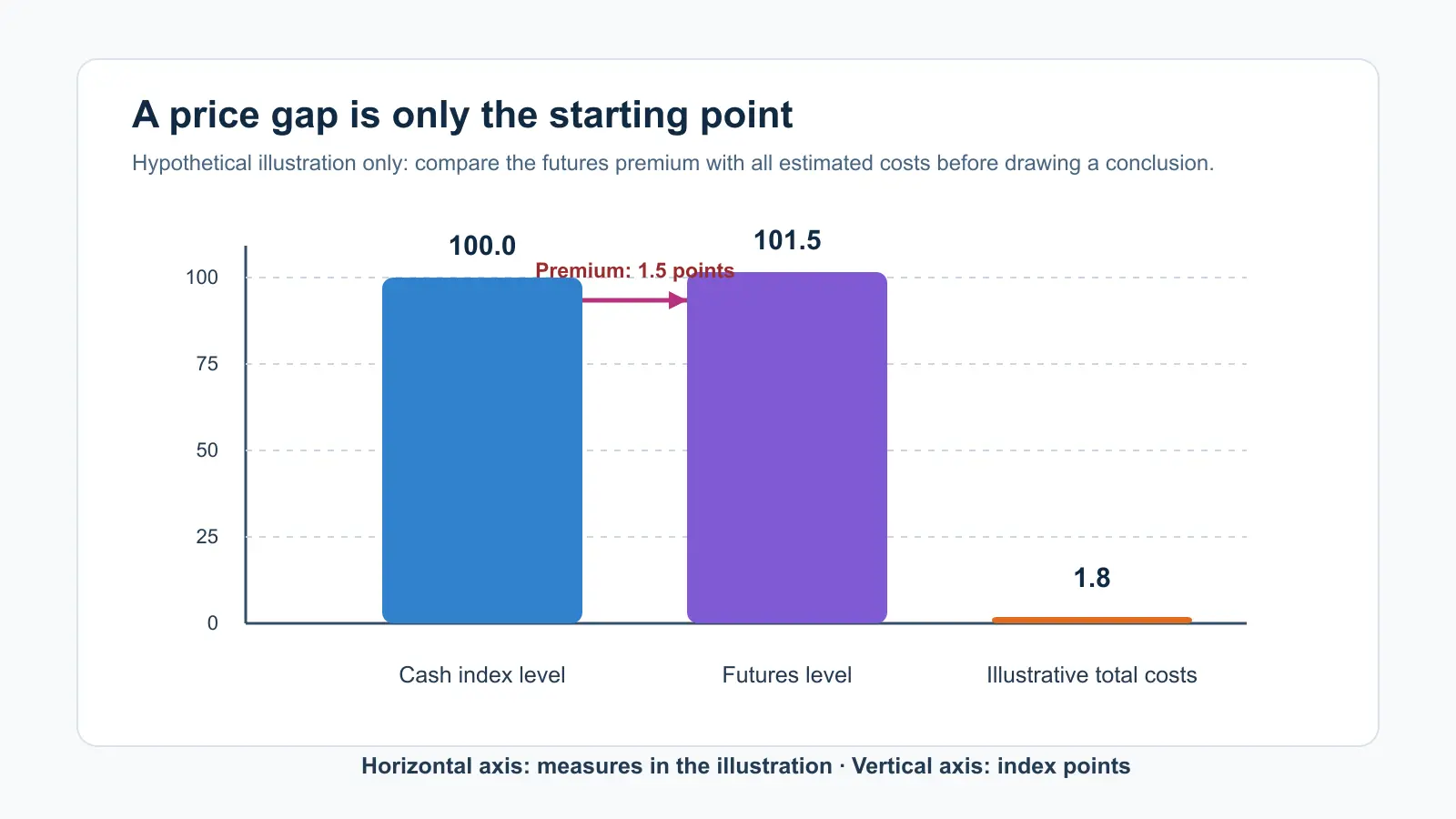
The horizontal axis names the measures in the illustration; the vertical axis shows index points. The difference between the two quoted levels is 1.5 points, while the illustrative cost estimate is 1.8 points. Inference: a positive premium alone is not enough. If estimated costs and execution frictions exceed the observed gap, the simplified comparison does not support a positive net result.
| Hypothetical input | Index points |
|---|---|
| Cash index level | 100.0 |
| Futures level | 101.5 |
| Observed premium | 1.5 |
| Illustrative total costs | 1.8 |
A control sequence before treating prices as comparable
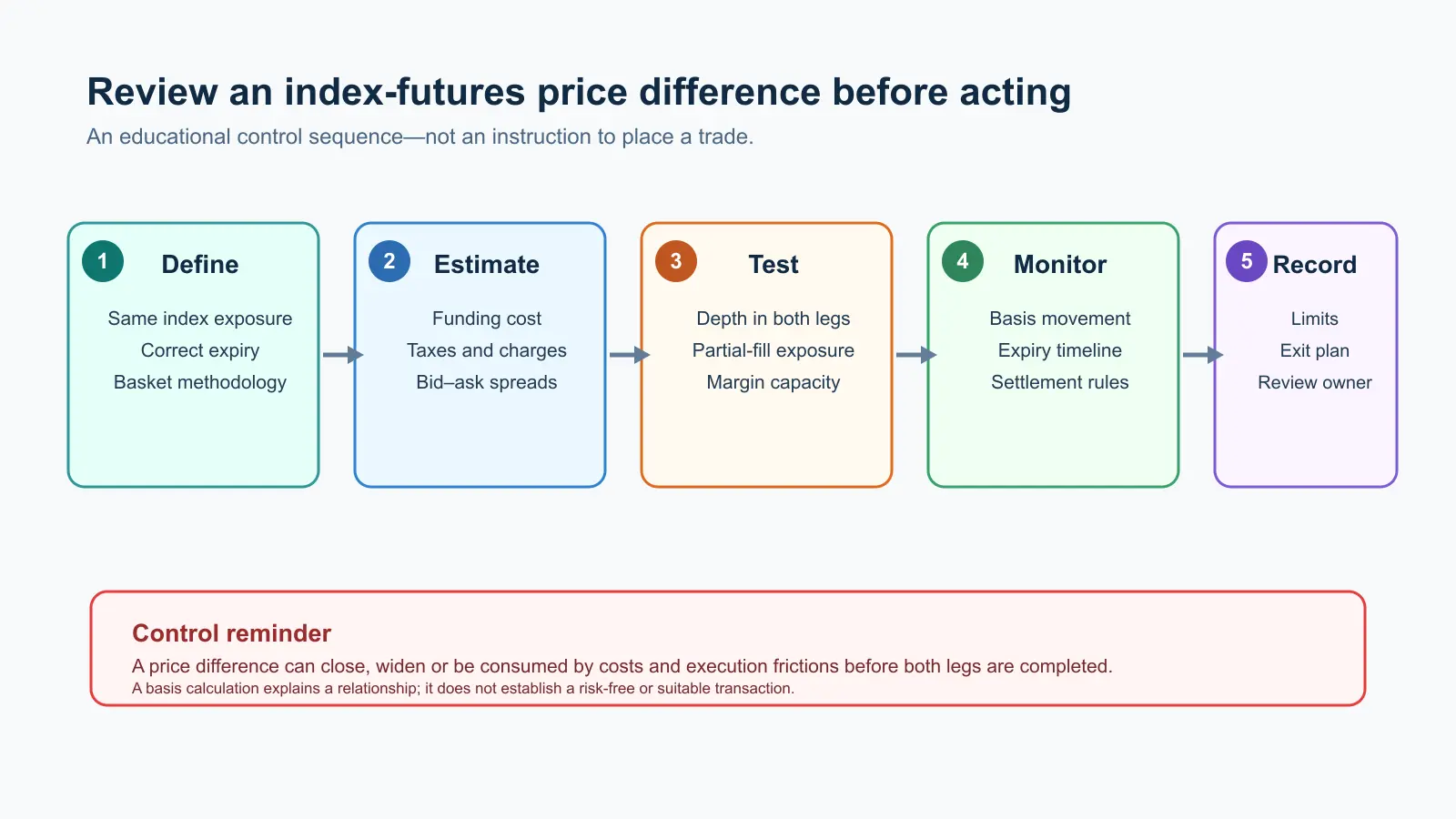
- Define the exposure: check that the index, contract expiry and basket methodology actually match the comparison being made.
- Estimate all costs: include funding, taxes and charges, bid–ask spread and any expected cash-flow adjustments.
- Test execution capacity: assess depth in both legs, partial-fill risk, lot size and margin capacity.
- Monitor the relationship: basis can move before expiry; settlement rules and the calendar matter.
- Record controls: document position limits, exit conditions and who is accountable for review.
Risk context for individual participants
SEBI’s FY25–FY26 study of individual equity-derivatives traders reported that 87.7% of individual traders incurred losses in FY26. This market-level result is not an outcome forecast for a person or a strategy. It is a reason to be cautious about treating multi-leg derivatives activity as simple, costless or risk-free.
Investor checklist
- Do I understand the basis convention and the contract’s current specifications?
- Have I included every relevant cost and considered what happens if one leg fills first?
- Is there enough depth to enter and exit both legs at realistic prices?
- Can I meet changing margin or settlement requirements without disrupting other financial goals?
- Have I obtained professional, regulated advice if this is beyond my knowledge, systems or risk capacity?
Key takeaway
Index arbitrage is a market relationship between a futures contract and a cash basket, not a shortcut to assured returns. A sound analysis begins with a basis calculation and ends only after execution, costs, liquidity, margin and suitability have been examined.
Source Links
- NISM — Equity Derivatives FAQ
- SEBI Investor — Understanding Derivatives
- SEBI — Profitability of Individual Traders in the Equity Derivatives Segment (FY25–FY26)
Disclaimer
This material is for investor education only. It is not a recommendation, a live-market call, a suitability assessment or an assurance of return. The numerical illustration is hypothetical and excludes instrument-specific details. Derivatives involve substantial risk and may not be suitable for every investor. Consult a SEBI-registered investment adviser where appropriate and read applicable risk disclosures before trading.
Reviewed by Abhipra Research / Compliance Team.