
Bear Call Spread: A Credit Strategy With Defined Upside Risk, Not Defined Safety
A bear call spread is a two-leg options structure that combines a short call at one strike with a long call at a higher strike on the same underlying and expiry. The long call can cap the upside loss at expiry; it does not make the trade safe, suitable, or likely to be profitable.
The practical value of learning the structure is its clarity. Before any order, an investor should be able to identify the two contracts, the net credit, the strike gap, the maximum loss at expiry, charges, margin requirements and the plan for closing the position. This is investor education, not a recommendation to trade.

What the two legs do
In its basic form, a bear call spread uses two calls on the same underlying with the same expiry:
- Sell a call at the lower strike.
- Buy a call at a higher strike.
The first leg creates an obligation for the seller; the higher-strike long call is the element that limits the expiry loss if the underlying rises sharply. NISM’s Equity Derivatives FAQ describes the structure as two calls with different strikes and the same expiration date. Contract specifications, lot size, available strikes and margin can differ by instrument and can change; check the current exchange and broker information before acting.

Defined payoff is not the same as defined outcome
“Defined risk” usually refers to the theoretical expiry payoff once both legs are in place. It does not remove risks before expiry or operational frictions. Bid–ask spreads, thin depth, changing margin, charges, taxes, assignment/exercise mechanics, a delayed exit and legging risk can all matter. SEBI’s derivatives education page highlights market, liquidity and operational risks, including the difficulty of exiting promptly at a fair price.
The distinction is especially important in a short-call structure. A maximum-loss number should be converted to the contract lot size and assessed alongside the capital set aside, broker margin policy and the ability to manage the position in fast markets.
Illustrative payoff: read the axes before the line
The figure below is deliberately hypothetical. It assumes a short 100 call, a long 105 call and a net credit of 2 per unit, before charges and taxes.
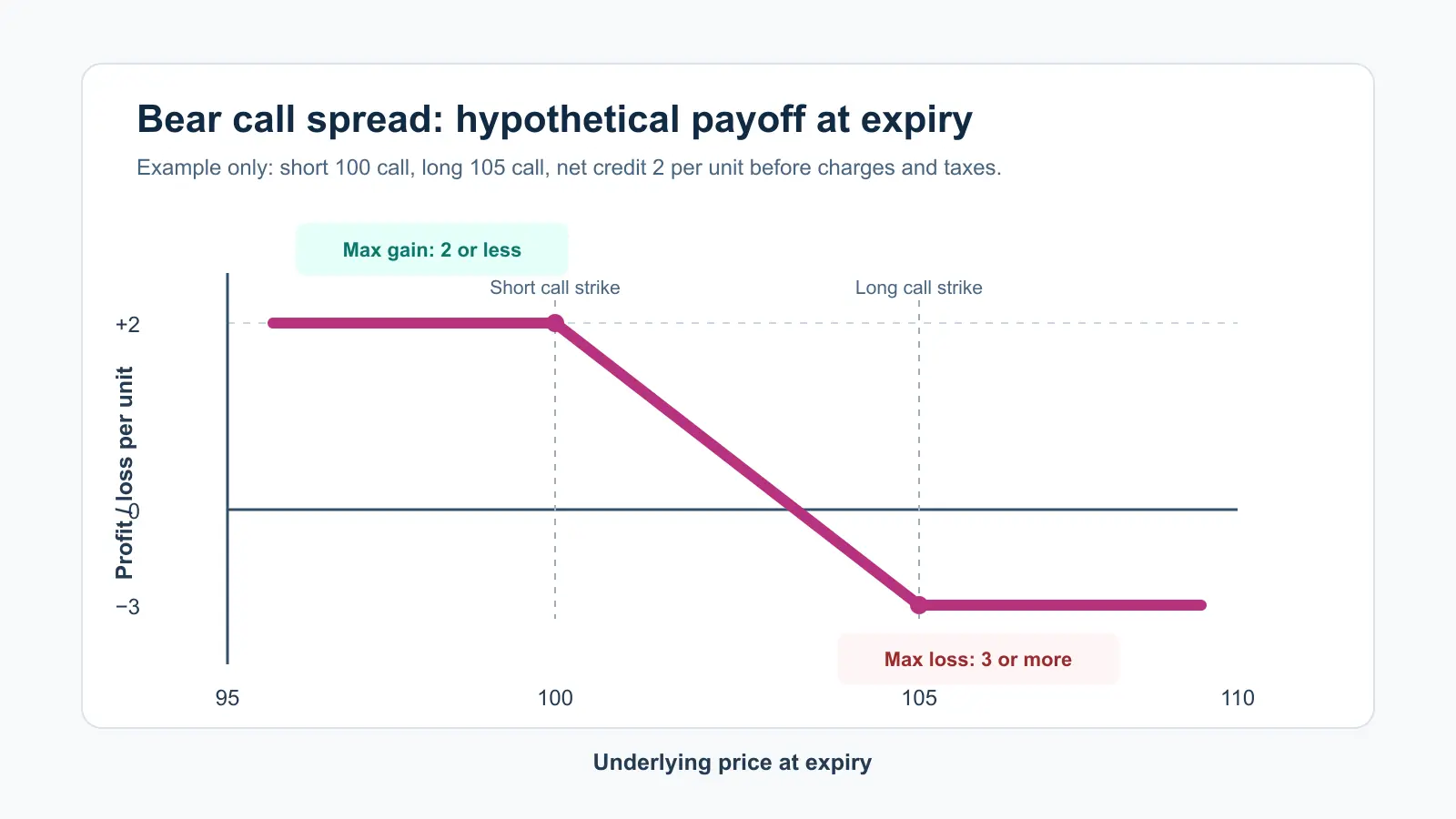
The horizontal axis is the underlying price at expiry. The vertical axis is profit or loss per unit. At or below 100, this example retains the 2-unit credit. Between 100 and 105, the short-call loss rises and reduces that credit. At or above 105, the higher-strike long call offsets further rise in the short call, leaving a 3-unit maximum loss per unit in this illustration.
| Hypothetical input | Per-unit result at expiry |
|---|---|
| Net credit received | 2 |
| Strike gap | 5 |
| Maximum gain | 2, at or below the short-call strike |
| Maximum loss | 3, at or above the long-call strike |
Inference: the line is capped at both ends because the two calls work together. It is not a forecast of price, a probability estimate or a statement of the likely result. Actual P&L also depends on lot size, execution price, brokerage, statutory levies and any action before expiry.
Why risk-first preparation matters
SEBI’s FY25–FY26 study of individual traders in equity derivatives reported that 87.7% of individual traders incurred losses in FY26. The study also reported aggregate individual net losses of ₹91,685 crore and that options accounted for 92% of aggregate individual losses. These are market-level observations, not a prediction for any individual. They are a reason to treat position sizing, liquidity and an exit process as central—not as footnotes.
A review workflow before placing an order
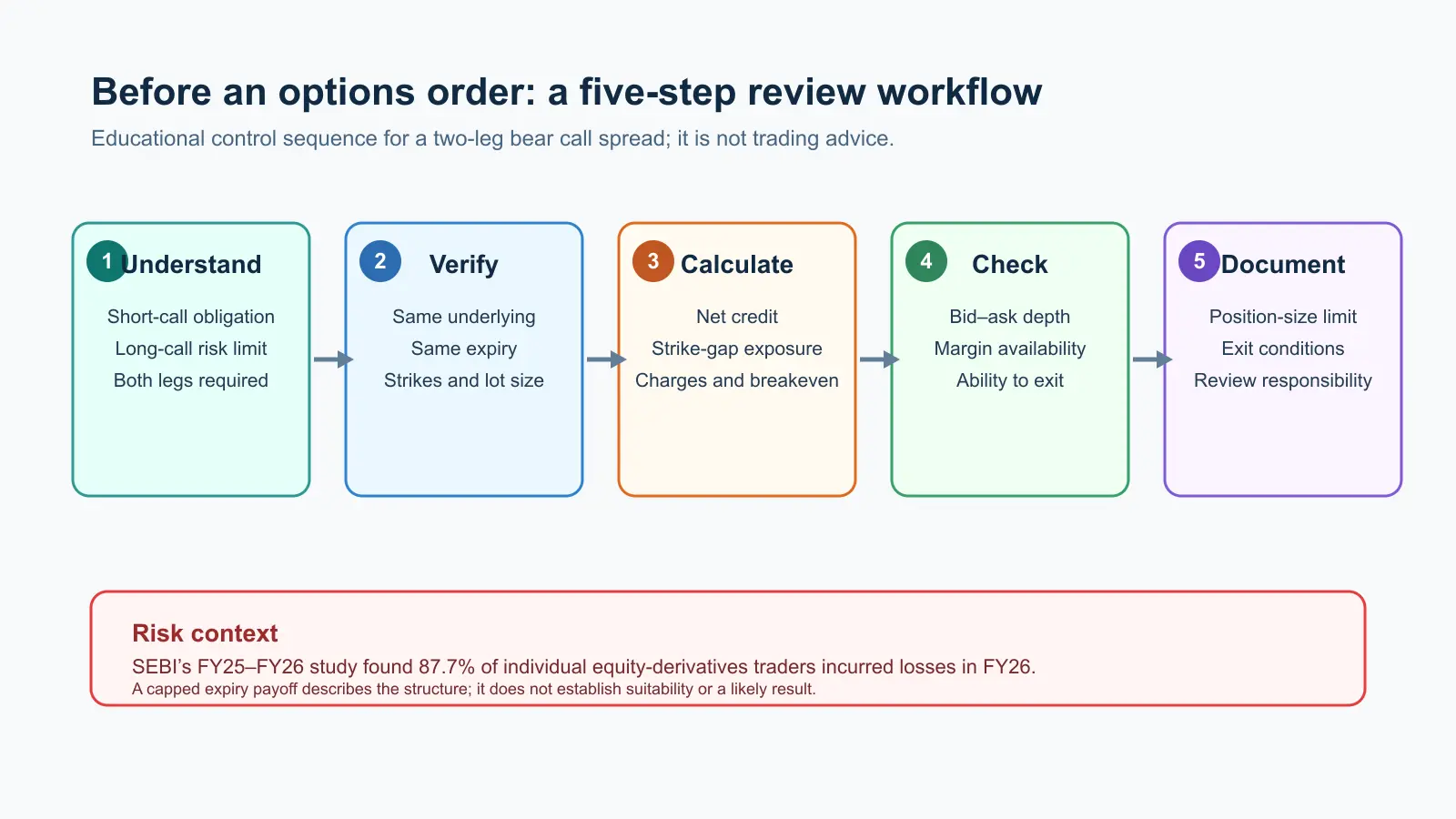
The workflow is intentionally operational:
- Understand: confirm the short-call obligation and the long call that limits the expiry payoff.
- Verify: match underlying, expiry, strikes, contract lot size and current product specifications.
- Calculate: write down net credit, strike-gap exposure, maximum gain/loss at expiry, breakeven assumption, charges and taxes.
- Check: assess market depth, bid–ask spread, available margin and the feasibility of closing both legs.
- Document: set a position-size limit, review responsibility and exit conditions before an order is placed.
Questions worth answering before any derivative position
- Can I explain what happens to each leg if the underlying rises, falls or remains near the short strike?
- Is the loss at the chosen lot size affordable without relying on additional funds?
- Have I checked live contract terms, current margin and bid–ask depth rather than relying on an old example?
- Can I close or adjust both legs if conditions change, and what are the costs of doing so?
- Is this a hedging need, or is it speculation that should be reconsidered in light of my risk capacity?
Key takeaway
A bear call spread can define an expiry payoff by pairing a short call with a higher-strike long call. Its cap is a structural feature, not a safety label. Treat the credit as one input in a larger risk review that includes lot size, liquidity, margin, charges, execution and personal suitability.
Sources
- NISM — Equity Derivatives FAQ
- SEBI — Profitability of Individual Traders in the Equity Derivatives Segment (FY25–FY26)
- SEBI Investor — Understanding Derivatives
Disclosure: This material is for investor education only. Derivatives involve substantial risk and may not be suitable for every investor. Illustrations are hypothetical, exclude charges and taxes, and are not recommendations or assurances of return. Consult a SEBI-registered investment adviser, where appropriate, and read applicable risk disclosures before trading.