
Calendar Spread in Futures: Trading the Difference Between Expiries
A futures calendar spread uses two futures contracts on the same underlying with different expiry months, held in opposite directions. The position is about the difference between the two contract prices—not a simple view that the underlying will rise or fall. That distinction matters, but it does not make the position low-risk or suitable for every investor.

Two expiry dates, one spread relationship
For example, a position may be long one expiry and short another expiry on the same underlying. The relevant number is the spread: far-expiry futures price minus near-expiry futures price, with the sign interpreted according to the position. A change in the underlying’s price can affect both legs, while changes in funding, carry, supply-demand conditions, liquidity and time to expiry can change the gap between them.
NSE Clearing describes a calendar spread as offsetting positions across different expiries and notes that contract months do not necessarily move in perfect correlation. That is why its risk system adds an inter-month or calendar-spread charge. Read NSE Clearing’s SPAN explanation.
Margin relief is not a safety certificate
Exchange treatment may recognise offsetting positions, but it does not remove risk. NSE Clearing states that calendar-spread treatment applies until the near-month contract expires; for index derivatives, the offsetting benefit is not available on the expiry day for contracts expiring on that day. Investors should check current exchange parameters and their broker’s margin display rather than relying on a remembered number. See NSE Clearing’s current treatment note.
SEBI’s derivatives guidance highlights market, liquidity and operational risk, and warns that derivatives’ relatively small margin compared with contract value can magnify gains and losses. Read SEBI’s derivatives overview.
| Area | Review question | Risk if overlooked |
|---|---|---|
| Contract match | Are both legs on the same underlying, with the intended expiries and quantities? | An unintended mismatch can create directional exposure rather than the planned spread exposure. |
| Spread behaviour | What could widen or narrow the expiry gap, and what assumptions support that view? | Basis and carry assumptions may fail even when the broad underlying move is modest. |
| Liquidity and execution | Is there executable depth in both months, including during stress? | One leg may fill at a different price, leaving unwanted exposure and higher costs. |
| Expiry and margin | When can margin treatment change, and how will the near contract be closed or rolled? | Margin calls, expiry-day treatment or a delayed exit can force an unplanned decision. |
The illustrative chart: axes and inference
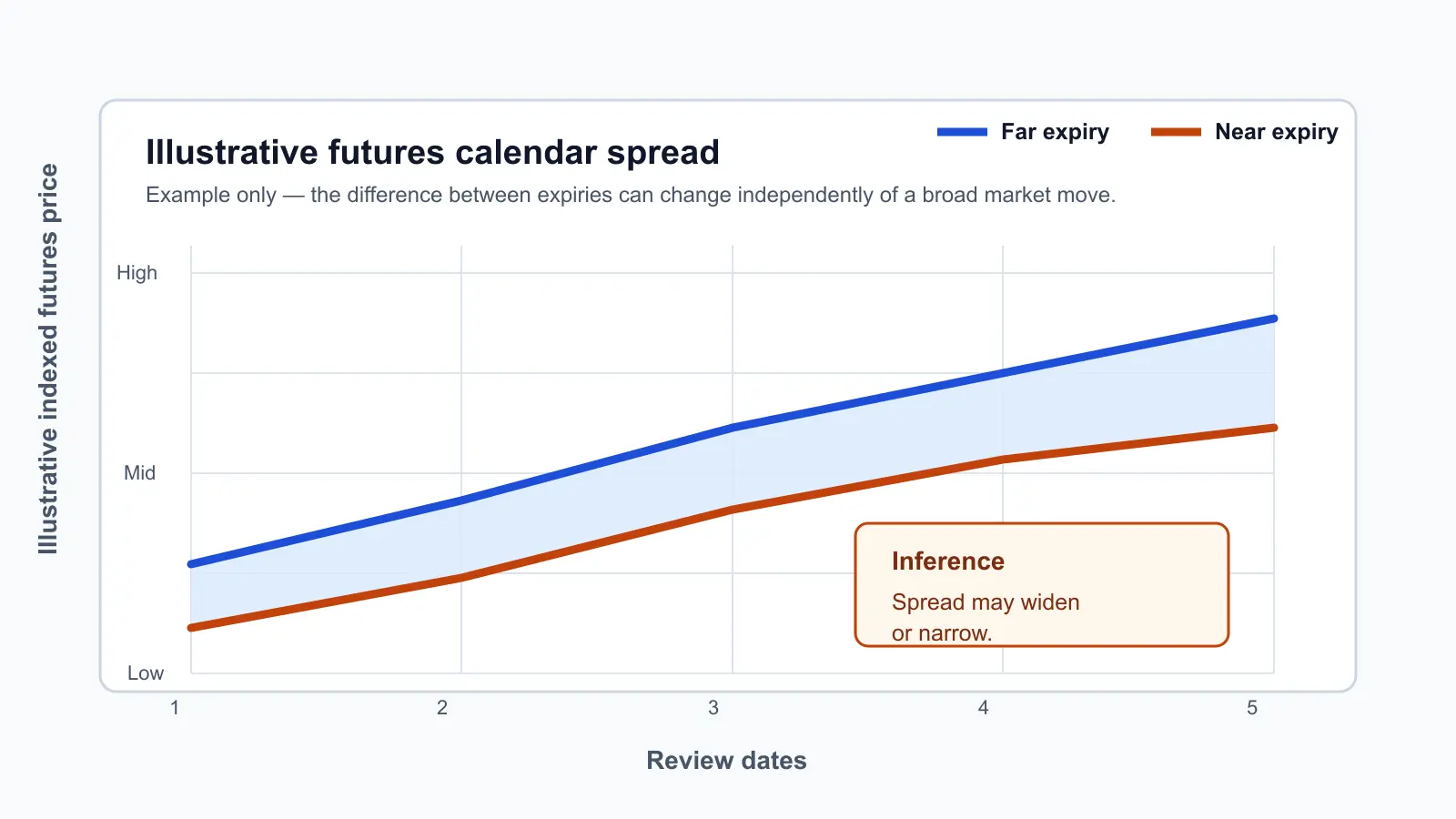
The horizontal axis is a sequence of review dates; the vertical axis is an illustrative indexed futures price, not live market data. The blue and orange lines represent different expiries of the same hypothetical underlying. The shaded distance is the spread. The inference is deliberately narrow: the gap can widen or narrow, so a two-leg position can lose value even if both contract prices move in the same broad direction.
A disciplined review sequence
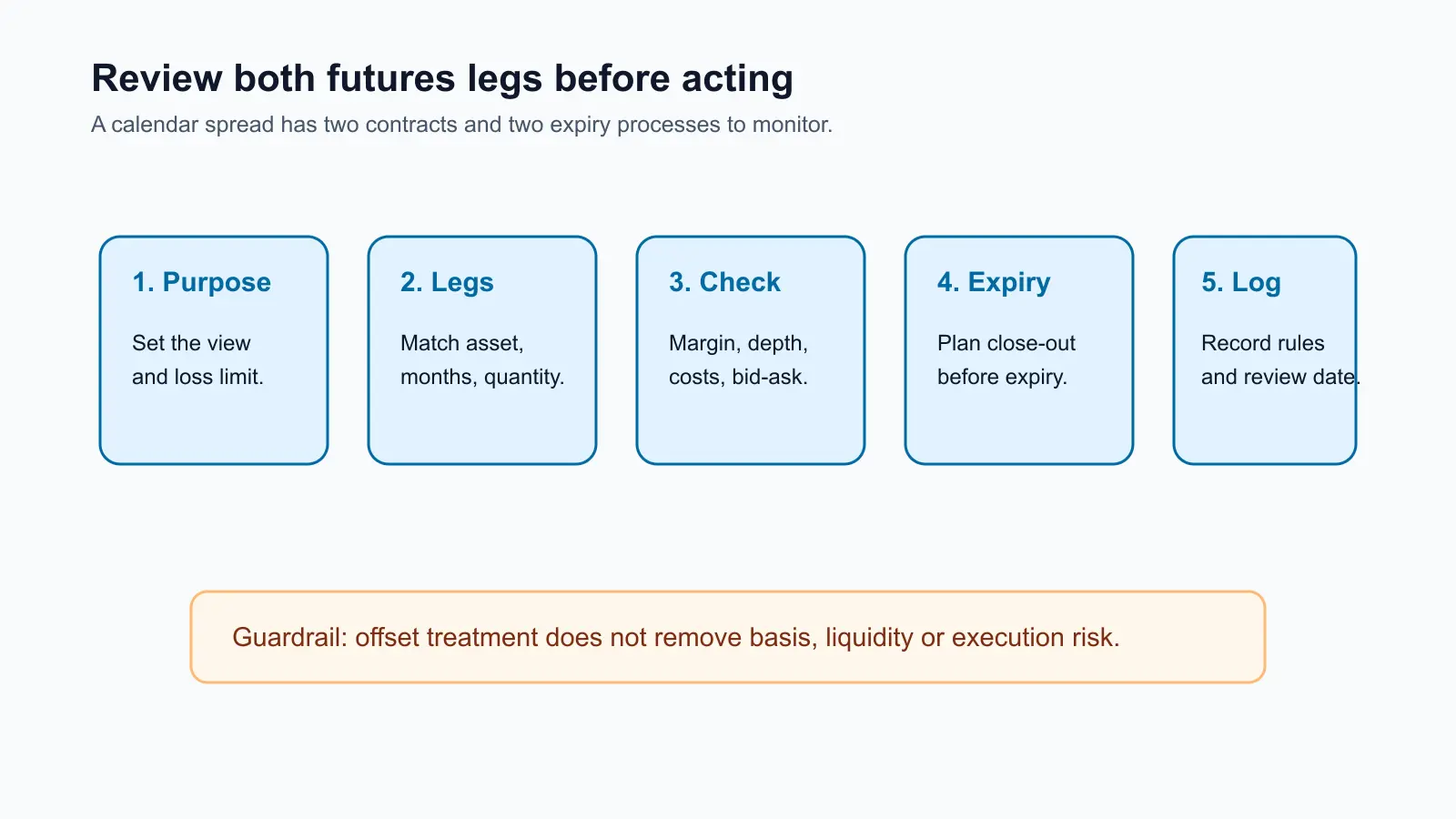
- State the purpose, time horizon and maximum loss that can be absorbed before placing an order.
- Confirm underlying, contract months, quantity and long/short direction for each leg.
- Check current margin, bid-ask spreads, market depth, brokerage and statutory charges for both contracts.
- Plan the close-out or roll before the near expiry; do not assume an offset remains available at expiry.
- Record the thesis, assumptions, costs, risk trigger and review date.
Common mistakes
- Calling a calendar spread “hedged” without defining exactly what is hedged.
- Looking only at the underlying price instead of the relationship between expiry months.
- Ignoring different liquidity and bid-ask conditions in the two contracts.
- Treating lower initial margin as a maximum-loss estimate.
- Waiting until the near expiry to decide how to manage the remaining leg.
Investor checklist
- Do I understand the two individual contracts as well as the spread?
- Can I explain what would cause the spread to widen or narrow?
- Have I checked exchange parameters and broker margin for the current session?
- Can I exit both legs under reasonable and stressed liquidity conditions?
- Are costs, taxes, slippage and mark-to-market requirements included in my risk plan?
For related education, see Futures and Options Explained for Beginners, Margin Calls Explained, and Basis Risk: Why a Hedge May Not Offset the Cash Position Perfectly.
Source Links
- SEBI Investor: Understanding Derivatives
- SEBI: Derivatives risk disclosure document
- NSE Clearing: SPAN and calendar-spread treatment
- NISM: Commodity-derivatives learning objectives
Reviewed by Abhipra Research / Compliance Team.
Disclaimer
This article is for educational and informational purposes only. It should not be considered investment advice, trading advice, tax advice or insurance advice. Investments in securities market are subject to market risks. Please read all related documents carefully before investing. Past performance is not indicative of future returns. Please consult a qualified financial advisor, tax advisor or insurance advisor before making any financial decision.