From Private Company to SME IPO: Where Dematerialisation Fits in the Roadmap
Reviewed on: 7 October 2026. Reviewed by Abhipra RTA Team.
Dematerialisation is a core workstream in an SME IPO preparation, but it is not a single rule or a substitute for IPO eligibility. The issuer must separately assess its company-law position, clean its capital records and meet the depository and promoter-holding conditions that apply to the public issue.

Keep Rule 9A and SME IPO rules distinct
Rule 9A of the Companies (Prospectus and Allotment of Securities) Rules, 2014 applies to an unlisted public company. It requires such a company to issue securities only in dematerialised form and facilitate dematerialisation of existing securities. Before an offer, buyback, bonus issue or rights offer, the promoters, directors and key managerial personnel must hold their entire securities in demat form.
An SME IPO has a separate public-issue framework. For an SME issue, SEBI ICDR Regulation 230 requires the issuer to enter into an agreement with a depository for dematerialisation of specified securities already issued and proposed to be issued; it also requires promoter specified securities to be in demat form. The issuer’s legal form and the exact facts decide whether Rule 9A also applies. Neither assessment should be assumed from the other.
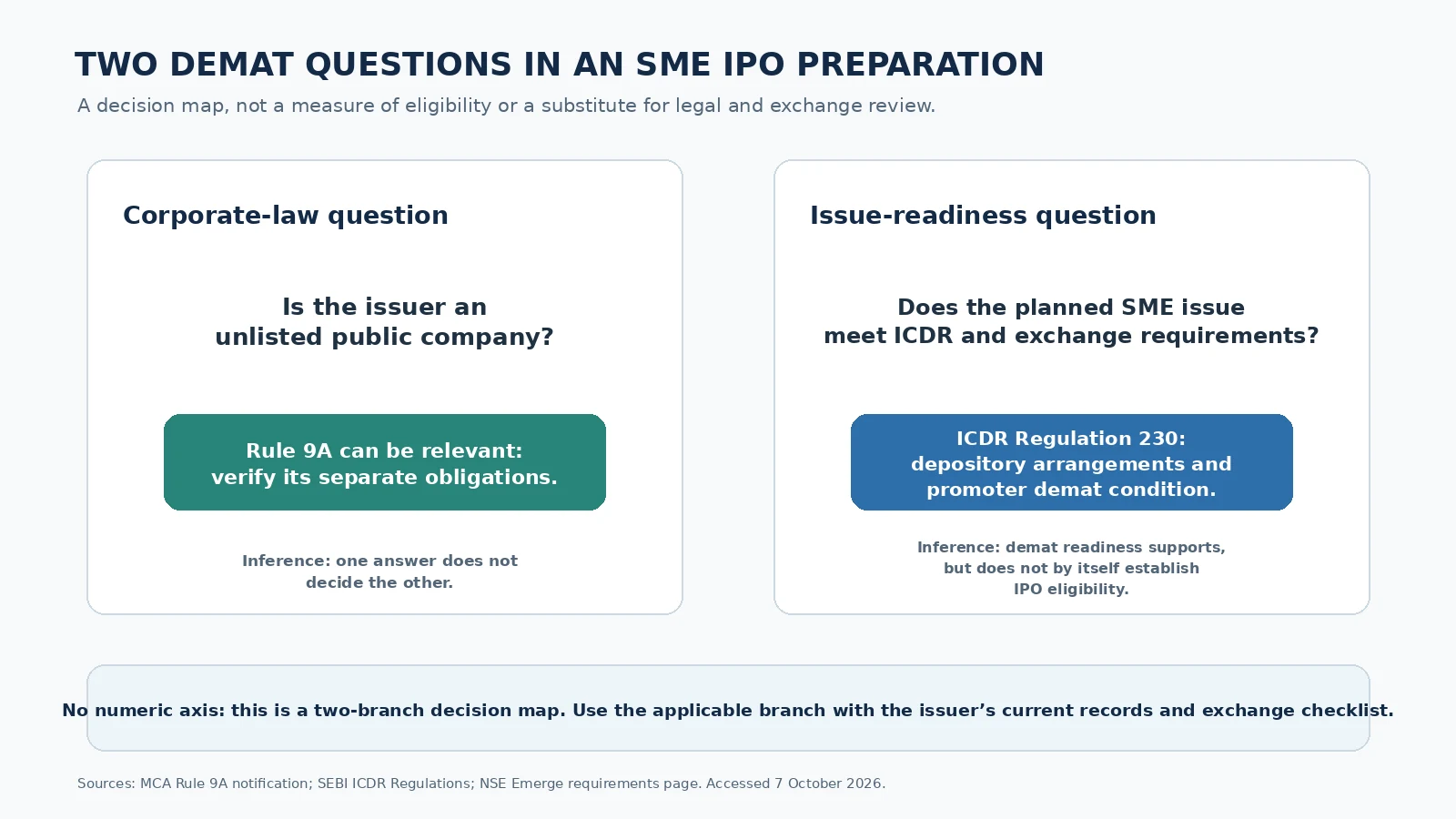
This is a two-branch decision map, so it has no numeric axis. Its inference is limited: Rule 9A and SME IPO demat readiness are related controls with different triggers. Demat readiness supports the listing process; it does not itself prove eligibility, exchange acceptance or regulatory approval.
Records that need to agree before filing
The cap table, register of members, prior allotments, transfers, corporate actions, ISIN details and depository/RTA data should reconcile before the draft offer document is finalised. Differences become harder to resolve once the filing, bidding and allotment schedules are active.
NSE’s current Emerge process page says the issuer files the draft prospectus with the IPO-vetting checklist and that the prospectus must follow the applicable ICDR regulations and other governing law. It also states that an issuer with post-issue face-value capital up to ₹25 crore is eligible to seek listing on the SME platform, subject to the framework and its other criteria. Those are listing-process points, not a complete eligibility conclusion.
Demat controls through the SME IPO roadmap
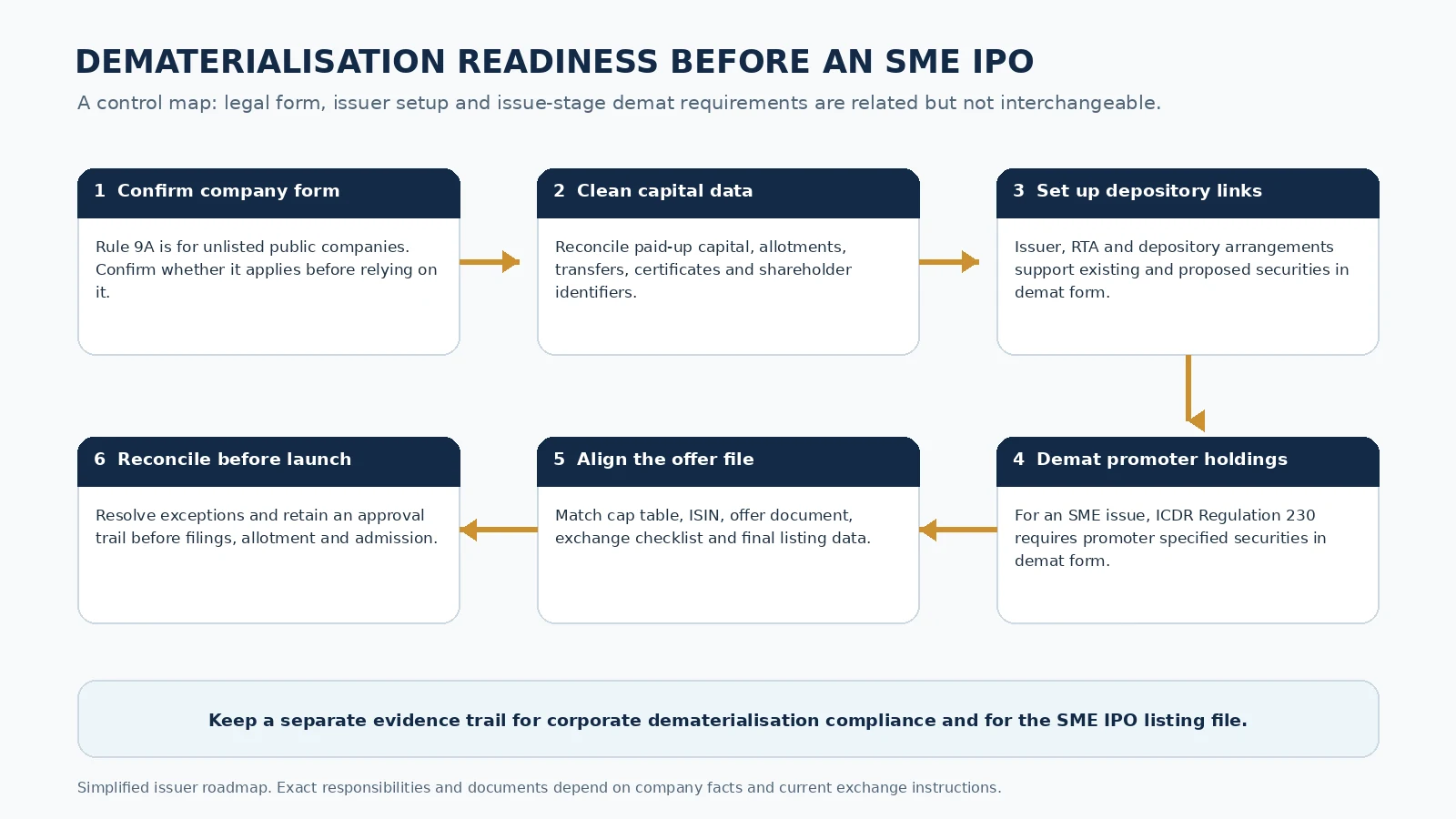
The workflow starts with the company-form analysis and ends with reconciliation before launch. Each card has an independent control: capital-record cleanup, depository/RTA setup, promoter demat verification, offer-document alignment and evidence retention. The end note is a reminder to preserve separate records for corporate dematerialisation obligations and the issue file.
Common avoidable delays
- treating a private-company conversion as proof that all historical capital records are ready for an IPO;
- leaving old allotments, transfers or certificate records unresolved until the offer-document stage;
- assuming promoter holdings are demat-compliant without validating the current depository position; and
- allowing the cap table, ISIN data, offer document and exchange checklist to use different versions of the same information.
How Abhipra can assist
Preparing for an SME IPO or main-board IPO and need a Registrar-to-an-Issue/RTA workstream?
Contact Abhipra RTA Services at rtaservices@abhipra.com, call 011-42390783, or contact +91-9818080700.
Share the company name, current company type, proposed listing platform, latest audited financial year, capital structure, shareholder count, existing ISINs and target issue timeline for an initial operational discussion. Eligibility, merchant-banker advice and regulatory approvals remain subject to the applicable framework.
Official source links
- MCA Rule 9A notification dated 10 September 2018.
- SEBI ICDR Regulations, 2018, last amended 21 March 2026 — see Regulation 230.
- NSE Emerge requirements and process, updated 29 April 2026.
- NSE Emerge eligibility criteria.
Disclaimer
This article is for general educational information and does not constitute legal, tax, investment or transaction advice. Applicability depends on the company's and investor's facts and on the law, circulars and depository instructions in force on the relevant date.