Covered Call: Income Strategy Or Risk Trap?

A covered call can look attractive because it converts an existing shareholding into a source of option premium. The basic structure is simple: an investor owns a stock or portfolio position and sells a call option on the same underlying. If the stock stays flat or rises only moderately, the premium can improve the overall outcome. If the stock rises sharply, the upside is capped because the short call creates an obligation under the option contract.
That trade-off is why a covered call should not be treated as a low-risk income product. It is an options strategy with market risk, settlement obligations, margins, taxes, liquidity impact and behavioural risk.
What A Covered Call Really Does
SEBI explains that derivatives derive value from an underlying asset, and that an option gives the buyer a right while creating an obligation for the seller. In a call option, the buyer has the right to buy the underlying at the agreed terms. The covered call seller receives premium, but accepts the risk that gains above the chosen strike may effectively be given up.
For a long-term investor, that means the strategy can be useful only when three conditions are clear:
- The investor is willing to continue holding the underlying if it does not move much.
- The investor is willing to part with upside above the call strike.
- The investor has enough liquidity and risk capacity to meet exchange, broker and settlement requirements.
The Payoff Trade-Off
The example below is only for education. It assumes one stock position bought at Rs 100, a call strike of Rs 110 and call premium received of Rs 4. It ignores brokerage, taxes, slippage, margin funding and other charges.
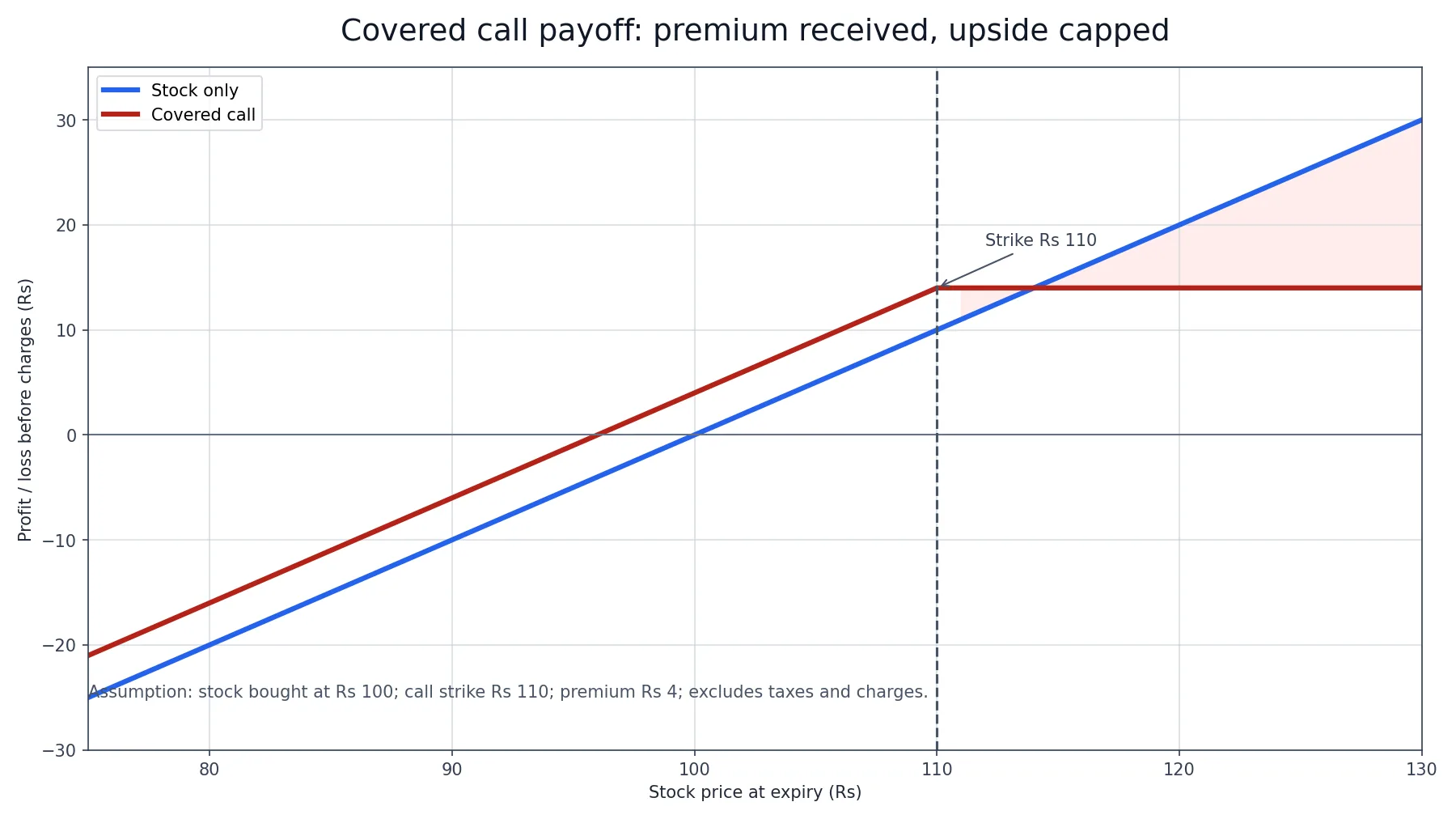
| Stock price at expiry | Stock-only P/L | Covered call P/L | What changed? |
|---|---|---|---|
| Rs 80 | -Rs 20 | -Rs 16 | Premium cushions loss, but downside remains large. |
| Rs 100 | Rs 0 | +Rs 4 | Premium improves a flat outcome. |
| Rs 110 | +Rs 10 | +Rs 14 | Premium adds to gains up to the strike. |
| Rs 125 | +Rs 25 | +Rs 14 | Upside is capped after the strike and premium. |
The most important point is this: a covered call reduces some downside by the amount of premium received, but it does not insure the portfolio against a major fall. It also limits the benefit of a strong rally.
Why The Risk Trap Happens
Covered calls become risky when investors focus only on recurring premium. SEBI's updated study in September 2024 found that 93% of individual traders incurred losses in equity F&O between FY22 and FY24. SEBI's July 2025 update reported that individual traders made a net loss of Rs 1,05,603 crore in equity derivatives in FY25, and that over 91% of individual traders incurred net losses.
Those numbers do not mean every options strategy is unsuitable. They do mean that option premium should never be marketed or consumed as predictable income. A small premium can encourage repeated trades, larger lot exposure and poor exit discipline.

Practical Checks Before Using It
Before writing a covered call, an investor should review:
- Suitability: The strategy should match the investor's time horizon, risk appetite and willingness to sell the stock if the trade moves above the strike.
- Underlying quality: A covered call on a weak stock is still exposure to a weak stock. Premium does not repair poor portfolio selection.
- Strike selection: A lower strike may give higher premium but caps upside earlier. A higher strike may give more room but lower premium.
- Expiry and liquidity: Illiquid options can increase bid-ask costs and make adjustments expensive.
- Lot size mismatch: Exchange-traded derivative contracts are standardised. A portfolio may not match exact contract quantities.
- Margin and collateral: Selling options can create margin requirements and mark-to-market pressure.
- Tax and charges: Brokerage, STT, GST, exchange charges, stamp duty and tax treatment can materially change net results.
- Exit plan: The investor should know whether they will hold, roll, close or allow settlement before entering the trade.
When It May Be Reasonable
A covered call may be reasonable for an experienced investor who already owns the underlying, understands the contract, is comfortable with capped upside, and wants to earn premium in a range-bound view. It is less suitable for investors who cannot monitor positions, do not understand margin calls, or are trying to recover losses through option writing.
The decision should begin with the stock thesis, not the option premium. If the investor would be uncomfortable selling the stock at the strike, the call may not be truly covered from a planning perspective.
Bottom Line
A covered call is not free income. It is a defined trade-off: premium today in exchange for capped upside and continuing downside exposure. Used carefully, it can be a portfolio overlay. Used casually, it can become a premium-chasing risk trap.
Source Links
- SEBI Investor: Understanding Derivatives
- SEBI press release, 7 July 2025: Comparative study of growth in equity derivatives segment
- SEBI press release, 23 September 2024: Updated study on individual traders in equity F&O
- NSE: About Equity Derivatives
- NSE: Equity Derivatives Contract Information
- NSE Clearing: Equity Derivatives Risk Management
Disclaimer
This article is for investor education only and is not investment advice, trading advice, research recommendation, solicitation or an offer to buy or sell securities or derivatives. Equity derivatives are high-risk products and may not be suitable for all investors. Please consult a SEBI-registered investment adviser or other qualified professional before taking investment or trading decisions. Reviewed by Abhipra Research / Compliance Team.