
Basis Risk: Why a Hedge May Not Offset the Cash Position Perfectly
A hedge is designed to reduce a defined price risk; it is not a promise that every movement in a cash position will be cancelled. The remaining gap is commonly called basis risk. It appears when the cash exposure and the contract used to hedge it do not move by the same amount, at the same time, or in the same direction.

Start with the two exposures, not the contract label
Consider a business holding a cash-market exposure while using a futures contract to reduce part of its price risk. A useful hedge review begins by writing down two separate items:
- What exactly is exposed in the cash position: asset, quantity, quality, location, currency, date and expected holding period.
- What exactly the derivative contract references: underlying, contract size, expiry, settlement method and liquidity.
If those descriptions are not close enough, the hedge can be imperfect even if both prices usually appear to move together. SEBI materials describe basis risk as the risk that price movements in the derivative used for hedging do not match the underlying exposure being hedged. That mismatch can leave a residual loss and may even add risk.
Four ways a hedge can leave a gap
Underlying mismatch. A specific share, bond, commodity grade or business exposure may have risks that a broad index or related contract does not capture.
Timing mismatch. The expected cash transaction date may not match the futures expiry. A hedge that must be rolled adds another price and execution point.
Size mismatch. Cash exposure and exchange contract quantities may not divide neatly. Rounding the number of lots can leave part of the exposure unhedged or create an unintended extra exposure.
Market and execution mismatch. Liquidity, bid-ask spreads, changes in volatility, funding conditions and contract availability can affect the price at which a hedge is entered, adjusted or exited. A screen price is not necessarily the execution price.
An illustrative chart: offset is not the same as cancellation
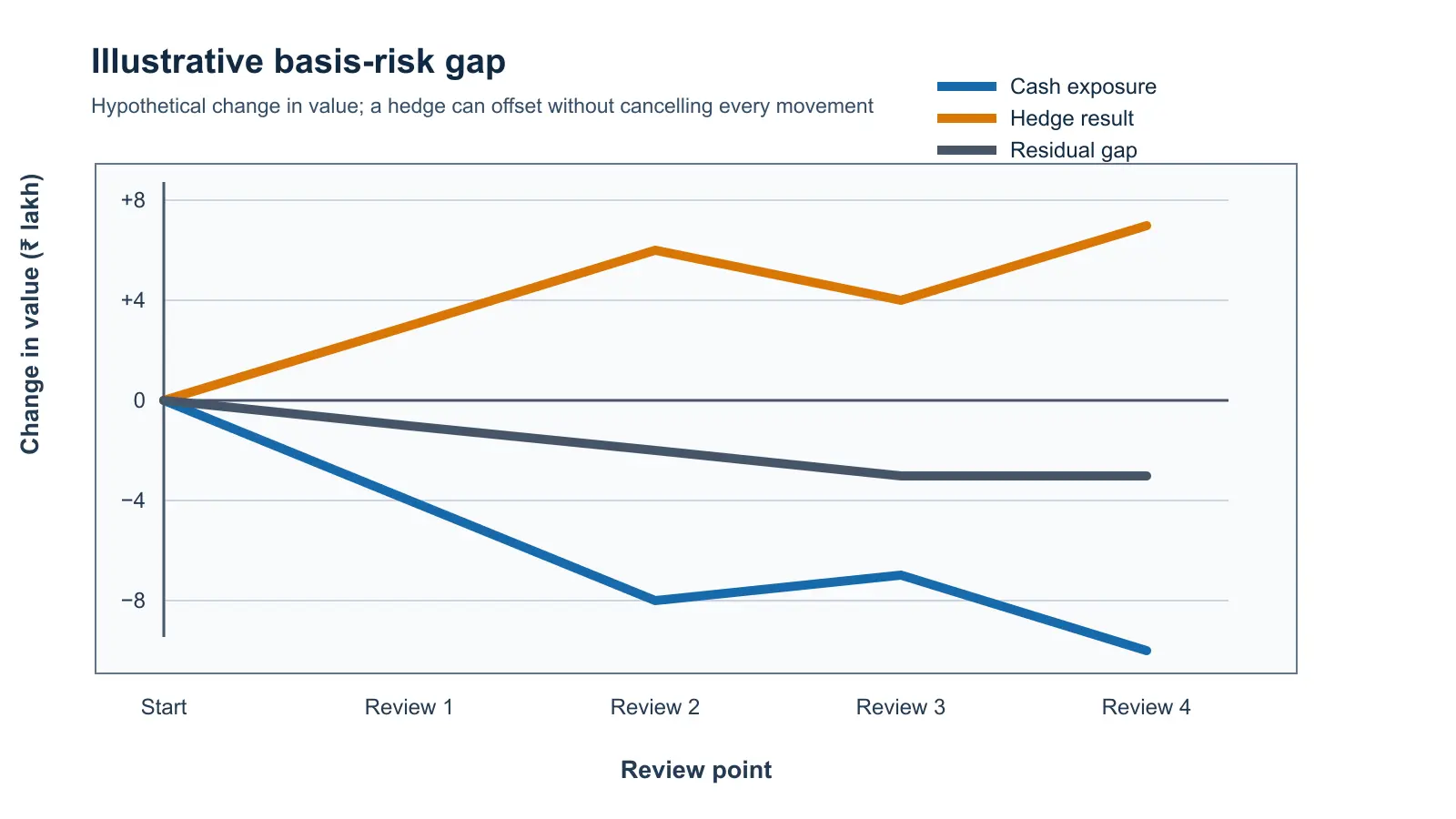
The chart uses hypothetical values only; it is not market data or a trade example. The horizontal axis is the review point, and the vertical axis is change in value in ₹ lakh from the starting point. The cash exposure falls while the hedge result rises, but the two lines differ in size at each point. The grey line is the remaining combined gap. The inference is simple: opposite direction is helpful, but it is not proof of a full offset.
| Review point | Cash exposure change (₹ lakh) | Hedge result (₹ lakh) | Combined gap (₹ lakh) |
|---|---|---|---|
| Start | 0 | 0 | 0 |
| 1 | -4 | +3 | -1 |
| 2 | -8 | +6 | -2 |
| 3 | -7 | +4 | -3 |
| 4 | -10 | +7 | -3 |
A review workflow before any hedge is changed
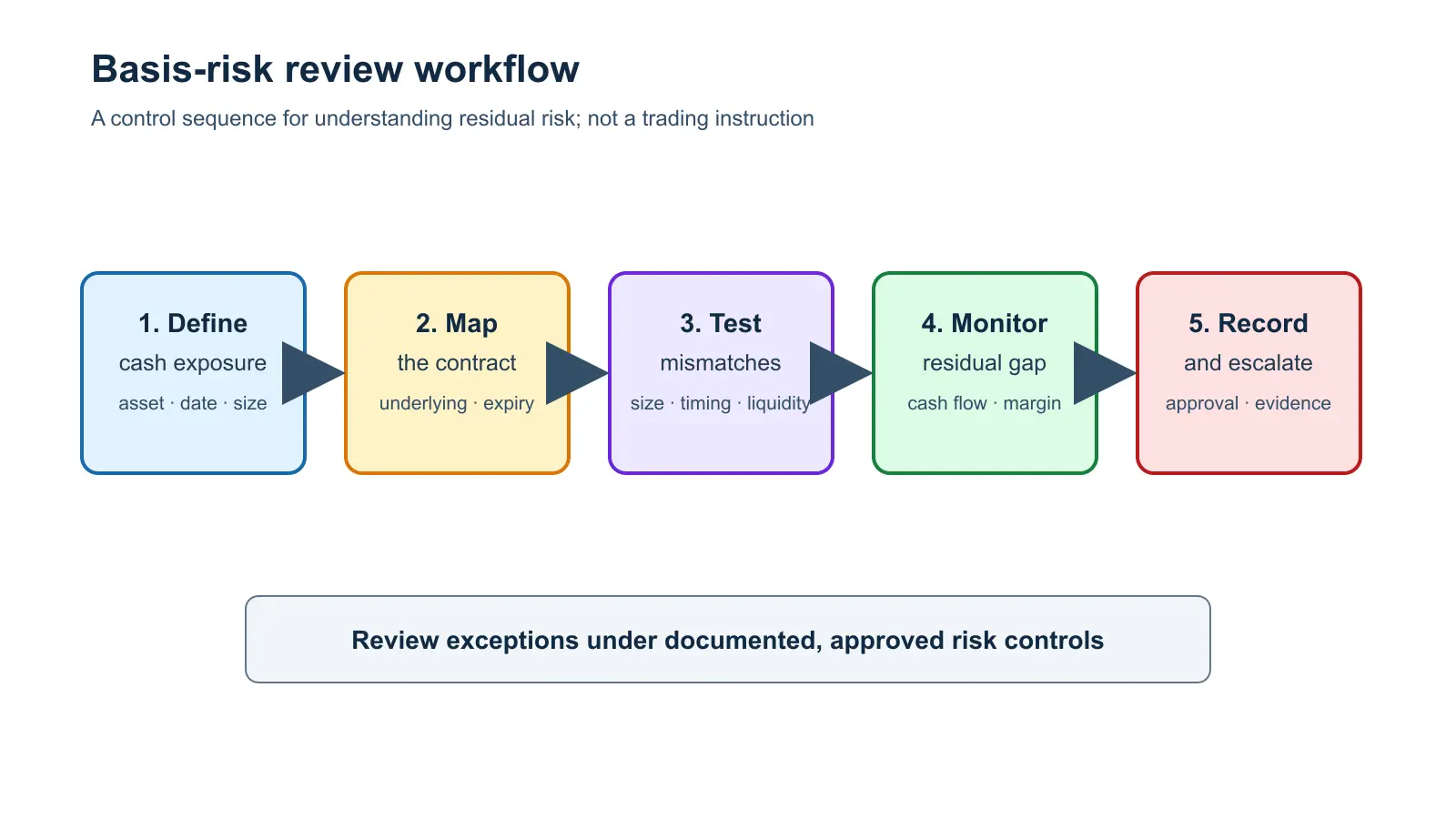
The workflow is a control sequence, not a trading instruction. First define the cash exposure. Next map the proposed contract against it. Then test maturity, quantity, underlying and liquidity mismatches. During the life of the hedge, monitor the residual gap and margin or cash-flow effects. Finally, document the rationale, assumptions and any decision to adjust or close the position under the organisation’s approved controls.
Questions to ask before calling a position “hedged”
- What price risk is being reduced, and what risks remain outside the hedge?
- Does the contract’s underlying closely represent the cash exposure?
- Do quantity, settlement basis and expiry fit the cash-exposure timeline?
- How will residual basis risk, liquidity and margin requirements be monitored?
- Who can approve changes, and where will the hedge rationale and exceptions be recorded?
For many retail investors, the most appropriate response to a complex hedge is not to replicate it. SEBI’s investor guidance advises people new to markets to start with simpler options before exploring derivatives. Derivatives can be leveraged, and a hedge can introduce execution, liquidity, operational and documentation risks even when its purpose is risk reduction.
What the editorial visual shows

The visual reinforces the discipline behind basis-risk management: compare the real exposure and the contract separately, calculate the remaining gap, and record the decision. A hedge should be reviewed as an ongoing control, not treated as an automatic guarantee.
Source Links
- SEBI: Understanding derivatives
- SEBI: Factors to consider before investing
- SEBI: Key risks in investing
- SEBI reference describing basis risk and imperfect hedging
- NSE Academy derivatives curriculum including hedging, basis risk and rolling hedges
Reviewed by Abhipra Research / Compliance Team.
Disclaimer
This article is for educational and informational purposes only. It is not investment advice, trading advice, tax advice, legal advice, a research recommendation or a solicitation to buy or sell any security or derivative. Derivatives can be complex and may involve leverage, margin and substantial losses. Investments in securities market are subject to market risks. Please read all related documents carefully and consult a qualified adviser before making a financial decision.