
AIF Service Providers in India: Sponsor, Manager, Trustee, Custodian, RTA, Valuer and Auditor Roles
Reviewed on: 5 November 2026. Reviewed by Abhipra RTA Desk.
An Alternative Investment Fund (AIF) is not operated by one person or one service provider. The manager is central to investment and operating decisions, but the sponsor, trustee or other governing body, custodian, RTA, valuer and auditor each have different responsibilities. Their exact allocation must be stated in the constitutional documents, placement memorandum and contracts.

Start with the governing documents
The SEBI AIF Regulations define the manager as the person or entity appointed to manage the investments of the AIF. The sponsor establishes the AIF; the two roles can be performed by the same entity where the structure permits. The trust deed, LLP agreement, memorandum/articles or other constitutional record, the placement memorandum and the service agreements should make the allocation visible instead of assuming that every provider has the same mandate.
For a trust-form AIF, the trustee or trustee company has a governance and oversight role under the applicable structure and fund documents. In a company or LLP form, the comparable governance arrangements need to be read from the structure and documents. This is a role map, not a substitute for transaction-specific legal advice.
A practical responsibility map
| Role | Core contribution | Boundary to keep clear |
|---|---|---|
| Sponsor | Establishes the AIF and supports the structure described in the regulations and documents. | Does not displace the manager's day-to-day investment responsibility. |
| Manager | Manages investments and owns the operating decisions and regulatory responsibilities assigned to it. | May appoint providers, but appointment does not erase its accountability. |
| Trustee / governing body | Provides oversight appropriate to the legal form and fund documents. | Not every AIF has the same trustee arrangement. |
| Custodian | Provides custody where required or appointed under the current framework and agreements. | Custody is not the same as unit-holder recordkeeping. |
| RTA | May support unit-holder records, transaction processing, statements, communications and depository-facing workflows within its mandate. | Does not make investment decisions, value assets or give legal/tax advice. |
| Valuer | Performs valuation work under the applicable valuation policy and appointment. | Independence, eligibility and frequency must follow the current framework. |
| Auditor | Audits the AIF's books of account annually as required. | An audit is not a guarantee of investment performance or regulatory approval. |
How the roles meet across the operating cycle
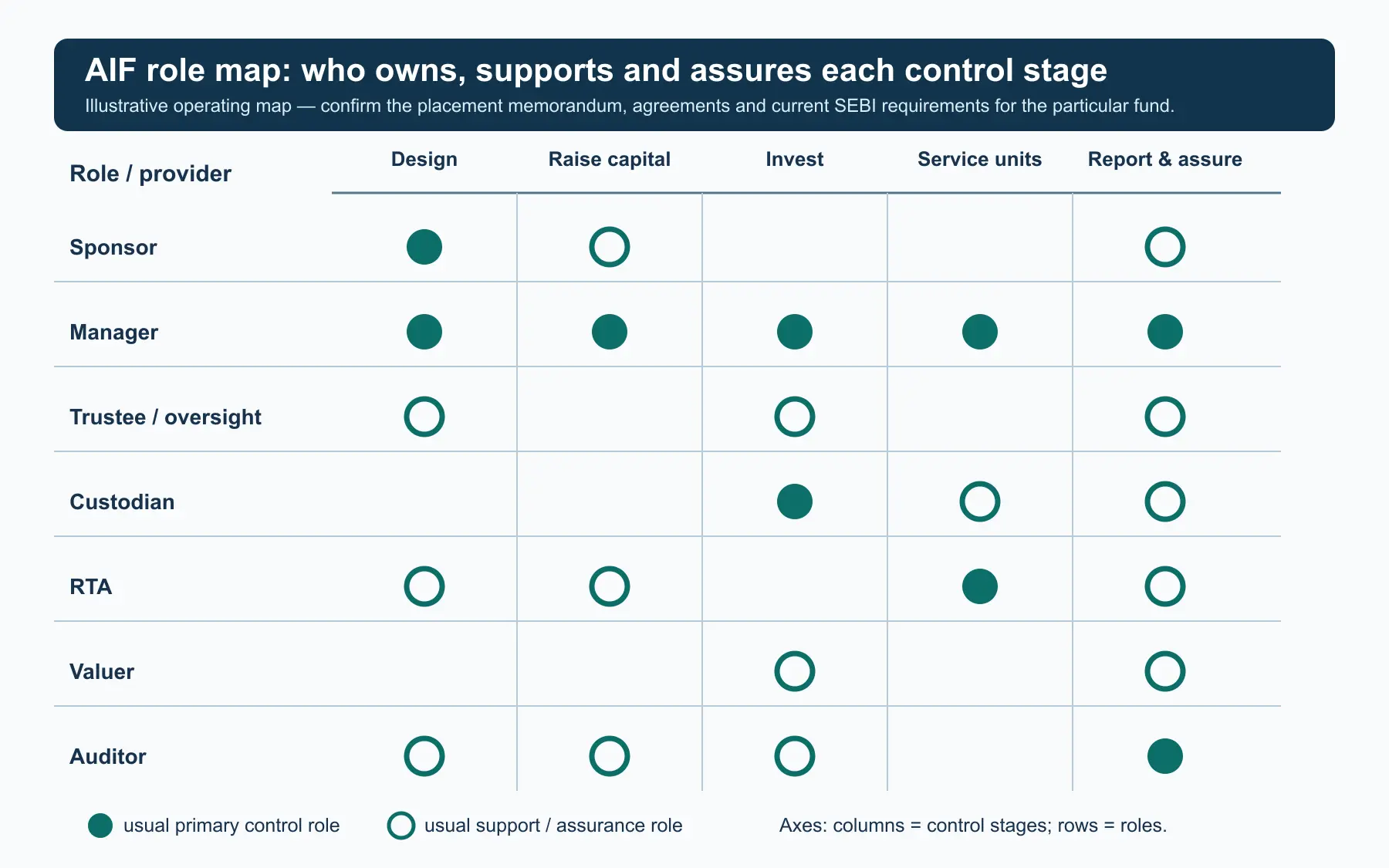
The horizontal axis is the operating stage: design, raising capital, investing, servicing units, and reporting/assurance. The vertical axis lists the service-provider roles. A filled circle marks a usual primary control role; an outlined circle marks usual support or assurance. The chart is illustrative rather than a regulatory allocation: its inference is that the manager remains the coordinating accountability point, while the RTA, custodian, valuer and auditor contribute at distinct control points. The placement memorandum and agreements determine the actual hand-offs.
Custody, valuation and reporting controls
SEBI's consolidated AIF framework includes conditions on appointing a custodian and on the manager's obligations. It also contains valuation, disclosure and reporting requirements that vary by AIF category and facts. For example, the current Master Circular records at least half-yearly valuation disclosure for Category I and II AIF investments, with the stated investor-approval route to annual disclosure, while Category III NAV disclosures follow the stated closed-ended or open-ended cadence. Do not transplant these frequencies into a specific scheme without checking the current regulation, circular and fund documents.
The 6 February 2026 SEBI circular on reporting unit values to depositories is particularly relevant where an AIF's operational model includes depository-facing unit data. Its scope, effective workflow, data fields and responsibility split should be confirmed against the current circular, depository instructions and RTA engagement.
RTA hand-offs should be controlled, not assumed

Before an RTA begins work, agree a documented control matrix covering authorised instructions, maker-checker approvals, data ownership, reconciliation, exception escalation, record retention, investor communication approval and incident reporting. Restrict access to the minimum necessary data, retain an audit trail of privileged actions, and use secure channels for investor information. Do not email passwords, OTPs, unmasked PAN, bank details or signatures; wait for a secure submission route.
Questions to settle before go-live
- Who approves each unit issuance, transfer, redemption or correction?
- Which system is the source of truth for unit-holder and unit-value data?
- What is the reconciliation timetable between the manager, RTA, custodian and depository where applicable?
- Which role owns a valuation exception, an investor complaint and a data-security incident?
- Which fund document, policy or service-level agreement records each hand-off?
How Abhipra can assist
Evaluating RTA, dematerialised-unit, ISIN, depository or unit-holder servicing workflows for an AIF? Contact Abhipra RTA Services at rtaservices@abhipra.com, call 011-42390783, or contact +91-9818080700. Share only high-level, non-sensitive details until a secure submission route is confirmed.
Official sources
- SEBI AIF Regulations, 2012—consolidated through 15 October 2026
- SEBI Master Circular for Alternative Investment Funds, issued 3 June 2026 and updated 16 June 2026
- SEBI circular on reporting AIF unit values to depositories, 6 February 2026
Disclaimer
This is general regulatory education, not legal, tax, accounting, valuation, FEMA or investment advice. Role allocation, custody, valuation, reporting, records and investor arrangements depend on current law, the AIF category, fund documents and facts. Obtain professional advice before acting.