
Tax Benefits of Life and Health Insurance: Put Protection Before the Deduction
A tax deduction can be useful, but it is a poor reason to buy unsuitable insurance. First decide whose income, health costs and financial responsibilities need protection. Then check whether the premium and payment qualify under the tax rules for the relevant year.

Start with the risk, not the section number
Life insurance is primarily meant to address the financial impact of the insured person's death, subject to the policy terms. Health insurance is meant to help with eligible medical costs, again subject to the sum insured, exclusions, waiting periods, co-payments and other policy conditions. The IRDAI health-insurance guidance asks buyers to read these conditions, disclose pre-existing health information and check the Customer Information Sheet.
Tax treatment cannot turn an unsuitable policy into suitable protection. It also does not assure a claim payment or a return. Compare the protection need, policy wording, affordability and continuity before considering a deduction.
The familiar 80C and 80D labels: what the limits mean
For returns relating to the earlier law, the Income Tax Department lists eligible life-insurance premium within the combined ₹1.50 lakh deduction ceiling for sections 80C, 80CCC and 80CCD(1). It is a combined ceiling, not a separate ₹1.50 lakh limit for life insurance. See the Department's AY 2026–27 guidance for taxpayers with business or professional income.
The Department's AY 2026–27 salaried-individual guidance lists the familiar section 80D limits for health-insurance premium: ₹25,000 for self, spouse and dependent children, and ₹25,000 for parents. Each relevant block can be ₹50,000 where the conditions for a senior citizen are met. Preventive-health-check-up spending can be included up to ₹5,000 within, not over and above, the applicable 80D ceiling.
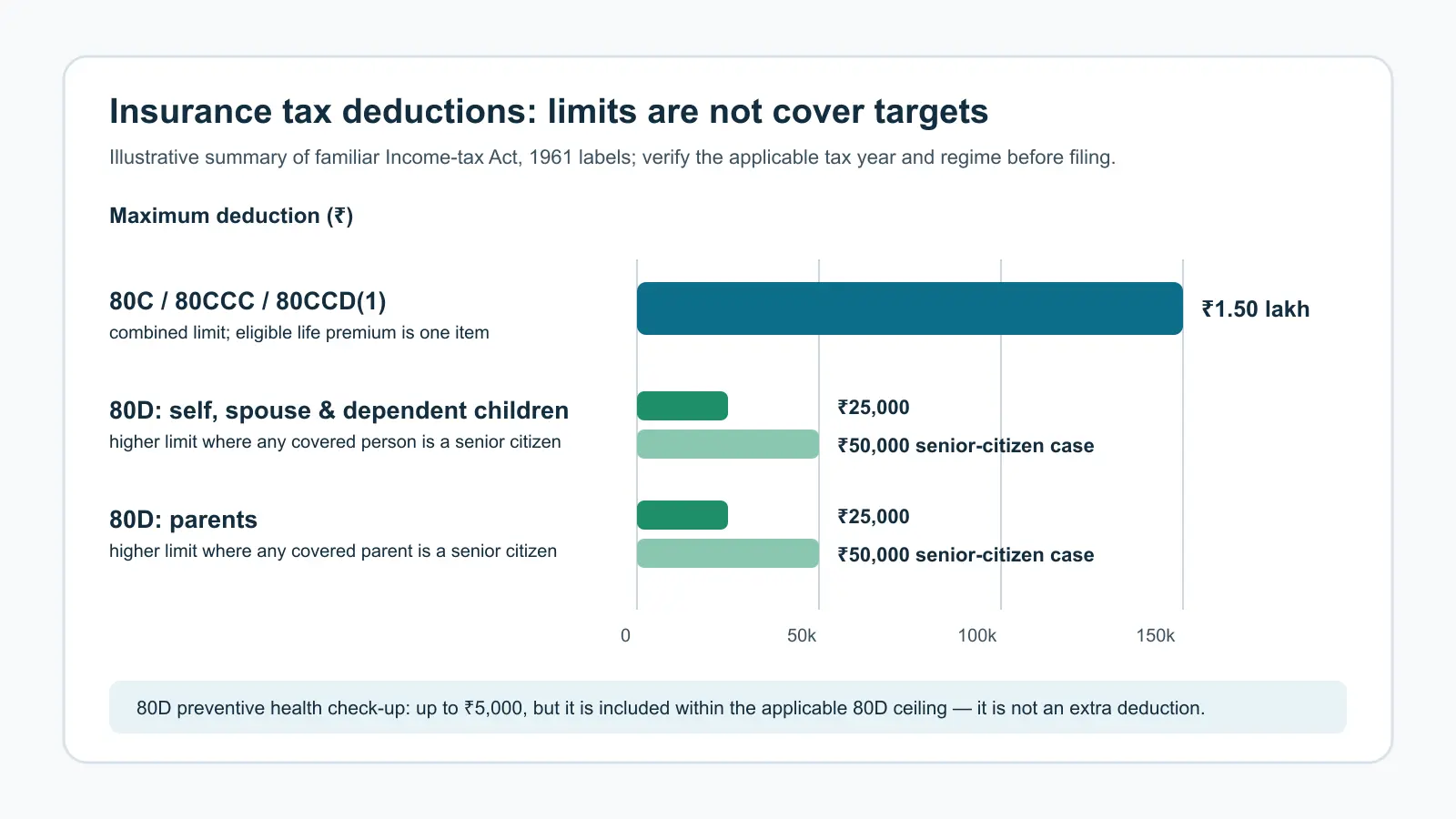
The chart’s horizontal axis is the maximum deduction in rupees. It compares statutory caps, not premiums, policy quality, cover adequacy or tax saved. Its key inference is simple: a limit is a filing boundary, not a recommended amount of insurance.
| Familiar provision | What the official guidance describes | Limit shown in AY 2026–27 guidance |
|---|---|---|
| 80C / 80CCC / 80CCD(1) | Combined ceiling that includes eligible life-insurance premium among several qualifying payments | ₹1,50,000 combined |
| 80D: self, spouse, dependent children | Health-insurance premium; a qualifying senior-citizen case has a higher ceiling | ₹25,000 / ₹50,000 |
| 80D: parents | A separate parent block; a qualifying senior-citizen case has a higher ceiling | ₹25,000 / ₹50,000 |
| 80D preventive check-up | Included within the relevant 80D ceiling | Up to ₹5,000 within the ceiling |
Tax-year and regime checks are essential in 2026
The law and labels change by tax year. The Income Tax Department says the Income-tax Act, 2025 applies from 1 April 2026, while the 1961 Act continues for tax years before that date; it also says the new regime remains the default under the 2025 Act. Its transition FAQ should be read with the return instructions for the year being filed.
For example, the Department's older new-versus-old regime FAQ states that Chapter VIA deductions such as 80C and 80D generally cannot be claimed in the new regime, subject to listed exceptions. Do not rely on a previous year's Form 16, payroll declaration or blog post. Use the Income Tax Department calculator, the applicable return instructions and, where necessary, a qualified tax professional.
A five-step review before paying or filing
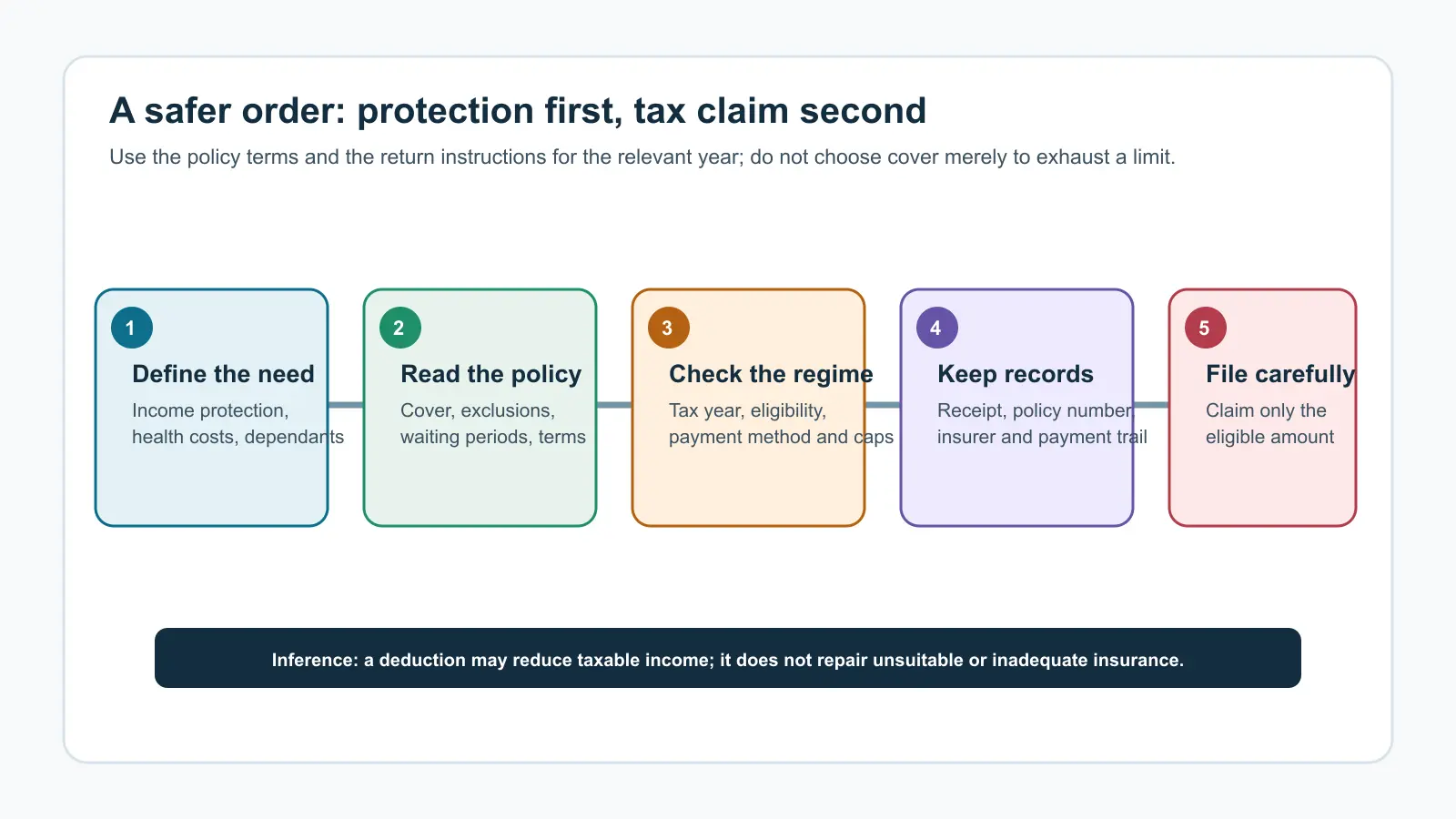
- Define the protection gap. List dependants, liabilities, income that would need replacement, expected health-cost exposure and existing cover.
- Read the policy documents. Check eligibility, exclusions, waiting periods, room-rent or treatment limits, co-payments, renewal terms and claim process. IRDAI says buyers should read terms and conditions and understand restrictions before purchase.
- Check the applicable tax year and regime. Confirm which Act, return form and regime apply before treating a premium as deductible.
- Retain the evidence. Keep the premium receipt, policy number, insurer details and payment record. The AY 2026–27 ITR guidance requires insurer, policy-number and health-insurance details for an 80D claim.
- Claim only what is eligible. Use the relevant return instructions; do not count preventive check-ups outside the 80D ceiling or claim the same payment twice.
The workflow is ordered left to right. It has no numeric axis: it is a decision sequence. The inference is that tax review comes after the protection and policy review, not before it.
Common mistakes to avoid
- Buying a policy only to use an unspent deduction limit.
- Assuming every premium, rider or family member is eligible without checking the applicable rule.
- Treating the ₹1.50 lakh 80C/80CCC/80CCD(1) ceiling as life-insurance-only capacity.
- Adding the ₹5,000 preventive-health-check-up figure on top of the applicable 80D limit.
- Ignoring declarations, exclusions, waiting periods, sub-limits or co-payments because a tax benefit is available.
- Saving only a payment confirmation and not the policy wording, receipt and policy number.
Before you decide: a compact checklist
- Does the policy solve a defined protection need at a premium you can sustain?
- Have you read the Customer Information Sheet and policy wording, including exclusions and renewal conditions?
- Which tax year and regime apply to you?
- Is the payment method and covered person eligible under the applicable rule?
- Do your records reconcile to the amount you intend to claim?
Source links
- Income Tax Department: AY 2026–27 guidance for salaried individuals
- Income Tax Department: AY 2026–27 guidance for individuals with business or professional income
- Income Tax Department: transition to the Income-tax Act, 2025
- Income Tax Department: new-versus-old-regime FAQ
- IRDAI: health-insurance buyer guidance
Disclaimer
This article is for investor education only and is not tax, insurance or investment advice. Insurance benefits, eligibility, limits, tax treatment and return-form requirements can change and depend on individual facts. Read the policy documents and current official instructions; consult a qualified professional before making a decision. Investments are subject to market risks.
Reviewed by Abhipra Research / Compliance Team.