
Annual Insurance Audit for Companies: A Practical Year-End Review Checklist
An annual insurance review is not a renewal-price exercise alone. For a company, it is a chance to compare today’s people, premises, assets, contracts and operations with the documents that would matter after a loss. The aim is to identify questions early—not to assume that every risk is insured.

Start with the business that exists today
Begin by fixing the review scope: each legal entity, location, warehouse, plant, office, vehicle fleet, critical equipment, key contract and relevant employee group. Then compare it with the prior year’s schedule and policy wording. A new site, larger inventory, outsourced process, changed customer contract, acquired asset or additional responsibility may change the questions that need answers.
IRDAI’s policyholder-protection material emphasises the importance of policy information and servicing; the insurer’s schedule and the complete wording remain the controlling documents. Keep the signed proposal, endorsements, current schedule, wording, premium record, asset evidence and claims correspondence in a controlled repository. Do not place passwords or unrestricted policy documents in a broadly shared folder.
Put the policy count in perspective—not the cover decision
The Department of Economic Affairs reports that insurers issued 270.22 lakh individual life policies and 3,913.53 lakh general, health and specialised policies in 2024–25, citing IRDAI data. That scale is useful context for why clear records and a repeatable review matter. It does not say whether any company has adequate cover, whether a claim will be paid, or which policy is suitable.
| Category | Policies issued (lakh) |
|---|---|
| Individual life | 270.22 |
| General, health and specialised insurance | 3,913.53 |
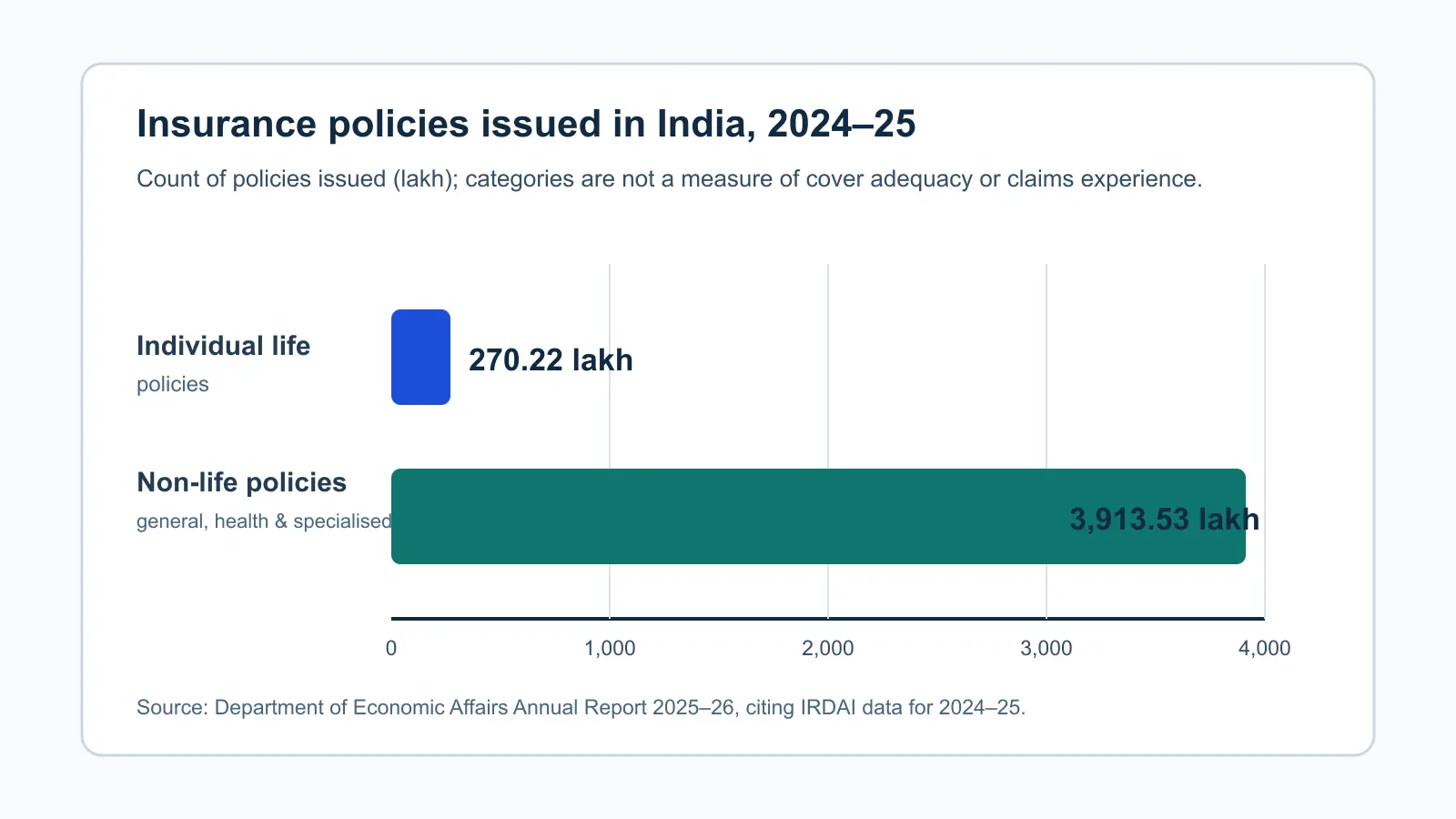
The chart’s horizontal axis is the number of policies issued, measured in lakh; each bar is one broad industry category. The general, health and specialised category is much larger in policy count, but the comparison is not a quality, risk, premium, claims or coverage score. For a company’s review, the useful inference is procedural: do not replace its own asset, contract and scenario analysis with an industry aggregate.
Verify the facts behind the schedule
Ask the finance, operations, HR, IT, facilities, legal and procurement owners to validate what has changed. The list below is a review prompt, not a standard policy checklist.
- People and responsibilities: Have key roles, headcount, travel patterns, employee benefits or contractually assumed responsibilities changed?
- Assets and locations: Are buildings, machinery, stock, vehicles, leased assets and values still described accurately? Are new sites or storage locations reflected?
- Operations and dependencies: Could a supplier disruption, utility failure, technology incident, fire, theft, transit event or loss of access interrupt a critical process? What records substantiate the exposure?
- Contracts and compliance: Do customer, landlord, lender, vendor or tender terms create insurance, indemnity, notice or evidence obligations? Legal review may be appropriate for the contract itself.
- Claims readiness: Are incident contacts, document-retention arrangements, photographs, invoices, maintenance records, payroll and accounting evidence available to authorised people?

Read the wording before treating a risk as covered
Use the actual schedule and wording to test each scenario. Record the insured entity and interest, triggering event, sums insured or limits, sub-limits, deductibles, waiting period, exclusions, conditions, territories, notification route and documentary duties. A policy label is not enough: similar labels can have materially different triggers and exclusions.
For example, property damage, business interruption, cyber, liability, employee benefits and marine/transit risks can be connected to different events, definitions and evidentiary requirements. A decision that a particular risk is covered should be confirmed against the current policy documents by the insurer or an appropriately licensed adviser. The annual audit should record the question and owner, rather than make an unsupported coverage conclusion.
Run a five-step annual review
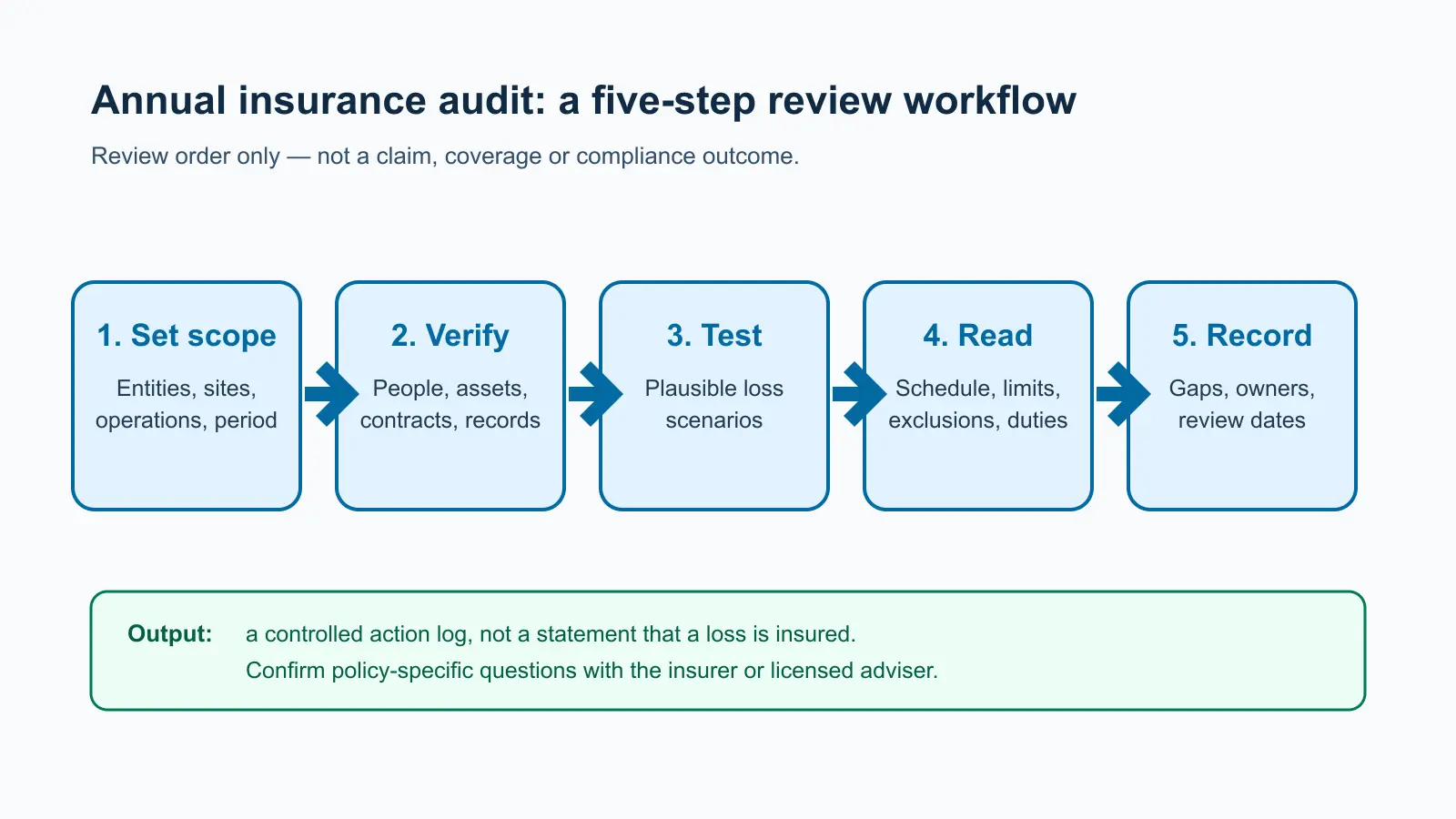
Read the workflow from left to right. First define the entities, sites, operations and review period. Next validate the underlying facts, test plausible scenarios, and compare them with the precise wording. Finally, maintain an action log with the issue, evidence needed, accountable owner, target date and review status. The workflow shows order only; it is not a claim decision, a coverage determination or a compliance certification.
A controlled annual-audit record
Maintain one restricted action log rather than scattered email threads. For each item, capture the policy/document reference, business change or scenario, question raised, evidence link, owner, insurer or adviser query, due date, decision and approver. Apply role-based access to personal, health, employee and claims information; retain an audit trail for edits and approvals.
If a complaint about insurer or intermediary service remains unresolved, IRDAI directs policyholders to the insurer’s Grievance Redressal Officer first and provides policyholder grievance information. Use the route applicable to the policyholder and issue; it does not substitute for immediate contractual claim-notification obligations.
Prepared by Abhipra Business Protection Desk for Abhipra Research / Compliance Team review.
Source Links
- Department of Economic Affairs Annual Report 2025–26 — reports 2024–25 individual-life and general/health/specialised policy counts, citing IRDAI data.
- IRDAI Handbook on Indian Insurance Statistics 2024–25 — official statistical handbook page, updated 3 February 2026.
- IRDAI Master Circular on Protection of Policyholders’ Interests, 2024 — regulator circular listing and policyholder-protection reference.
- IRDAI grievance cell information — outlines the insurer-first grievance route and states that a grievance is to be resolved within two weeks of receipt.
Disclaimer
This article is general educational information, not insurance, legal, tax, investment, risk-management or compliance advice. Insurance scope, claim eligibility and obligations depend on the insured entity, proposal, policy schedule, current wording, endorsements, exclusions, limits, evidence and applicable law. Review the documents with the insurer or an appropriately licensed and qualified adviser before acting.