
Key-Man Insurance and Business Loans: Keep the Credit File Separate From the Cover Decision
When a founder, technical lead or relationship manager is central to an MSME, their sudden absence can affect operations, customer confidence and cash flow. That is a continuity question. A business loan is a separate credit decision made by a lender under its own policy. Bringing the two discussions together carefully can improve documentation—but insurance is not a shortcut to loan approval, collateral or a guaranteed outcome.

Start with two distinct questions
First, ask what would happen to the business if a named person could not work for an extended period or died: who would run operations, approve payments, maintain customer relationships or operate critical equipment? Second, ask what the lender needs for the loan proposal: financial statements, bank records, cash-flow information, projections, security details and other documents it specifies.
Keep those files distinct. A lender may evaluate a proposal under its own underwriting and credit policy. The policyholder, insurer and lender should not assume that a life-insurance policy settles the credit decision, or that a sanctioned facility determines suitable insurance cover.
What official MSME-credit context does—and does not—say
RBI’s Annual Report 2024–25 records instructions for a uniform 14-day turnaround time for loan applications up to ₹25 lakh from MSE borrowers, along with a credit-proposal tracking system, written reasons for rejection and an indicative document checklist. This describes an application-service standard; it does not promise sanction. Read the RBI Annual Report discussion of MSE credit delivery.
The Ministry of MSME’s Annual Report 2025–26 states that CGTMSE’s guarantee-coverage ceiling is ₹10 crore per borrower from 1 April 2025 and describes guarantee coverage ranging from 75% to 90%, depending on loan quantum and beneficiary type. CGTMSE is a credit-guarantee framework for eligible MSE lending through member lending institutions—not a life-insurance policy. See the Ministry’s 2025–26 Annual Report.
| Official item | Current figure / standard | What it means |
|---|---|---|
| RBI MSE application service standard | 14 days for applications up to ₹25 lakh | A turnaround-time instruction; not an approval commitment. |
| CGTMSE coverage ceiling | ₹10 crore per borrower | A scheme limit; eligibility and lender process still apply. |
| CGTMSE guarantee range | 75%–90% | Varies by loan quantum and beneficiary type; it is not insurance cover. |
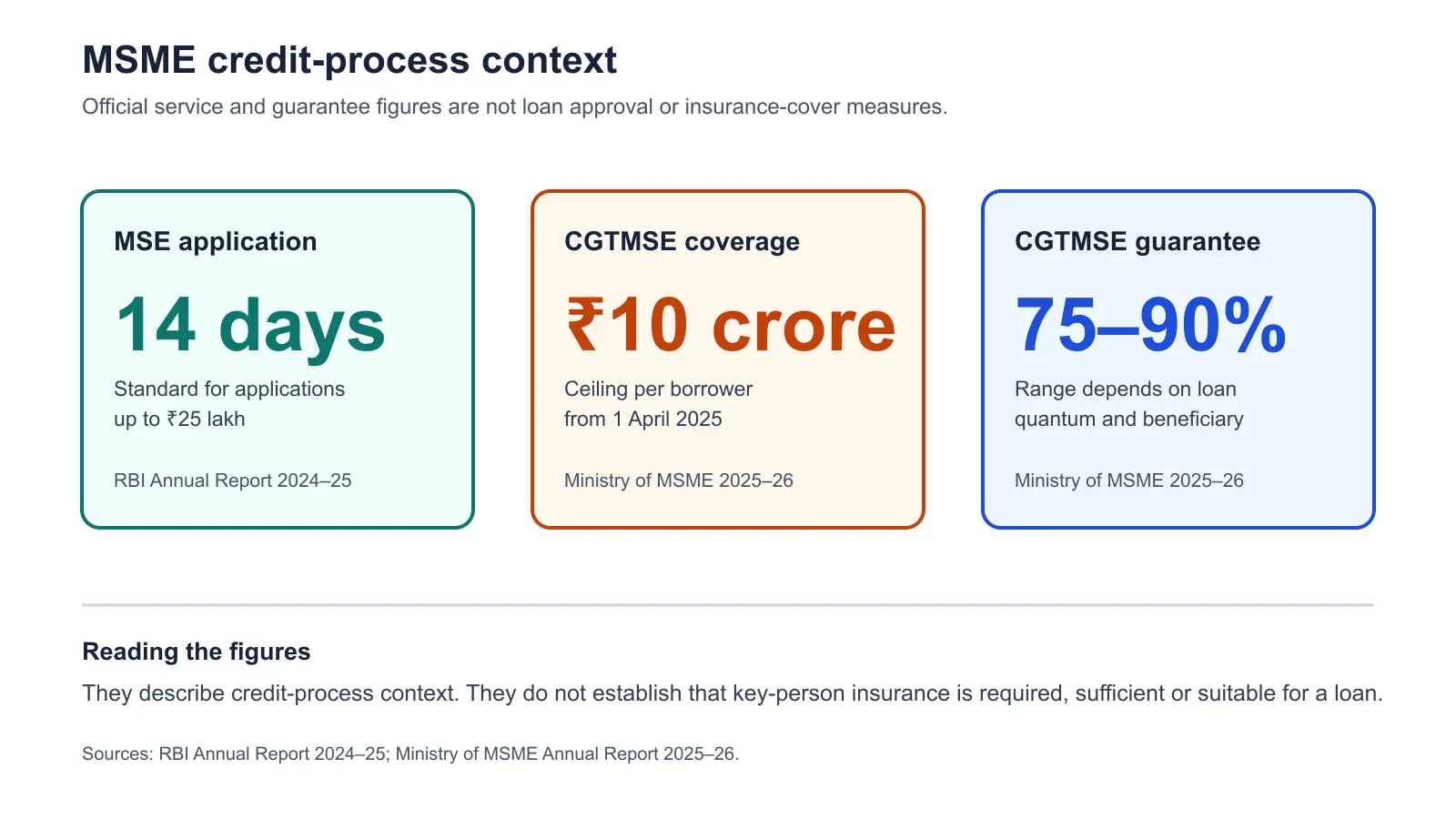
The chart uses three different measurement scales: days, ₹ crore and percentage. It is a compact source-based context view, not a like-for-like comparison. Its inference is limited: the formal credit process has documented service and guarantee mechanisms, while a key-person insurance decision must be evaluated separately from the contract wording and business need.
Where a key-person policy may fit in a continuity review
Key-person insurance is generally considered when the business could face a financial disruption because of the death of a crucial individual. The business should clarify the business reason, proposer/owner, life assured, beneficiaries, premium payer, policy term, assignment terms (if any), and how any proceeds would be governed. Those choices are legal, tax, credit and insurance matters—not merely paperwork.
Before signing a proposal or accepting any lender-related arrangement, request the complete policy wording, benefit illustration or key-feature document where applicable, schedule, exclusions, nomination or assignment documents, and servicing contacts. IRDAI’s Master Circular on Life Insurance Products is a useful regulatory reference, but the precise rights and duties come from the policy and applicable law.

A five-step file discipline for a credit-and-continuity discussion
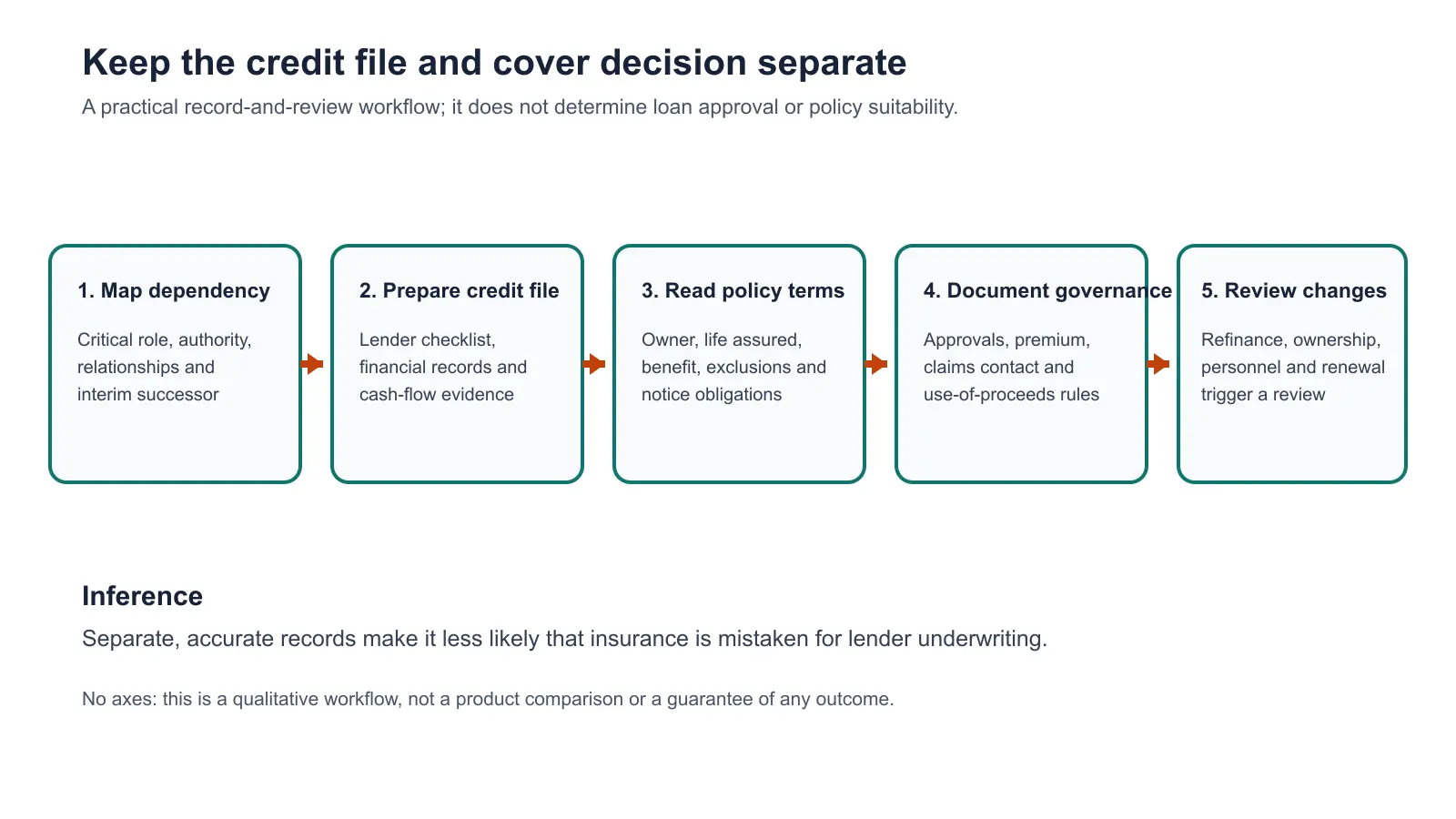
This qualitative workflow has no axes. Its inference is that clear ownership, accurate records and separate decision trails reduce the risk of treating an insurance policy as a substitute for lender underwriting.
- Map dependency: identify the critical role, key decisions, customer relationships, authority limits and a practical interim successor.
- Prepare credit facts: use the lender’s requested checklist; retain financial statements, cash-flow information, bank records and the reasons for any changes in the proposal.
- Read insurance terms: check the proposer, ownership, insured person, benefit, term, exclusions, assignment or nomination arrangements, disclosures and notice duties.
- Document governance: minute who may decide on policy purchase, premium payment, claims communication and use of proceeds; obtain qualified legal, tax and insurance advice as needed.
- Review when facts change: revisit the file after a refinance, ownership change, major hire or departure, material expansion, policy renewal or changed lender requirement.
Questions worth asking before relying on an assumption
- Has the lender stated in writing which documents, security and conditions it requires for this facility?
- Is a life policy being described as a lender condition, an optional continuity measure, or something else? Ask for the distinction in writing.
- Who owns the policy and who has the right to receive, assign, amend or surrender it under the actual documents?
- What disclosure, premium and notice obligations apply, and what happens if they are missed?
- Are legal, accounting and tax implications being reviewed independently? Do not rely on a generic tax statement; treatment depends on facts and current law.
Source links
- Reserve Bank of India: Annual Report 2024–25 — MSE credit-delivery instructions, including the 14-day application-turnaround standard for applications up to ₹25 lakh.
- Ministry of MSME: Annual Report 2025–26 — CGTMSE coverage ceiling and guarantee-range context.
- MSME RAMP Portal: CGTMSE overview — scheme purpose and collateral-free / third-party-guarantee-free credit context.
- IRDAI: Master Circular on Life Insurance Products — current product-regulatory reference.
- Income Tax Department: company return information — use current law and professional advice for tax treatment.
Disclaimer
This article is for educational and informational purposes only. It is not investment, lending, legal, tax or insurance advice and does not recommend any loan, insurer or policy. Loan sanction, collateral, pricing, guarantees, policy eligibility, cover, assignment, claims and tax outcomes depend on the lender’s and insurer’s terms, underwriting, documents, applicable law and the facts of the case. Please consult qualified professionals before making a financial or insurance decision. Reviewed by Abhipra Research / Compliance Team.