Insurance for MSMEs: Build the Evidence Before You Compare Cover
For an MSME, an insurance decision is rarely just a premium comparison. A workshop, shop, services firm or small manufacturer may have equipment, stock, customer commitments, employee responsibilities and digital records that fail in different ways. The useful first step is to document what would interrupt the business, then read the actual policy terms against that evidence.

Start with the business you actually run
The Ministry of MSME’s revised classification has applied from 1 April 2025. It uses both investment in plant and machinery or equipment and annual turnover: micro enterprises are capped at ₹2.5 crore and ₹10 crore, small at ₹25 crore and ₹100 crore, and medium at ₹125 crore and ₹500 crore, respectively. See the Ministry’s current MSME classification.
| Classification | Investment cap | Turnover cap |
|---|---|---|
| Micro | ₹2.5 crore | ₹10 crore |
| Small | ₹25 crore | ₹100 crore |
| Medium | ₹125 crore | ₹500 crore |
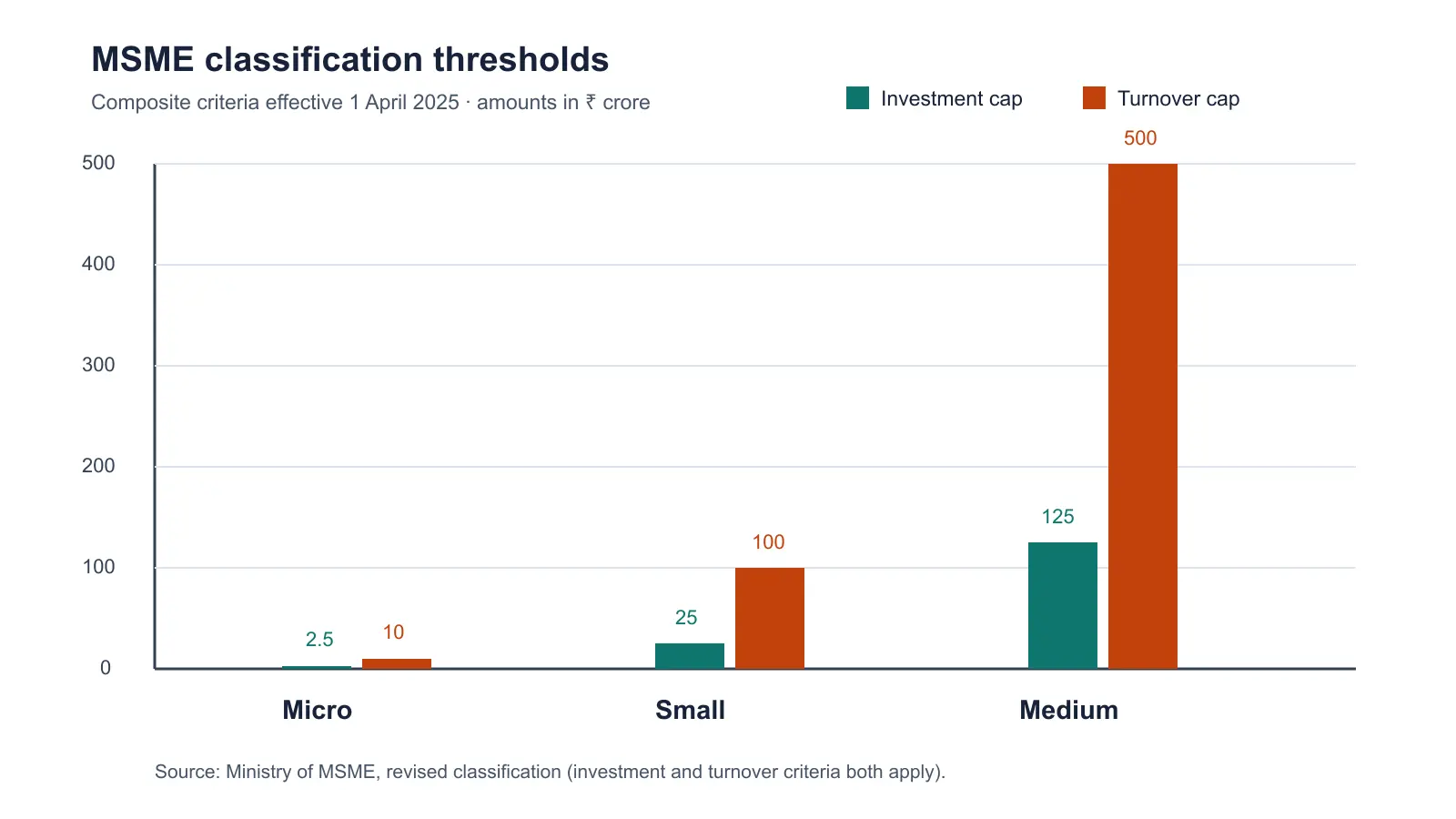
The chart uses enterprise class on the x-axis and the threshold in ₹ crore on the y-axis. It shows that the two criteria have different caps and both are relevant to classification. It does not indicate how much insurance an enterprise should buy, its premium or its claim outcome.
A package name is not a coverage conclusion
IRDAI explains that an SME may consider a package policy covering different needs, and lists examples such as property, machinery or electronic equipment damage, workers’ compensation, liability, money in transit and employee benefits. Availability, scope and conditions remain insurer- and policy-specific. Read IRDAI’s SME insurance information.
Before requesting quotations, build a short evidence file: sites and rented premises; machinery, stock and records; critical suppliers and customers; payroll and employee duties; contracts that allocate liability; prior incidents; and the systems that must work for the business to reopen. This helps the proposer answer questions accurately, but it does not replace underwriting advice.
Compare wording, limits and duties—not only a headline sum insured
Ask for the proposal, schedule, full wording and endorsements. Read the insured property or activity definition, exclusions, deductibles, sub-limits, territorial scope, waiting periods, warranties, safety conditions and claims-notification requirements. A broker summary or product name cannot settle a coverage question.
For example, a property loss can raise separate questions about stock valuation, machinery, business interruption, documents and restoration. A customer allegation can raise a different liability question. Whether an event is covered depends on the specific contract and facts. Record questions and seek written clarification from the insurer or a licensed intermediary before relying on an assumption.
A five-step renewal and incident-readiness workflow
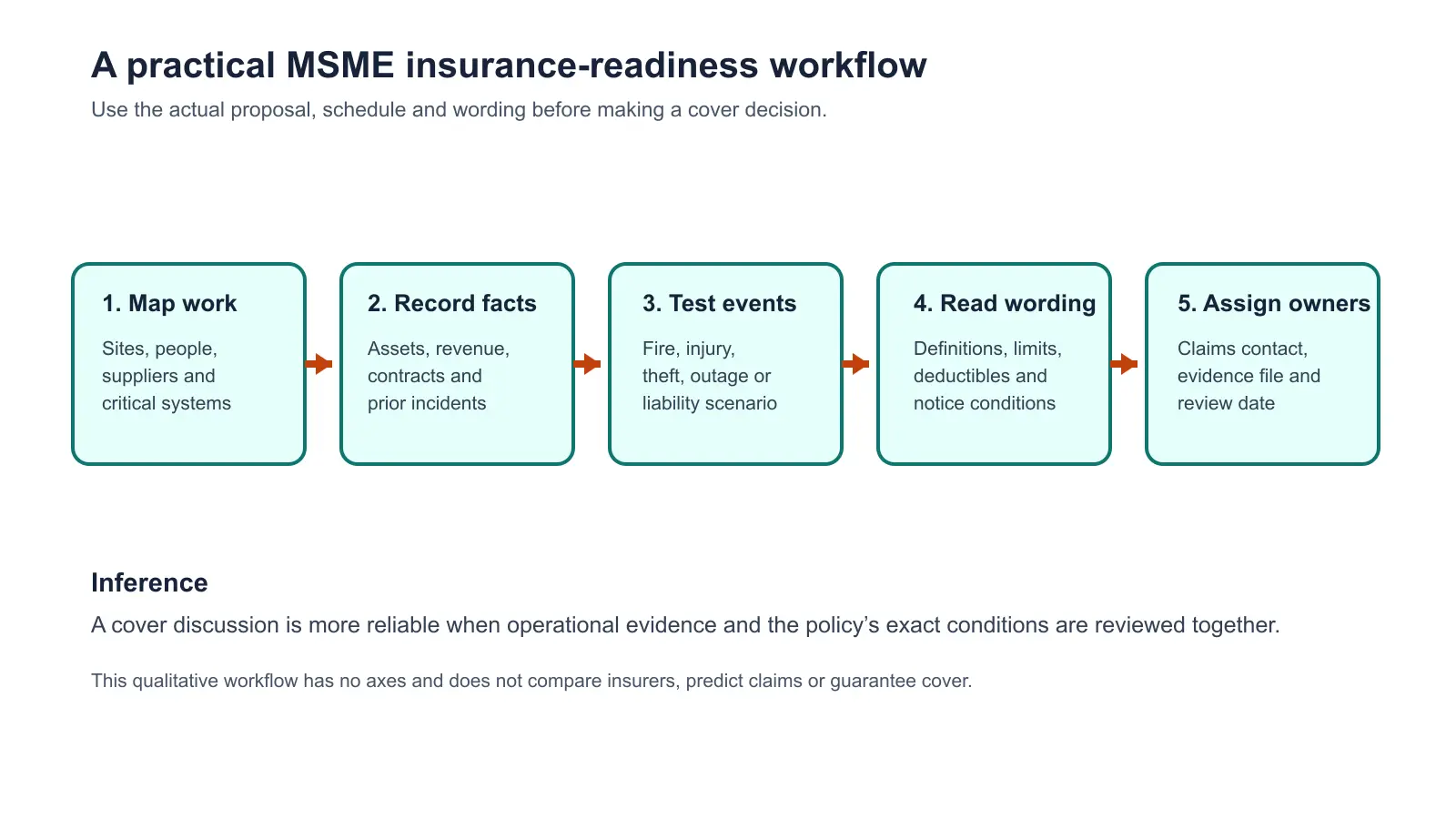
This is a qualitative workflow rather than a data chart, so it has no axes. Its inference is simple: an insurance discussion is more reliable when operational evidence and the policy’s exact conditions are reviewed together.
- Map the work: list sites, people, suppliers, customer commitments and systems that keep the business running.
- Record facts: maintain dated asset, stock, contract, revenue and incident records appropriate to the business.
- Test disruption scenarios: consider a fire, equipment breakdown, theft, injury, digital outage or liability allegation without assuming every scenario is insured.
- Read the wording: compare those facts with definitions, limits, deductibles, exclusions, endorsements and notice conditions.
- Assign owners: identify a claims contact, a backup contact, the evidence location and the next review date.

A disciplined policyholder checklist
- Do not understate material facts or assume last year’s proposal remains accurate after a change in location, equipment, turnover, activity, suppliers or claims history.
- Preserve invoices, photographs, maintenance records, contracts and incident logs in a controlled location. They may be relevant to a future claim review.
- Know the policy’s notification route and retain the insurer and intermediary contact details outside the affected site or system.
- Do not authorise major repair, disposal or restoration work after an incident without checking the policy and obtaining appropriate technical or insurer guidance, except where immediate safety action is necessary.
- Use IRDAI’s policyholder resources and the insurer’s grievance process if a servicing concern is not resolved. IRDAI’s grievance guidance explains the escalation path, including Bima Bharosa and the Insurance Ombudsman context.
Source links
- Ministry of MSME: current MSME classification — revised investment and turnover criteria effective 1 April 2025.
- Ministry of MSME Annual Report 2025–26 — confirmation of the revised classification notification and thresholds.
- IRDAI: Non-Life / SME insurance information — examples of SME insurance needs; actual cover is insurer- and wording-specific.
- IRDAI Master Circular on General Insurance Business, 2024 — current general-insurance regulatory context.
- IRDAI policyholder grievance guidance — insurer-first escalation, Bima Bharosa and Ombudsman context.
Disclaimer
This article is general business and insurance education, not legal, insurance, tax or investment advice and not a recommendation to buy a policy. Cover, eligibility, pricing, limits, exclusions, claims handling and outcomes depend on the policy wording, schedule, endorsements, facts, underwriting and applicable law. Reviewed by Abhipra Research / Compliance Team.