Buy-Sell Planning for Business Partners: Agree the Process Before a Disruption
When two or more people build a business together, the ownership question is often deferred: what happens if one partner dies, becomes permanently unable to work, retires, or needs to exit? A buy-sell arrangement can document a process for those events. Insurance may sometimes be considered as one potential source of funds, but neither a policy nor a template agreement decides the outcome by itself.

Ownership continuity is a business-control question
The Ministry of MSME’s Annual Report 2025–26 describes the sector as contributing around 31.1% of India’s GDP and over 48.5% of exports. Those sector-wide figures do not value an individual business, but they underline why continuity, records and decision rights merit attention. Read the Ministry’s Annual Report 2025–26.
| Reported MSME-sector measure | Figure stated by the Ministry | Appropriate reading |
|---|---|---|
| Contribution to India GDP | Around 31.1% | Sector context, not a valuation of a particular firm. |
| Contribution to India exports | Over 48.5% | Sector context, not a measure of insurance need or cover. |
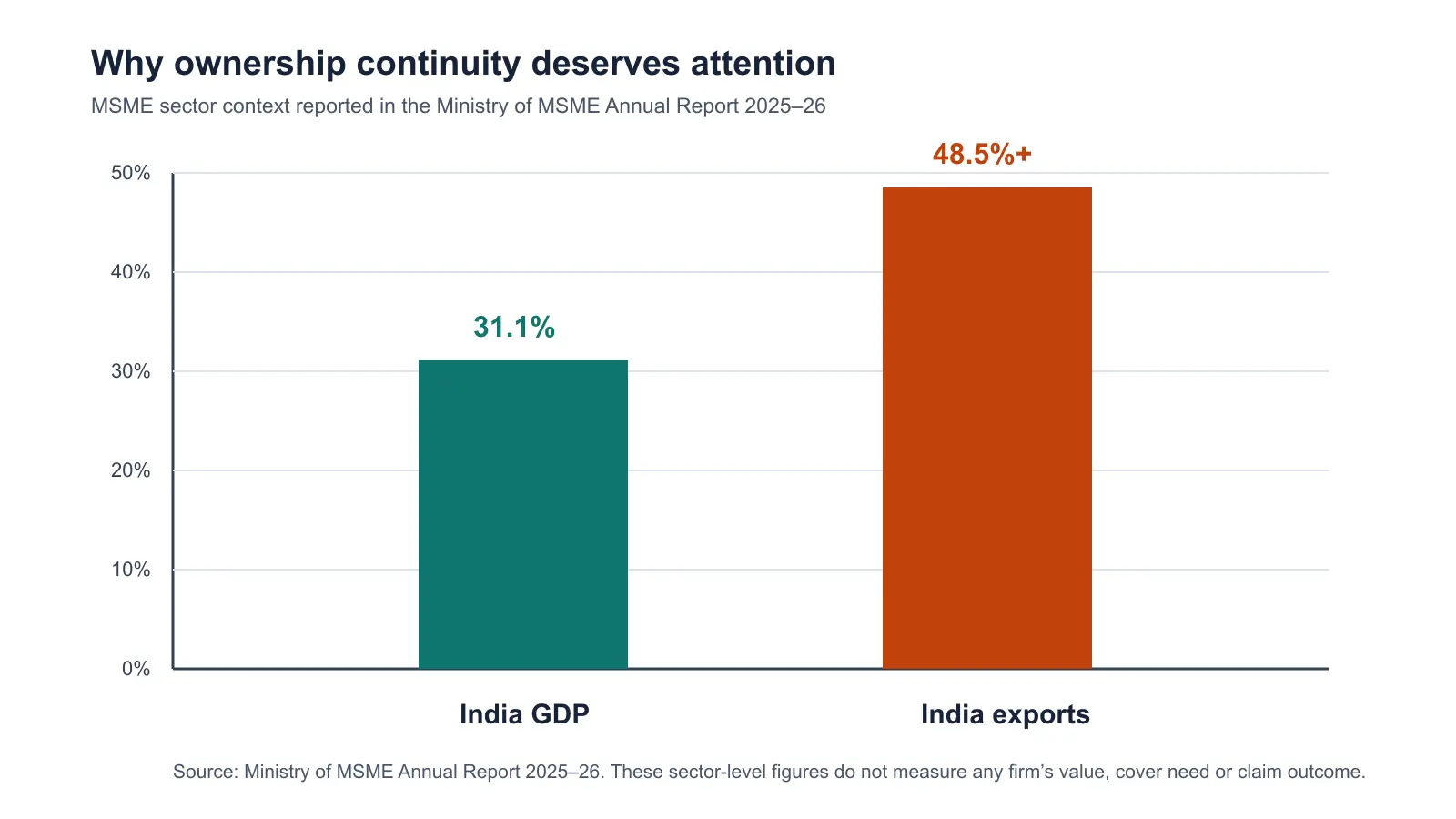
The chart’s x-axis lists the two reported measures and its y-axis is percentage of the relevant India total. The limited inference is that MSMEs have substantial economic context. It does not tell partners what their business is worth, what agreement they need, or how much insurance they should buy.
Begin with legal form and the documents already in force
The right answer differs for a partnership, LLP, private company or other structure. Under the Indian Partnership Act, partners may determine their rights and duties by contract; the Act also contains rules on dissolution and winding up. See the Indian Partnership Act, 1932. For a company, share transmission on death has a separate legal process; it is not the same as a commercial sale between continuing owners. See the Companies Act, 2013.
Before signing a new document, gather the partnership deed, shareholders’ agreement, articles, share or interest register, nominee records, financing documents, existing personal guarantees and any earlier valuation clauses. A qualified legal and tax adviser should assess which documents control for the entity and facts involved.
What a thoughtful buy-sell arrangement needs to answer
- Which events trigger the process? Death, disability, retirement, insolvency, breach, deadlock and voluntary sale may need different treatment.
- Who has a right or obligation to buy? The agreement should distinguish continuing owners, the entity and the exiting owner or estate.
- How is value determined? Agree the method, valuation date, information source, treatment of debt and dispute route before a difficult event.
- How will payment work? Identify available cash, instalment provisions, financing and any insurance arrangement without assuming all funds are immediately available.
- What must be notified and recorded? Set notice owners, document locations, consent requirements and a review date.
Where insurance can fit—and the limits that still apply
Life or other insurance is sometimes explored as a potential funding layer for a defined buy-out event. That is not automatic cover. Ownership of the policy, life assured, beneficiary, premium payer, insurable interest, disclosure, exclusions, conditions, tax treatment and the relationship between the policy proceeds and the agreement require fact-specific advice. Read the complete proposal, schedule, wording and endorsements; do not rely on a product label or an illustration.
An insurance payment, if any, does not by itself transfer a partnership interest or company shares. The commercial documents, statutory process, valuation and approvals still need to be followed. For a live event, obtain legal, tax, company-secretarial and licensed-insurance advice promptly.
A five-step readiness workflow
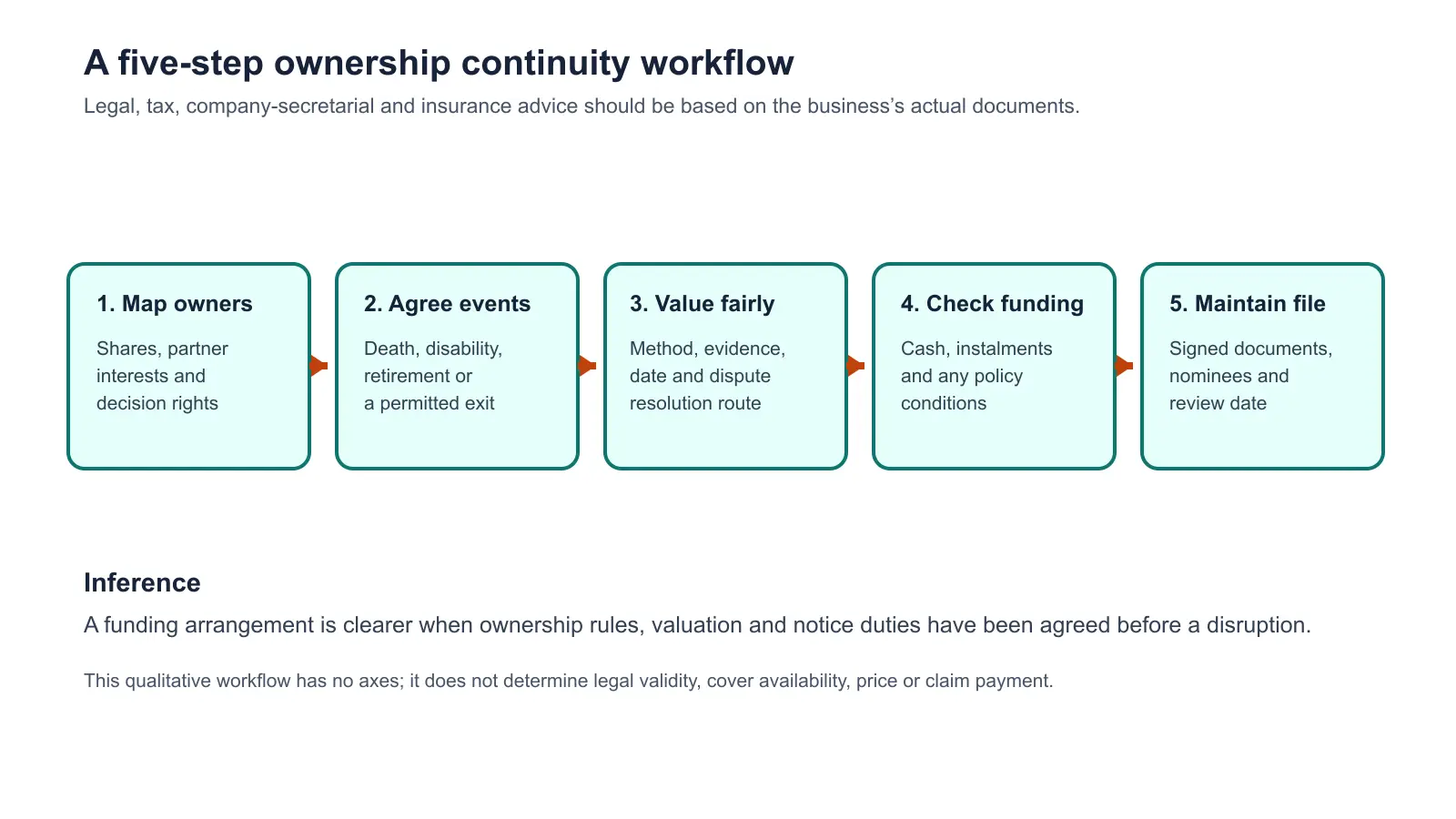
This qualitative workflow has no axes and does not compare insurers or predict a claim. Its inference is that funding is easier to coordinate when ownership, valuation and notice arrangements exist before an event.
- Map owners: record shares or partner interests, roles, nominees and decision rights.
- Agree events: state the events that trigger a review or purchase process.
- Value fairly: document a valuation method, date, evidence and dispute mechanism.
- Check funding: assess cash, instalments, financing and any policy terms together.
- Maintain the file: keep signed documents, nomination records and review dates controlled and current.

Common mistakes to avoid
- Treating a policy schedule as a substitute for a signed, entity-appropriate agreement.
- Leaving the valuation method to be negotiated only after a death, disability or dispute.
- Failing to update records after a new investor, loan, guarantee, marriage, divorce, retirement, succession event or material change in business value.
- Assuming a nominee, legal representative, estate, surviving partner or company automatically has the same rights in every legal form.
- Forgetting notice conditions, disclosure duties and policy ownership when reviewing a funding arrangement.
Source links
- Ministry of MSME Annual Report 2025–26 — MSME-sector GDP and export context.
- Indian Partnership Act, 1932, India Code — contractual rights, dissolution and winding-up context for partnerships.
- Companies Act, 2013, India Code — company-law and share-transmission context.
- IRDAI policyholder grievance guidance — insurer-first servicing and escalation context.
Disclaimer
This article is general business and insurance education, not legal, tax, company-secretarial, insurance or investment advice and not a recommendation to buy a policy. Ownership rights, valuation, cover, eligibility, pricing, exclusions, claims handling and outcomes depend on the entity documents, policy wording, schedule, endorsements, facts, underwriting and applicable law. Reviewed by Abhipra Research / Compliance Team.