NPS vs Atal Pension Yojana: Match The Pension Scheme To The Person

NPS vs Atal Pension Yojana is not a question of which scheme is universally better. It is a question of who is applying, what kind of income they earn, how much flexibility they need and whether they want a market-linked retirement account or a predefined pension slab.
This matters for families, small business owners, informal workers, self-employed professionals and salaried employees because both schemes sit inside India's pension architecture, but they solve different problems. PFRDA's latest homepage milestone data, marked as on 28 June 2026, shows 2.25 crore NPS subscribers with Rs 17,22,139 crore AUM and 7.70 crore APY subscribers with Rs 57,167 crore AUM. The numbers show the same broad message: India is using both flexible retirement accounts and simple pension-slab products at scale.
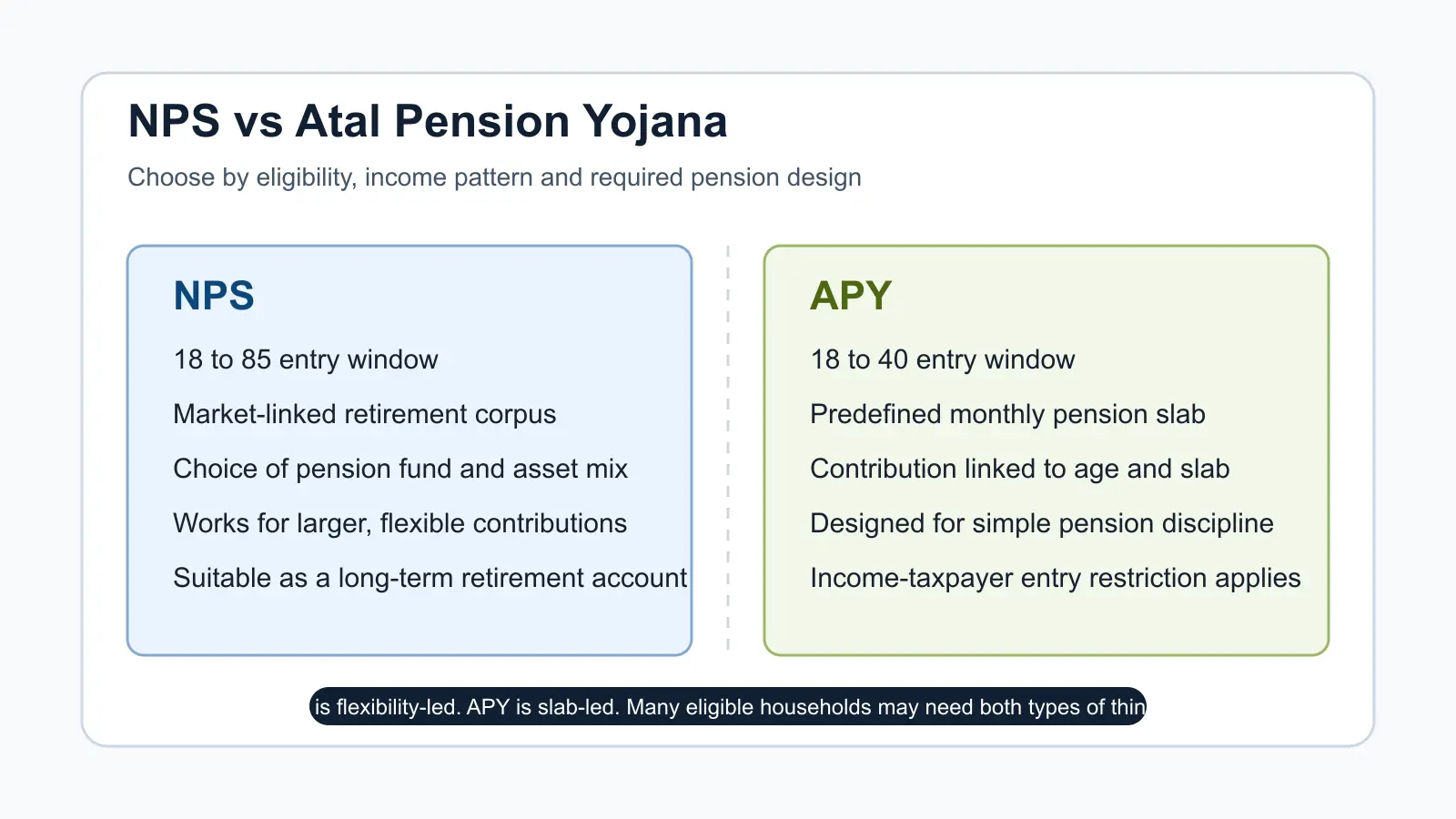
NPS is built for a subscriber who wants a long-term retirement corpus, pension fund choice, asset-allocation flexibility and portability across career stages. APY is built for an eligible Indian citizen who wants a simple contribution schedule linked to a pension slab payable from age 60.
NPS or APY: Start With Eligibility
PFRDA states that the NPS All Citizen Model can be voluntarily subscribed to by an Indian citizen, resident or non-resident, or an OCI, aged 18 to 85, subject to KYC and other conditions. NPS is an individual pension account, with Tier I as the default pension account and Tier II available only after Tier I activation.
For APY, PFRDA states that the minimum entry age is 18 and the maximum entry age is 40. The applicant needs a savings bank account or post office savings bank account. A critical rule applies from 1 October 2022: a citizen who is or has been an income-tax payer is not eligible to join APY.
That one eligibility rule often decides the answer before investment preference does. A 32-year-old non-taxpaying informal worker may evaluate APY. A 42-year-old self-employed professional cannot newly join APY because of age, but may evaluate NPS if otherwise eligible. A salaried taxpayer should generally evaluate NPS, employer NPS and other retirement buckets rather than trying to use APY.
NPS vs APY At A Glance
| Decision Point | NPS | Atal Pension Yojana |
|---|---|---|
| Entry age | 18 to 85 under the All Citizen Model, subject to KYC and scheme conditions. | 18 to 40 only. |
| Who can use it | Resident Indian citizens, NRIs and OCIs, subject to PFRDA eligibility conditions. | Indian citizens with a savings bank or post office savings bank account, subject to the income-taxpayer restriction for new joining from 1 October 2022. |
| Pension design | Market-linked retirement corpus with pension fund and asset-allocation choice. | Predefined pension slab of Rs 1,000 to Rs 5,000 per month from age 60, based on entry age, chosen slab and contribution schedule. |
| Contribution style | Flexible contribution amount with online and PoP-enabled contribution routes. | Periodic contribution linked to the chosen pension slab; monthly, quarterly and half-yearly modes are available. |
| Best-fit use case | Long-term retirement corpus building for salaried, self-employed, professional and business-owner households that need flexibility and scale. | Simple pension discipline for eligible citizens who want a modest fixed slab and can contribute until age 60. |
When NPS May Fit Better
NPS may fit better when the retirement plan needs flexibility. A professional whose income rises over time may want to increase contributions. A business owner may want to maintain a retirement account outside the business balance sheet. A salaried employee may already have EPF but may still need a second retirement bucket that can continue across jobs.
NPS also gives the subscriber a choice of pension fund and investment approach. Under the PFRDA All Citizen Model page, subscribers can select a pension fund and investment choice, and contributions are invested as recorded with the Central Recordkeeping Agency. This is useful for investors who understand that retirement investing involves market-linked outcomes and regular review.

When APY May Fit Better
APY may fit better when the person is eligible, between 18 and 40, not barred by the income-taxpayer rule and wants a simple pension slab rather than a flexible market-linked retirement corpus.
The Department of Financial Services describes APY as a scheme where the subscriber receives a fixed minimum pension of Rs 1,000, Rs 2,000, Rs 3,000, Rs 4,000 or Rs 5,000 per month at age 60 depending on contribution and age of joining. Contributions can be monthly, quarterly or half-yearly.
For many eligible households, APY can create a basic pension floor. It should still be reviewed against inflation, family expenses and healthcare needs because a fixed pension slab may not be enough as a full retirement plan.
A Practical Decision Framework
Choose APY only if eligibility is clear. The applicant must be an Indian citizen, must fall within the 18-to-40 entry window, must have the required savings account and must not be ineligible under the income-taxpayer rule applicable from 1 October 2022.
Choose NPS when the investor needs larger contribution potential, asset-allocation choice, portability and a long-term retirement corpus. NPS is especially relevant where retirement planning has to grow with income, career changes and family responsibilities.
For a household, the decision may not be either-or. An eligible family member may use APY for a basic pension slab while another family member uses NPS for flexible long-term retirement accumulation. The important step is to map every account to a clear purpose.
Action Checklist Before You Decide
- Confirm age eligibility separately for NPS and APY.
- Check whether the APY income-taxpayer restriction applies.
- Estimate monthly retirement expenses in today's rupees.
- Decide whether you need a predefined pension slab or a market-linked retirement corpus.
- Review spouse, nominee and bank details before opening or continuing any pension account.
- Keep contribution evidence, PRAN records and annual statements in one retirement file.
Speak To Abhipra's NPS Desk
Families comparing NPS, APY, NPS contribution setup or retirement-account continuation can connect with Abhipra's NPS Desk for process guidance.
Abhipra has served as a registered Point of Presence for NPS for 17 years, supporting account opening, contribution assistance and subscriber service workflows.
Learn more: Abhipra NPS services
Open an NPS account: Start NPS registration through Abhipra's PoP link
Set up NPS SIP: Create an NPS SIP through Abhipra's PoP link
For assistance, write to nps@abhipra.com.
Source Links
PFRDA NPS All Citizen Model: NPS eligibility and account features
PFRDA Atal Pension Yojana: APY overview and eligibility
PFRDA APY FAQ: Atal Pension Yojana frequently asked questions
Department of Financial Services APY page: APY scheme details from the Ministry of Finance
PFRDA pension system growth milestones: latest PFRDA subscriber and AUM dashboard
Disclaimer
This article is for investor education and process awareness only. NPS, APY, withdrawal, annuity, tax and eligibility rules may change, and outcomes depend on each subscriber's facts. Please review current official rules and consult a qualified tax or retirement-planning adviser before acting.