
NPS Tier II vs Mutual Funds: A Liquidity and Tax Check Before You Choose
Many investors ask whether an NPS Tier II account can replace a mutual fund. A better first question is: what job should this money do? NPS Tier II is an optional account connected to an active Tier I pension account. A mutual fund is a scheme-based investment route. Either can involve market risk; neither should be selected only because it looked best in a recent return table.

Start with the purpose of the money
Tier I is the NPS retirement account. Tier II is optional and requires an active Tier I account. PFRDA describes Tier II withdrawals as unrestricted, while Tier I is governed by NPS withdrawal and exit rules. That difference matters if the money is meant for a near-term goal or an emergency buffer.
An open-ended mutual fund may offer redemption access, but it is still necessary to read that scheme’s offer document, risk label, exit-load terms and settlement details. “Mutual fund” is not one uniform liquidity or risk category.

A quick access-to-money view
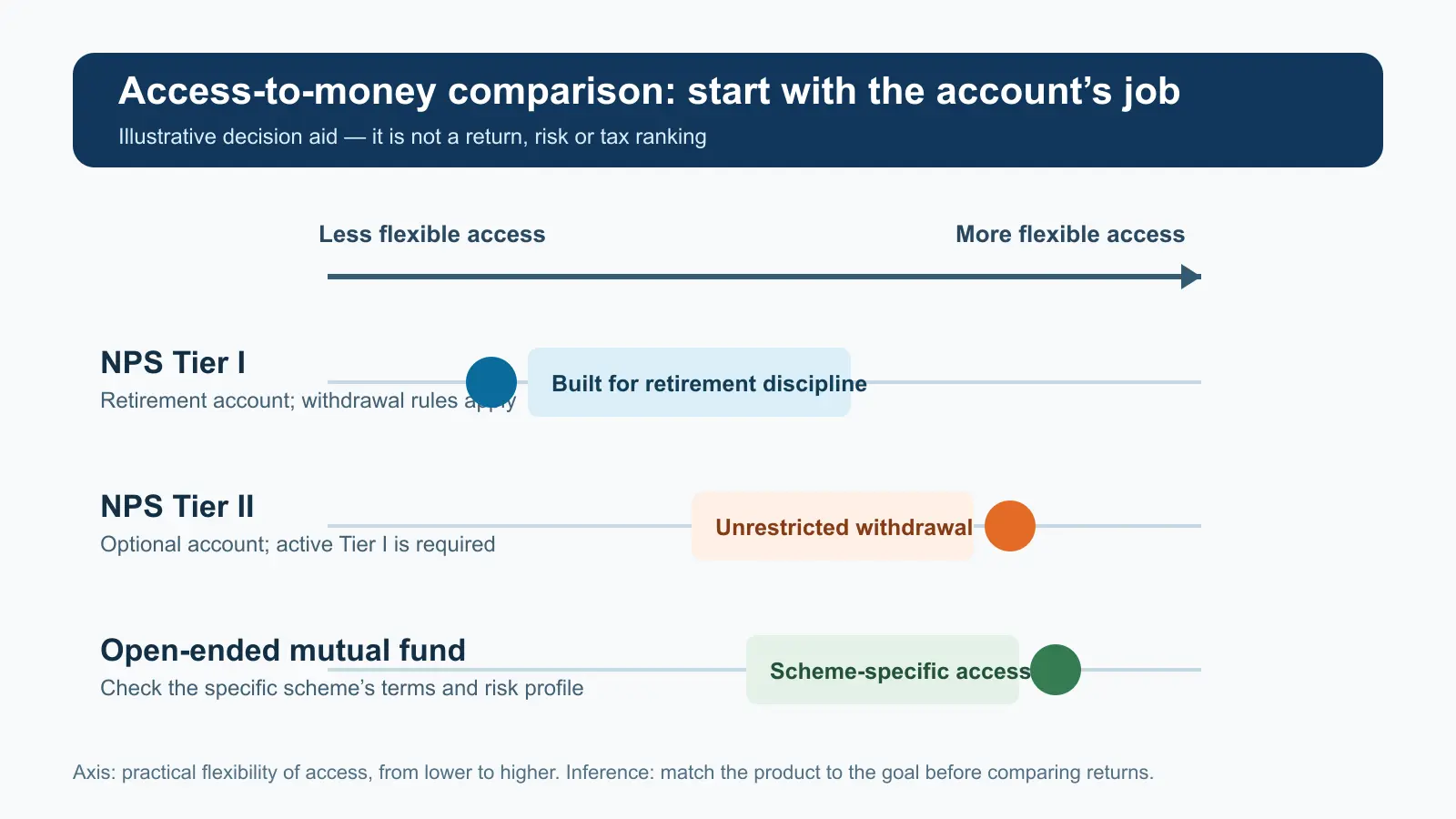
The chart’s horizontal axis runs from less flexible to more flexible access. It places Tier I nearer the restricted end because it is a retirement account. Tier II is shown toward the flexible end because withdrawals are unrestricted. Open-ended mutual funds are also shown toward that end, with an explicit reminder that access remains scheme-specific. The practical inference is simple: match the product to the goal before comparing returns.
| Question | NPS Tier II | Mutual fund |
|---|---|---|
| Account structure | Optional NPS account; an active Tier I account is required. | A scheme-based investment; features vary by scheme and category. |
| Access | PFRDA lists withdrawals as unrestricted. | Check the specific scheme’s redemption, exit-load and settlement terms. |
| Tax review | PFRDA’s All Citizen FAQ says Tier II has no tax benefit on contributions or gains. | Tax treatment depends on the fund type, holding period and applicable law; obtain tax advice for your case. |
| Risk check | Review the chosen pension fund, investment option and asset allocation. | Review the scheme objective, portfolio risk, benchmark and disclosures. |
Four checks before choosing
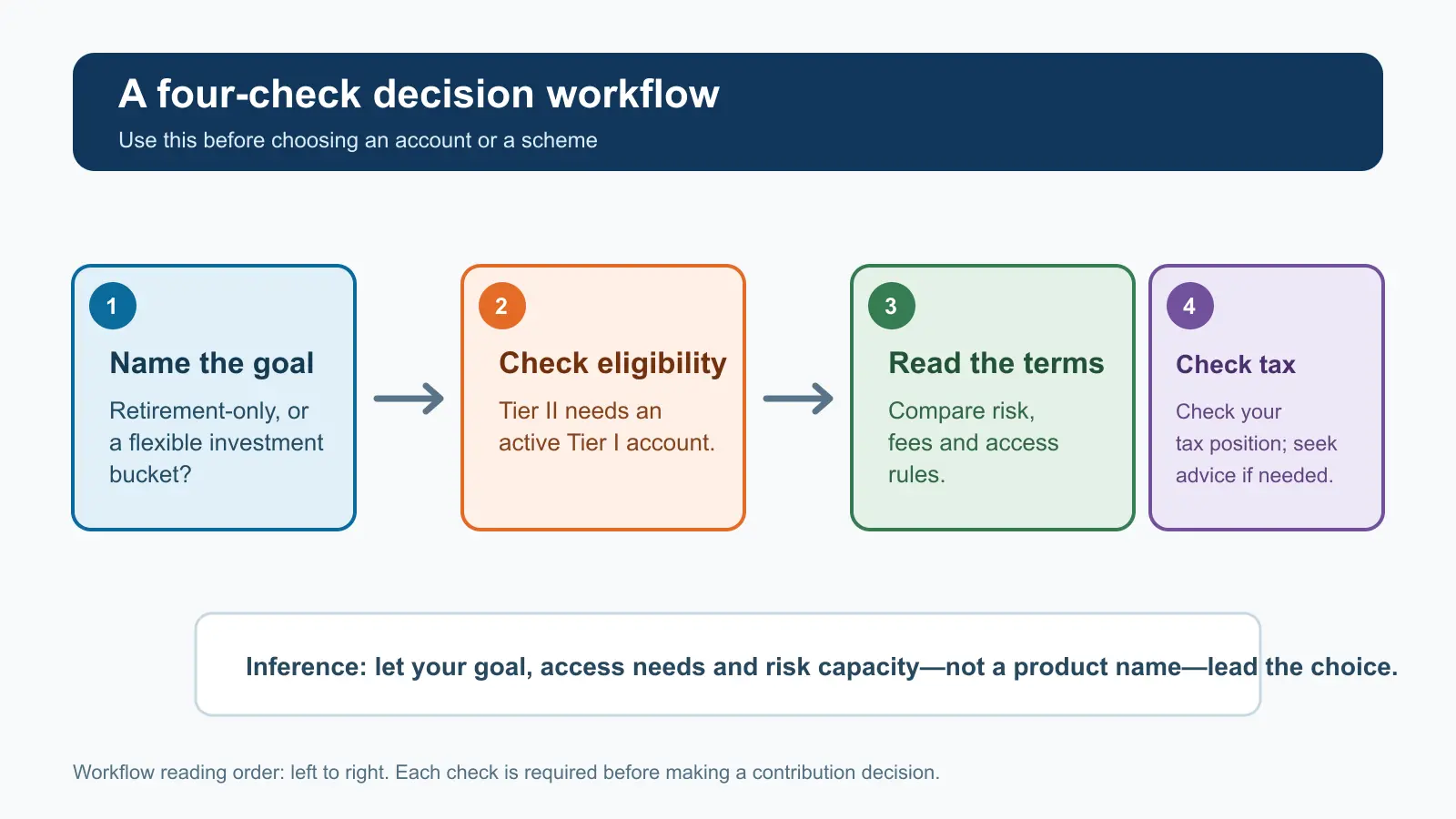
Use the workflow from left to right. First identify whether the money is for retirement or a flexible goal. Next confirm the account requirement: Tier II needs Tier I. Then read the risk, fees and access terms rather than relying on a category label. Finally, review tax implications in your own situation. The workflow’s inference is that a product name should not make the decision for you.
A practical way to separate the decisions
- Keep an emergency reserve outside long-term market-linked decisions.
- Use Tier I when the priority is disciplined retirement saving and you accept the applicable withdrawal framework.
- Consider Tier II only after understanding that it is linked to an active Tier I account and does not carry Tier I’s contribution tax benefit.
- When considering a mutual fund, read the scheme information document and risk disclosures; a recent return is not a forecast.
- If the choice affects retirement cash flow or taxes, take advice based on your complete financial position.
How Abhipra can help
Abhipra has acted as a Point of Presence for 17 years. Read about Abhipra NPS & Pension services, or use the approved Abhipra NPS account-opening route when an NPS account is appropriate for your retirement plan. For a recurring contribution routine, use the approved Abhipra NPS SIP route.
FAQs
Can I open Tier II without Tier I?
No. Tier II is optional, but an active Tier I account is required.
Does Tier II have the same tax benefit as Tier I?
PFRDA’s All Citizen FAQ says there is no tax benefit on Tier II contributions or gains. Tax outcomes can change and depend on facts, so seek tax advice when needed.
Is an unrestricted withdrawal the same as risk-free money?
No. Access and investment risk are separate questions. Review the investment choice or scheme before contributing.
Source links and disclaimer
- PFRDA: NPS All Citizen Model
- PFRDA: All Citizen Model FAQs
- PFRDA: registered pension funds and NPS investment choices
- AMFI: investor introduction to mutual funds
This article is for education only, not investment, tax, legal or retirement-planning advice. NPS and mutual funds are market-linked products. Evaluate objectives, liquidity needs, risk capacity, charges, applicable rules and tax position before acting.