NPS Swasthya 2026: What the New Health-Linked NPS Guidelines Mean
PFRDA’s operational guidelines dated 18 September 2026 introduce a more defined NPS Swasthya framework. It is designed to build a dedicated NPS corpus for eligible healthcare expenses while connecting subscribers to a separate super top-up health insurance policy. That structure makes the product worth understanding before treating it as either a normal NPS account or a replacement for health insurance.

What is NPS Swasthya?
Any individual eligible to join NPS may enrol under the guidelines, subject to the scheme’s conditions. The arrangement has two legally and operationally distinct parts:
- an NPS Swasthya investment account; and
- a separate super top-up health insurance policy, which is mandatory for enrolment.
The insurance policy remains governed by applicable insurance law and the insurer’s policy terms. Coverage, exclusions, premium, waiting periods and claims are therefore not determined by the NPS account alone. Read the policy wording before relying on it for a medical expense.
How the initial contribution is built
The minimum initial contribution is at least the first-year insurance premium including applicable taxes, annual maintenance charges of Rs. 200 plus applicable taxes, and Rs. 1,000 invested in the NPS Swasthya account. The premium is variable, so the guidelines do not create one universal rupee total for every subscriber. The minimum subsequent contribution is Rs. 10.

The article’s rule map separates the fixed amounts from the policy premium. This matters because a headline such as “open the account with Rs. 1,200” would omit the first-year premium and could mislead a reader.
What can be withdrawn for healthcare?
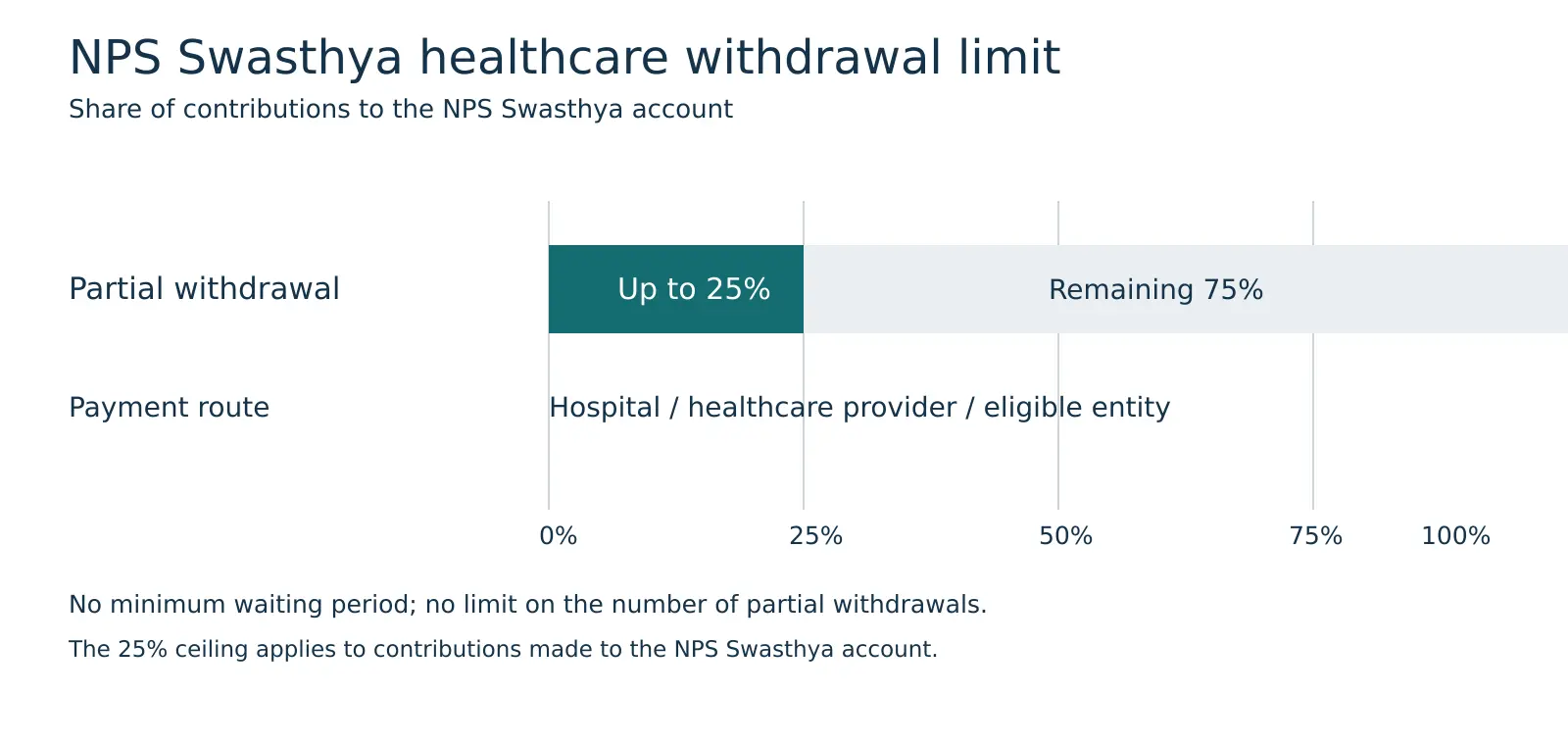
The chart’s horizontal axis shows the share of contributions, from 0% to 100%. The highlighted 25% is the maximum partial-withdrawal amount under the guidelines; the remaining 75% is outside that partial-withdrawal limit. There is no minimum waiting period and no restriction on the number of partial withdrawals, but the amount is not paid directly to the subscriber. It is settled with the hospital, healthcare provider or other eligible entity through the prescribed process.
If eligible inpatient healthcare expenditure in a single instance exceeds the amount permissible through partial withdrawal, the premature-exit route may apply. The accumulated NPS Swasthya corpus is first used for the eligible expense; any remaining balance is moved into an NPS scheme under the All Citizen Model, subject to the guidelines. This is a specific healthcare-exit rule, not a general-purpose cash withdrawal facility.
How the account and insurance work together
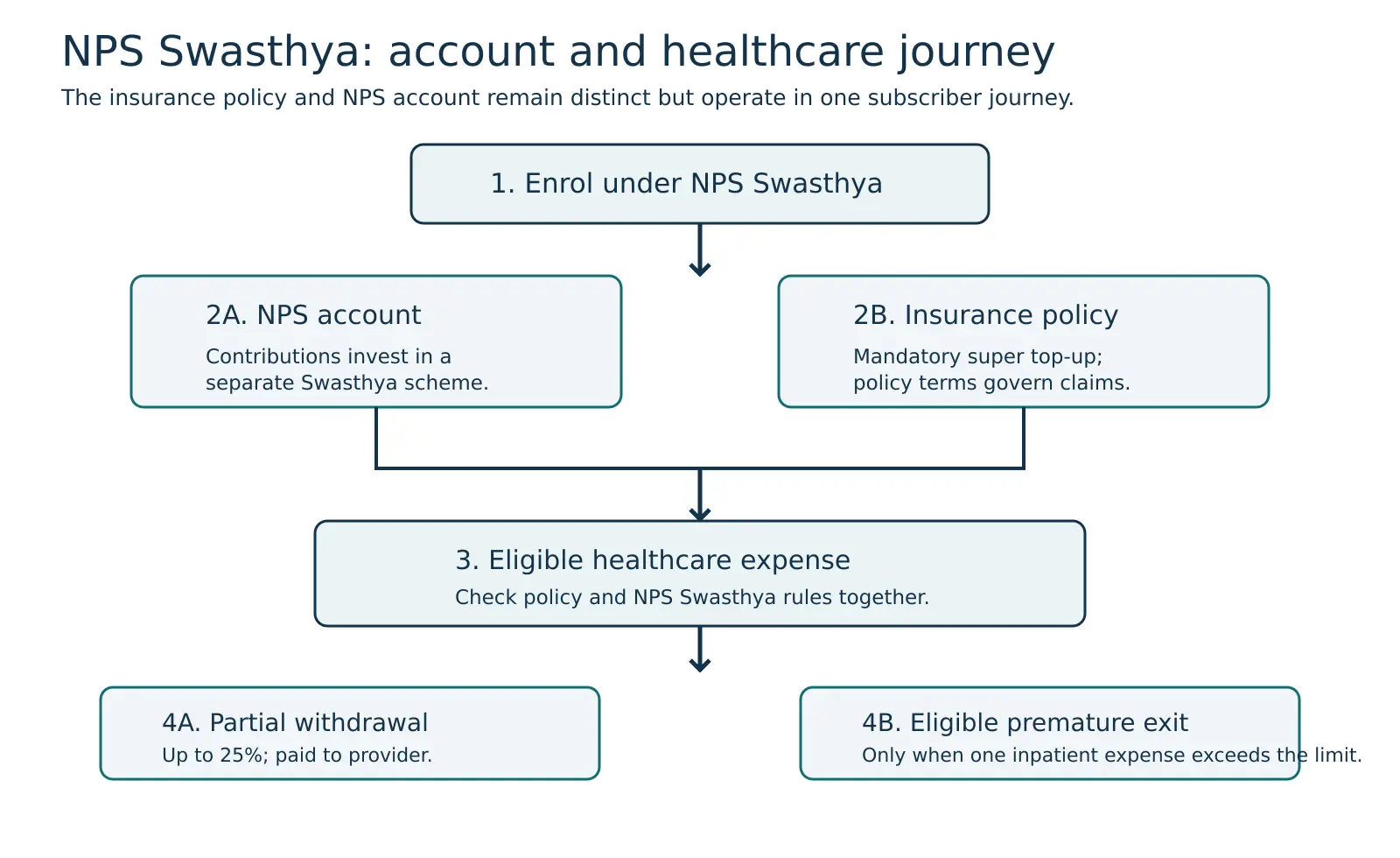
The workflow’s arrows describe sequence, not a promise of claim approval or payment speed. The practical inference is to keep two files: one for the NPS account and one for the insurance policy, including premium receipts, policy terms, exclusions, claim contacts and grievance routes.
Subscribers may transfer money from an existing NPS scheme under the All Citizen Model into NPS Swasthya, but the guidelines limit that transfer to the applicable insurance-policy deductible. A switch between NPS Swasthya schemes can occur at insurance renewal and may involve a different pension fund and associated policy, subject to insurance-law requirements.
Checks before considering it
- Compare the policy’s deductible, coverage, exclusions, waiting periods, renewal conditions and claim process with your existing health cover.
- Treat the NPS corpus as market-linked retirement money. Healthcare access does not remove investment risk or the cost of charges.
- Budget for the variable first-year premium, the Rs. 200 annual maintenance charge plus taxes, and the Rs. 1,000 investment component.
- Confirm how a participating pension fund, Health Benefit Administrator and insurer handle data, servicing and grievances.
- Do not assume that “super top-up” means first-rupee coverage; the deductible and policy conditions decide when it responds.
How Abhipra can help
Abhipra has acted as a Point of Presence for 17 years. Its NPS Desk can help you understand the NPS service route and documents to review. Visit NPS & Pension or contact the Abhipra NPS Desk. Any insurance decision remains subject to the insurer’s policy and applicable IRDAI requirements.
This article is for investor education only, not health-insurance, tax, legal or investment advice. NPS Swasthya is subject to the current PFRDA guidelines, scheme documents, insurance policy terms, investment risk and applicable regulations. The article uses the operational guidelines published on 18 September 2026; subscribers should check the latest official documents before acting.