NPS Sanchay Vs Bank Savings: Why Retirement Money Needs Its Own Structure

A bank savings account is useful. It helps you receive money, pay bills, keep emergency cash and manage daily liquidity. But the same convenience can become a problem when retirement money sits in the same account as business expenses, household spending and festival withdrawals.
NPS Sanchay is meant to solve a different problem: how to give informal-sector and irregular-income workers a simpler pension structure under the NPS framework. The question is not whether bank savings are bad. The better question is: should your emergency money and old-age income money live in the same mental bucket?
The Key Difference Is The Job Of The Money
Bank savings are designed for access. Pension money is designed for discipline. If the same account is used for both, retirement saving is usually the first thing to be postponed when cash flow gets tight.
| Money bucket | Best suited for | What can go wrong |
|---|---|---|
| Bank savings account | Daily liquidity, emergency buffer, near-term expenses and business cash flow. | Money remains easy to spend, so long-term retirement saving may keep getting delayed. |
| NPS Sanchay or NPS pension account | Earmarking money for long-term pension planning through a regulated retirement framework. | It is market-linked and subject to NPS rules, charges, exit conditions and liquidity limits. |
What NPS Sanchay Adds
NPS Sanchay was introduced by PFRDA in May 2026 as a simplified NPS variant under the All Citizen Model and Multi Scheme Framework for the informal sector. The circular highlights that India’s informal sector employs close to 90 percent of the workforce and that many such workers remain outside formal pension coverage.
The current eligibility frame is broad: Indian citizens aged 18 to 85 can open a pension account and opt for NPS Sanchay through a Point of Presence, PoP service provider or online platform, subject to KYC. The scheme design is intended to reduce complexity around investment-option selection and asset allocation at the last-mile level.
Current Contribution Reference
The PFRDA common-scheme charge circular dated 10 March 2026 gives an important small-ticket reference for NPS All Citizen, NPS Vatsalya and NPS Lite: Rs 250 at onboarding and Rs 10 for subsequent contributions. The NPS Sanchay circular links its minimum and subsequent contribution framework to the common-scheme structure unless PFRDA specifies otherwise.
That does not mean every subscriber should contribute only the minimum. It means the structure can support small beginnings. The actual contribution habit should be based on age, income stability, business seasonality, emergency fund, debt obligations and retirement target.
Structure Map
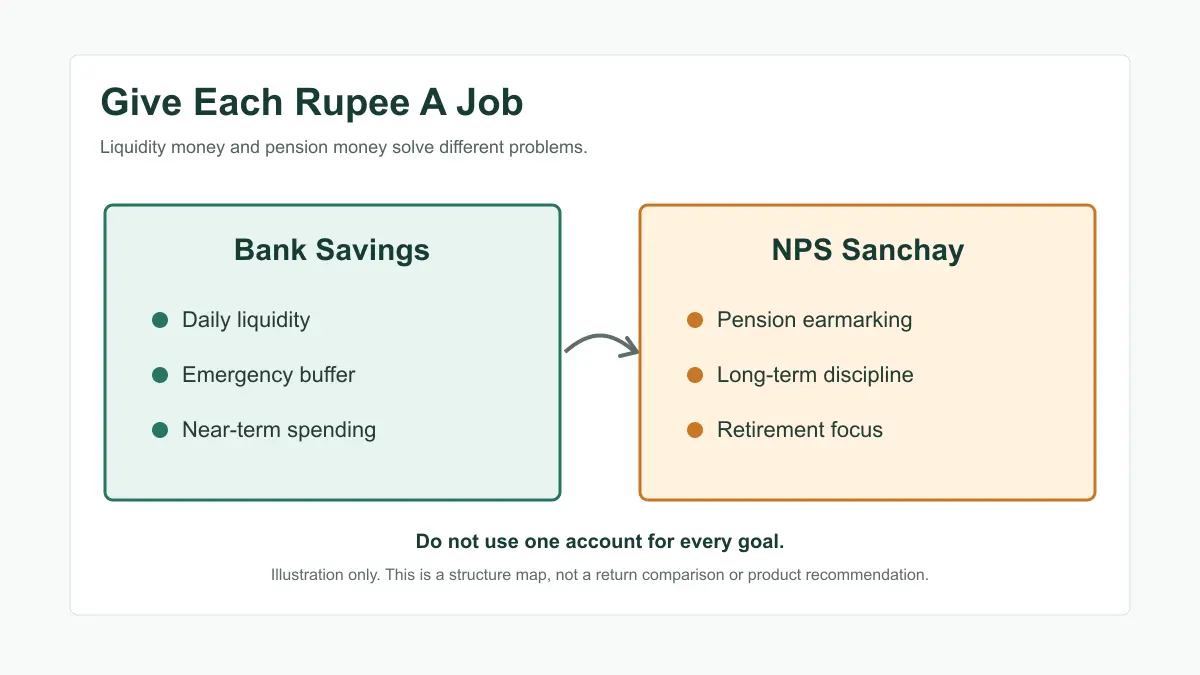
The visual separates the two roles. Bank savings should usually protect liquidity. Pension money should usually be ring-fenced for old age. The structure matters because a separate pension account makes retirement saving harder to forget and harder to spend casually.
| Question | Use bank savings when... | Use a pension structure when... |
|---|---|---|
| When will the money be needed? | Within days, weeks or months. | For retirement and old-age income security. |
| How should the money behave? | It should be accessible and stable for immediate needs. | It should stay earmarked and disciplined for the long term. |
| What is the main risk? | Spending the money before retirement because it is too easy to access. | Market risk, rule-based liquidity and exit conditions. |
A Practical Two-Bucket Habit

For a small trader or informal worker, a practical routine can be:
- Keep emergency and business cash in a bank account.
- Decide a separate pension contribution rule for surplus days or weekly collections.
- Review the pension account every quarter instead of treating it like a spending account.
- Increase contributions only after business working capital and essential household needs are protected.
- Recheck latest NPS rules, charges, tax treatment and exit conditions before large contributions or withdrawal decisions.
Bank deposits in insured banks also have a separate safety framework. DICGC currently insures eligible deposits up to Rs 5,00,000 per depositor per bank, in the same right and same capacity. That protection is useful for bank deposits, but it does not turn a bank account into a pension plan.
How Abhipra Can Help
Abhipra has acted as an NPS Point of Presence for 17 years. For subscribers who want support, Abhipra can help with NPS registration guidance, contribution support and service requests. You can read more on Abhipra's NPS and pension services page, open an NPS account online, or set up SIP in NPS.
FAQs
Is a bank savings account safer than NPS Sanchay?
They are built for different jobs. Bank savings are useful for liquidity and eligible deposits have DICGC insurance up to the applicable limit. NPS Sanchay is part of a market-linked pension framework, so it carries investment risk and retirement-specific rules.
Should informal workers keep money only in NPS Sanchay?
No. Emergency money and working capital should usually remain liquid. Pension money should be separate only after essential cash-flow needs are protected.
Does NPS Sanchay guarantee a fixed pension?
No. NPS Sanchay is under the NPS framework and should be treated as market-linked. Contribution discipline does not remove investment risk.
Why not simply save in a bank account for retirement?
You can save in a bank account, but easy access often weakens long-term discipline. A pension structure helps earmark money specifically for retirement, subject to NPS rules and suitability.
Source Links / Disclaimer
- PFRDA circular: Introduction of NPS Sanchay
- PFRDA circular: Charge structure for Common Schemes under NPS All Citizen, NPS Vatsalya and NPS Lite
- PFRDA: NPS All Citizen Model
- NPS Trust: About NPS
- DICGC: Frequently Asked Questions
This article is for educational and informational purposes only. It is not investment, tax, legal or retirement-planning advice. NPS is market-linked and subject to PFRDA rules, charges, investment risks, tax provisions and exit conditions. Bank deposits, pension products and retirement choices should be evaluated based on income stability, liquidity needs, age, risk appetite and latest applicable rules.