Large Cap, Mid Cap and Small Cap Funds: What Changes for an Investor?
Large-cap, mid-cap and small-cap mutual funds are not three versions of the same product. They invest in different parts of the listed equity market, so the volatility, liquidity and portfolio role can be very different. The right question is not which category looks most exciting today; it is which category fits your goal, time horizon and ability to handle sharp market moves.

What SEBI's Categories Mean
SEBI's mutual fund categorisation framework separates equity schemes by market-cap exposure. In simple terms, large-cap companies are the first 100 companies by full market capitalisation, mid-cap companies are the 101st to 250th, and small-cap companies are 251st onward. Under the same framework, a large-cap fund normally invests at least 80% of its total assets in equity and equity-related instruments of large-cap companies. Mid-cap and small-cap funds normally invest at least 65% in their respective market-cap buckets.
This structure helps investors compare funds within the same category. It does not make one category automatically better than another.
How The Three Buckets Differ
A large-cap fund usually holds established companies with higher market depth. It may still fall during equity market corrections, but its underlying companies are generally more widely tracked and traded.
A mid-cap fund moves into companies that may still be expanding their business scale. The opportunity can be meaningful, but earnings, valuations and liquidity may be more sensitive to market cycles.
A small-cap fund goes further down the market-cap ladder. This can expose investors to early-stage listed businesses and niche sectors, but it can also bring sharper drawdowns, lower liquidity and longer recovery periods. Investors should avoid treating small-cap exposure as a shortcut to higher returns.
Current Category Context From AMFI Data
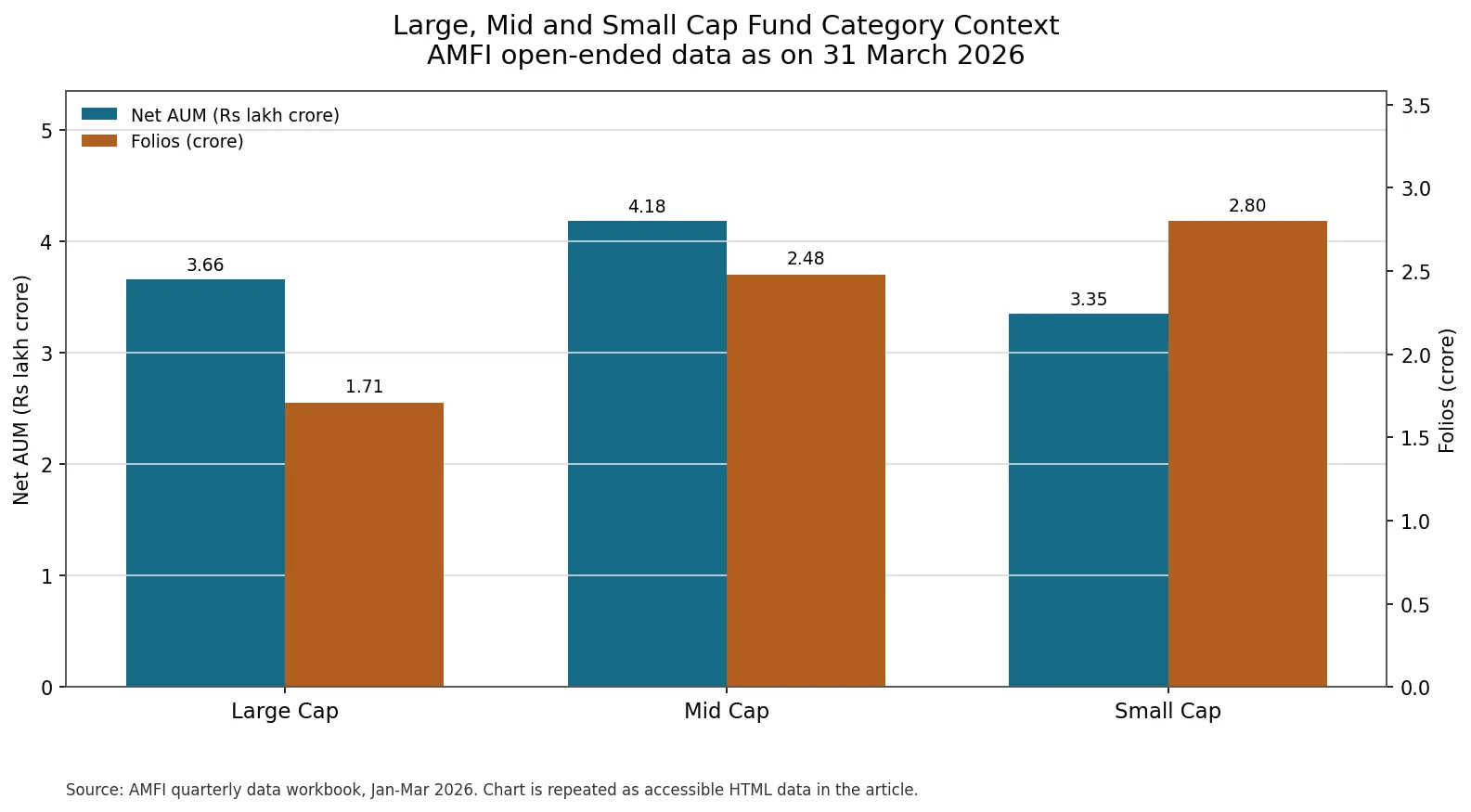
AMFI's official Jan-Mar 2026 quarterly workbook gives useful context for how large these categories have become. As on 31 March 2026, AMFI reported the following open-ended category data for large-cap, mid-cap and small-cap funds.
| Category | Schemes | Folios | Net inflow, Jan-Mar 2026 | Net AUM on 31 Mar 2026 | Average AUM, Mar 2026 |
|---|---|---|---|---|---|
| Large Cap Fund | 34 | 1.71 crore | Rs 7,114 crore | Rs 3.66 lakh crore | Rs 3.87 lakh crore |
| Mid Cap Fund | 33 | 2.48 crore | Rs 13,252 crore | Rs 4.18 lakh crore | Rs 4.38 lakh crore |
| Small Cap Fund | 36 | 2.80 crore | Rs 13,087 crore | Rs 3.35 lakh crore | Rs 3.47 lakh crore |
The table should not be read as a category recommendation. It only shows that all three categories are widely used and sizeable. The investor's decision should still start from suitability, not popularity.
Matching Category To Goal Horizon
A practical way to think about these categories is by the job of the money:
- Large-cap funds may be considered for investors who want equity exposure but prefer relatively established businesses within the equity allocation.
- Mid-cap funds may suit investors who can accept higher volatility for a long-term growth allocation.
- Small-cap funds need the most caution. They may require longer holding periods, smaller allocation sizes within an overall portfolio, and stronger discipline during market stress.
Investors should also look at existing portfolio overlap. A person already holding broad flexi-cap, multi-cap or index funds may already have some large-, mid- or small-cap exposure without buying a separate fund.
Liquidity And Stress-Test Disclosures Matter
AMFI hosts stress test and liquidity analysis disclosures for mid-cap and small-cap funds. This matters because smaller companies may not always be as easy to sell in large quantities without affecting prices. Investors do not need to read every data point like a fund manager, but they should understand the message: higher growth potential can come with liquidity and volatility risk.
For a household goal, the practical question is: if this category falls sharply or takes longer to recover, will the goal be disturbed? If the answer is yes, the allocation may need to be smaller or the category may not fit that money.
What The Companion Visual Shows

The visual shows a simple planning order: separate the money by goal, then choose the market-cap bucket, then check risk and liquidity. The large-cap bucket still carries equity risk, the mid-cap bucket is not automatically superior, and the small-cap bucket should not be used only because recent returns look attractive.
Common Mistakes
- Comparing a small-cap fund with a large-cap fund using only one-year returns.
- Assuming SIPs remove equity risk.
- Buying too many funds that repeat the same underlying exposure.
- Moving into small-cap funds after a strong rally without checking risk capacity.
- Ignoring exit load, taxation and the time horizon of the goal.
- Treating a category label as a substitute for reading the scheme objective and portfolio.
Investor Checklist
Before investing in any market-cap category, ask:
- What goal will this fund serve?
- How many years can this money stay invested?
- Can I tolerate a large temporary fall without stopping the plan?
- Does my current portfolio already have similar exposure?
- What does the scheme objective and benchmark say?
- What are the Risk-o-meter, expense ratio and exit load?
- How will I review the fund without reacting to every market move?
Investors who want help with account opening, mutual fund access, portfolio review or investment services can review Abhipra Services or complete the Abhipra eKYC journey.
Reviewed by Abhipra Research / Compliance Team.
Source Links
- SEBI: Categorization and Rationalization of Mutual Fund Schemes
- AMFI Monthly / Quarterly Data
- AMFI Jan-Mar 2026 quarterly data workbook
- AMFI Risk Parameters
- SEBI Investor Website
- Abhipra Services
Disclaimer
This article is for educational and informational purposes only. It should not be considered investment advice, trading advice, tax advice or insurance advice. Investments in securities market are subject to market risks. Please read all related documents carefully before investing. Past performance is not indicative of future returns. Please consult a qualified financial advisor, tax advisor or insurance advisor before making any financial decision.