
How To Select Asset Allocation In NPS Based On Age
The most useful NPS allocation question is not "which fund gave the best recent return?" It is "how much market risk should my retirement account carry at this age, and who will review it when life changes?"

NPS gives subscribers flexibility, but flexibility needs a control framework. A 28-year-old, a 45-year-old and a 58-year-old may all use NPS, but their retirement horizon, income stability, family obligations and tolerance for market movement can be very different.
Start With The Two Allocation Routes
Under the current All Citizen Model information available from PFRDA, subscriber contributions are invested as per the pension fund and asset allocation recorded with the Central Recordkeeping Agency.
There are two broad routes:
- Active Choice: the subscriber actively decides the allocation across Equity, Corporate Bonds and Government Securities, within the permitted caps.
- Auto Choice: the allocation is handled through lifecycle funds where equity exposure changes with age.
Active Choice may suit subscribers who are comfortable reviewing allocation periodically. Auto Choice may suit subscribers who prefer a pre-set age-based glide path instead of manually changing percentages.
The Official Caps Should Shape The Conversation
PFRDA's All Citizen Model page lists these Active Choice caps for common schemes:
| Asset Class | What It Represents | Listed Active Choice Cap |
|---|---|---|
| Equity (E) | Market-linked equity and related instruments. | Up to 75% |
| Corporate Bonds (C) | Corporate debt exposure within NPS investment rules. | Up to 100% |
| Government Securities (G) | Government securities exposure within NPS investment rules. | Up to 100% |
"Up to" is not the same as "must use". The right allocation should consider age, contribution stability, other retirement assets, emergency savings, tax position and comfort with temporary market declines.
What Auto Choice Shows About Age
Auto Choice is useful even for investors who eventually select Active Choice, because it shows the logic of a glide path: higher growth assets when the retirement horizon is longer, and lower equity exposure as age increases.

PFRDA lists these Auto Choice equity points:
| Auto Choice Option | Initial Equity Allocation Point | Equity Allocation At Age 55+ | Plain-English Use Case |
|---|---|---|---|
| Life Cycle 25 - Low | 25% up to age 35 | 5% | For subscribers who prefer a lower equity path. |
| Life Cycle 50 - Moderate | 50% up to age 35 | 10% | For subscribers who want a balanced age-linked path. |
| Life Cycle 75 - High | 75% up to age 35 | 15% | For subscribers comfortable with higher early equity exposure. |
| Life Cycle - Aggressive | 50% up to age 45 | 35% | For subscribers who can accept a higher equity level later into working life. |
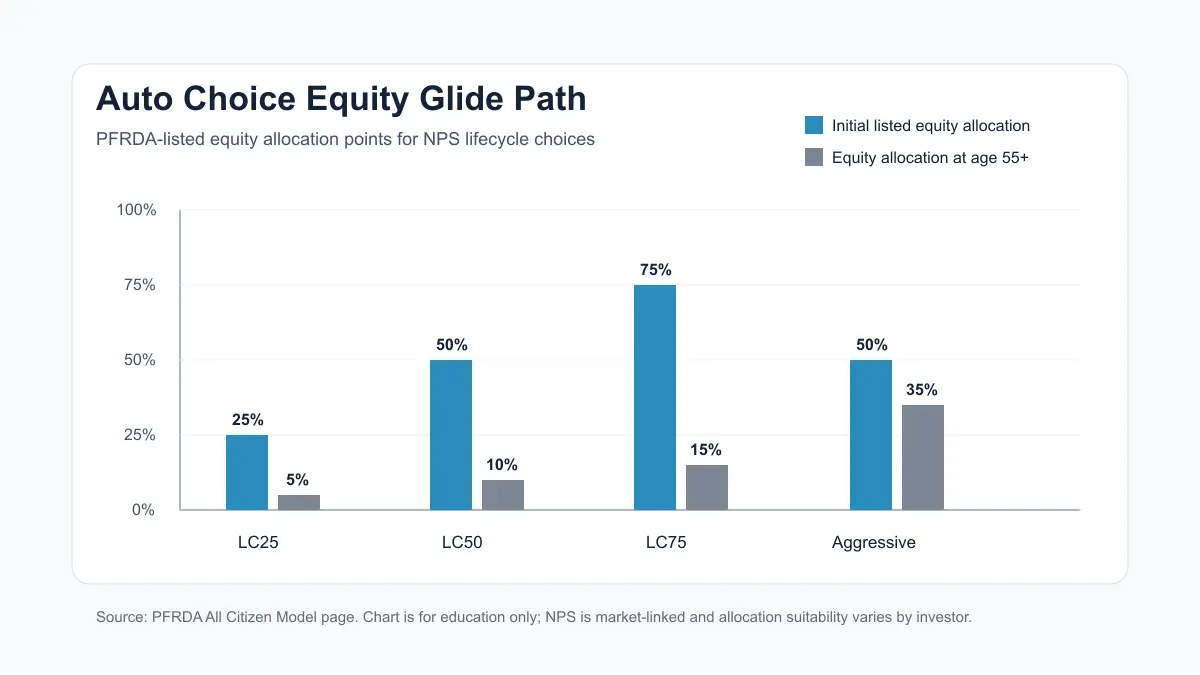
The chart compares only the listed equity allocation points. It is not a return forecast. It simply shows that the lifecycle design reduces equity exposure as the subscriber approaches older ages.
A Practical Age-Based Review Map
Use age as a starting point, not as the only rule.
- Ages 18-35: the retirement horizon is usually long, but income stability and emergency savings still matter. Higher equity exposure can create sharper short-term movement.
- Ages 36-45: contribution discipline and family obligations become more important. Review whether the earlier risk level still feels acceptable.
- Ages 46-55: the gap to retirement is narrower. Check whether equity exposure, debt exposure and contribution amount are aligned with retirement income planning.
- Age 55 and above: avoid last-minute allocation decisions driven by recent returns. Review exit rules, annuity readiness, liquidity needs and family documentation.
PFRDA also states that subscribers can change asset allocation or investment choice four times in a year. That flexibility should be used for thoughtful review, not frequent reaction to short-term market noise.
How Abhipra Can Help
Abhipra has acted as a Point of Presence for 17 years and can help subscribers review NPS account opening, contribution discipline, pension fund and allocation choices, nominee hygiene and service requests in a structured manner.
- Learn more about Abhipra's NPS services: NPS & Pension
- Start an NPS account through Abhipra's linked route: open an NPS account
- Make regular NPS contributions easier: set up SIP in NPS
FAQs
Is Auto Choice better than Active Choice?
Not necessarily. Auto Choice may suit subscribers who want an age-linked glide path. Active Choice may suit subscribers who can review allocation and risk consciously. Suitability depends on age, retirement horizon, risk comfort and overall finances.
Does the highest equity option guarantee a better NPS outcome?
No. NPS is market-linked. Higher equity exposure can improve long-term growth potential, but it also increases the chance of sharper short-term value changes.
How often can I change NPS asset allocation?
PFRDA's All Citizen Model page states that subscribers can change asset allocation or investment choice four times in a year.
What age can an individual subscribe to NPS?
The current All Citizen Model information lists eligibility for Indian citizens, resident or non-resident, and OCIs from age 18 to 85, subject to KYC and other applicable conditions.
Source Links / Disclaimer
- PFRDA All Citizen Model scheme page
- PFRDA Pension Funds and investment choices page
- PFRDA active circulars page
This article is for educational and informational purposes only. It should not be treated as investment, tax, legal or retirement planning advice. NPS is a market-linked retirement product and is subject to applicable PFRDA rules, investment risks, tax provisions and withdrawal conditions. Investors should evaluate their financial goals, risk appetite, investment horizon and applicable rules before making any decision.