Fear And Greed In Stock Markets: A Practical Guide For Indian Investors
Fear and greed are not market indicators by themselves, but they can become decision triggers. Greed says, "everyone is making money, I should enter now." Fear says, "prices are falling, I should exit before it gets worse." Both emotions can be useful warning signals, but they should not become the investment process.
Why Emotion Feels So Convincing In Markets
Markets show prices every second. Family conversations, social media posts, IPO listing gains and short-term trading stories can make a price move feel urgent. This is where greed usually appears: the investor starts fearing missed opportunity more than unsuitable risk.
Fear usually appears later. A holding falls, a headline turns negative, or a market correction arrives. The same investor who was comfortable at higher prices may now want to sell only to stop the discomfort.
SEBI's Investor Survey 2025 is useful context. It reported that 59% of surveyed investors used friends, family and colleagues as an information source for securities-market products, 56% used financial influencers on social media, 34% used online investment communities, and 28% used financial news and blogs. These sources can be useful for awareness, but they can also amplify crowd emotion if the investor does not verify facts independently.
| Data point | Reported figure | Emotion risk it can reveal |
|---|---|---|
| Investors using friends, family and colleagues for securities-market information | 59% | Crowd confidence can make greed feel like common sense. |
| Investors using financial influencers on social media | 56% | Repeated confident content can create urgency without suitability. |
| IPO shares allotted to investors, excluding anchor investors, sold within a week | 54% | Quick listing-gain focus can convert investing into reaction. |
| Individual traders who incurred losses in equity F&O during FY22-FY24 | 93% | Speed, leverage and overconfidence can turn emotion into large losses. |
Greed: When Opportunity Becomes Pressure
Greed is not simply wanting returns. Investors need returns to beat inflation and meet goals. The problem starts when expected return becomes detached from risk, time horizon, liquidity and documentation.
Common greed triggers include:
- A stock or IPO becoming popular after a sharp rise.
- A social media post suggesting urgency.
- A friend claiming quick profits.
- A belief that recent gains must continue.
- A fear of looking foolish for not participating.
SEBI's May 2025 caution on stock market scams through social media platforms is a reminder that fraudsters often use digital channels to create false confidence, urgency and trust. Greed becomes dangerous when it is mixed with unverified advice, assured-return language, complex strategies that the investor cannot explain, or pressure to act immediately.
Fear: When Risk Control Becomes Panic
Fear is also not always bad. Fear can make an investor check allocation, review liquidity needs and avoid oversized positions. But fear becomes harmful when it forces a sale without checking whether the original goal, asset allocation or investment reason has changed.
SEBI Investor's risk-management material asks investors to understand risks, diversify across assets, and match investments with time horizon and risk tolerance. That is the practical antidote to panic selling: an investor should know in advance which money is short-term, which money is long-term, and which investments can fluctuate.
A Three-Step Pause Before Acting
Before buying because of greed or selling because of fear, use a written pause rule:
- Name the trigger: price rise, price fall, social media, peer pressure, news, or personal cash need.
- Check the plan: goal, time horizon, risk appetite, liquidity, tax impact, charges and documentation.
- Decide the action: invest, wait, rebalance, reduce exposure, or seek regulated advice.
This pause does not remove emotion. It puts process between emotion and order placement.
What The Infographic Shows

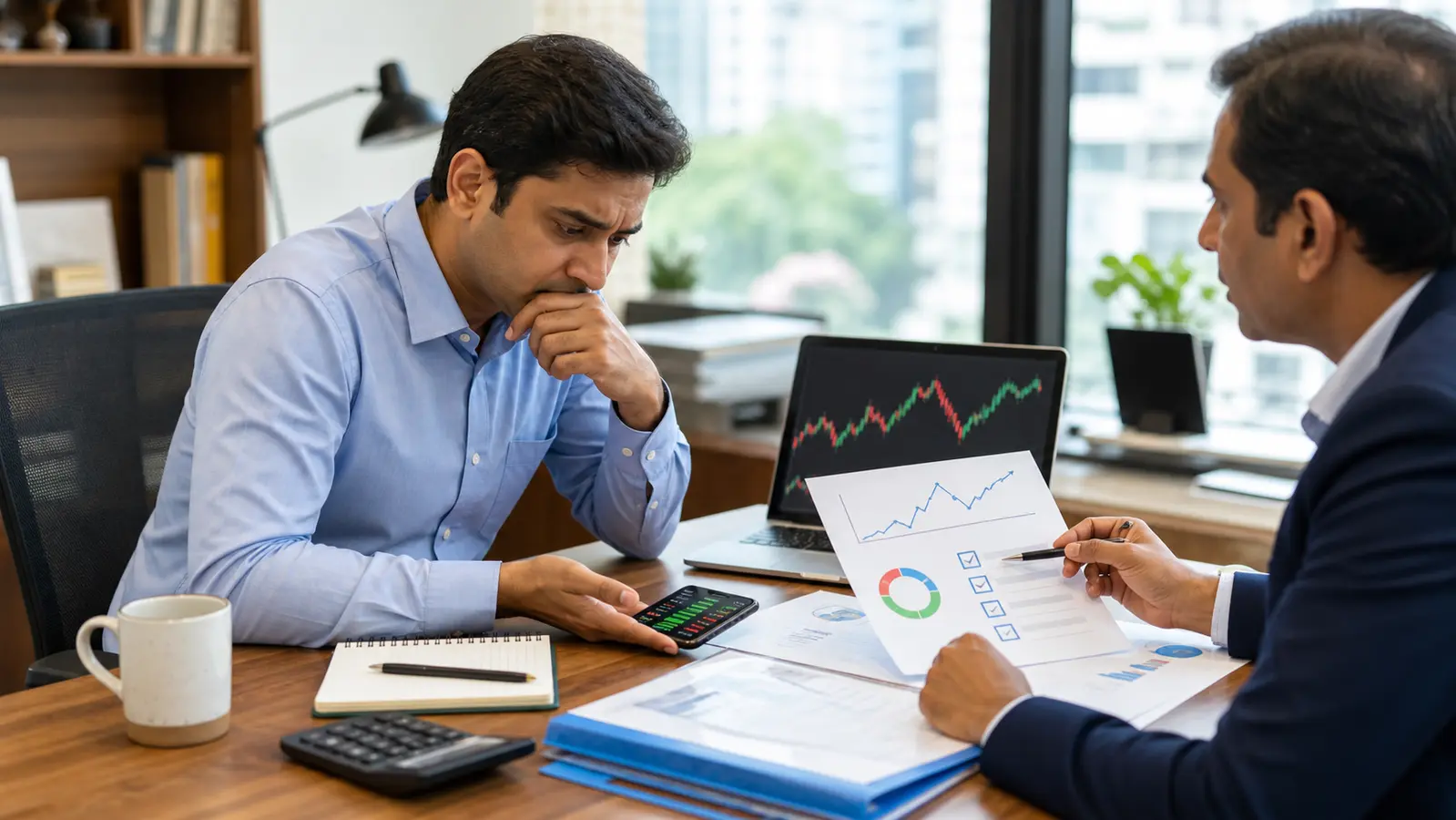
The visual shows the order of a disciplined decision. The phone and market screen are present, but they are not controlling the action. The investor first writes down the goal, reviews the risk folder, checks the action plan, and only then decides whether any trade or investment change is needed.
Common Mistakes
- Buying only because a price has recently gone up.
- Selling only because a holding has recently fallen.
- Treating social media confidence as research.
- Ignoring costs, taxes, exit loads, brokerage and liquidity.
- Borrowing money to participate in a market opportunity.
- Trading derivatives without understanding leverage, margin and loss limits.
- Forgetting that not every market move needs an action.
Investor Checklist
Before your next market decision, ask:
- Is this money needed within the next few months?
- Is the product regulated and documented?
- Does the risk match my goal and time horizon?
- Am I acting because of evidence or emotion?
- Have I checked charges, taxes and exit conditions?
- Would I still make this decision if nobody around me was talking about it?
If the answer is unclear, slow down. In investing, the most valuable action may sometimes be to avoid an emotional action.
Source Links
- SEBI Investor Survey 2025 - Main Report and Data
- SEBI Investor: Do's and don'ts of investing in securities market
- SEBI Investor: How to manage investment risks
- SEBI Investor: Key risks in investing in securities market
- SEBI press release: Caution to investors on stock market scams through social media platforms
- SEBI press release: IPO investor behaviour study showing 54% of allotted IPO shares sold within a week
- SEBI press release: 93% of individual traders incurred losses in equity F&O during FY22-FY24
Reviewed by Abhipra Research / Compliance Team.
Disclaimer
This article is for educational and informational purposes only. It should not be considered investment advice, trading advice, tax advice or insurance advice. Investments in securities market are subject to market risks. Please read all related documents carefully before investing. Past performance is not indicative of future returns. Please consult a qualified financial advisor, tax advisor or insurance advisor before making any financial decision.