Daily Earners And Small Traders: Start Pension Planning Before Income Becomes Regular

A shop owner, delivery partner, technician, commission agent or daily earner may not have the neat salary cycle that makes retirement planning feel easy. That is exactly why pension planning should start early. The goal is not to wait for income to become perfect. The goal is to create a small rule that survives uneven income.
India’s informal workforce remains a large part of the economy. PFRDA introduced NPS Sanchay in 2026 as a simplified NPS variant under the All Citizen Model and Multi Scheme Framework for the informal sector. The design aims to reduce complexity around investment-option selection and asset allocation for last-mile subscribers.
Why Irregular Income Needs A Pension Rule
For a salaried person, retirement saving may be linked to payroll. For a daily earner or small trader, the discipline has to be self-created. If every good income day is treated only as business cash, household cash or emergency cash, retirement money may never get a separate identity.
A pension routine creates that identity. It says: a small part of today’s surplus is not for inventory, festivals, fees, rent, debt repayment or the next emergency. It is for old-age income security.
The Current NPS Sanchay Frame
The PFRDA NPS Sanchay circular dated 6 May 2026 says any Indian citizen aged 18 to 85 can open a pension account and opt for NPS Sanchay through a Point of Presence, PoP service provider or online platform, subject to KYC. The same circular highlights India’s large informal workforce and positions NPS Sanchay as a simplified variant for that segment.
| Point to check | Current official frame | Why it matters to irregular-income workers |
|---|---|---|
| Eligibility | Indian citizens aged 18 to 85, subject to KYC. | A pension account need not wait for formal employment or a monthly salary. |
| Minimum contribution under the common-scheme circular | Rs 250 at onboarding and Rs 10 for subsequent contributions for NPS All Citizen, NPS Vatsalya and NPS Lite. | Small contributions can be planned around uneven cash flow instead of waiting for a large lump sum. |
| Investment simplicity | NPS Sanchay is intended to reduce complexity in investment choice and asset allocation for last-mile subscribers. | The first habit can be contribution discipline. Product choices can be reviewed with support as income and understanding improve. |
A Small-Habit Chart
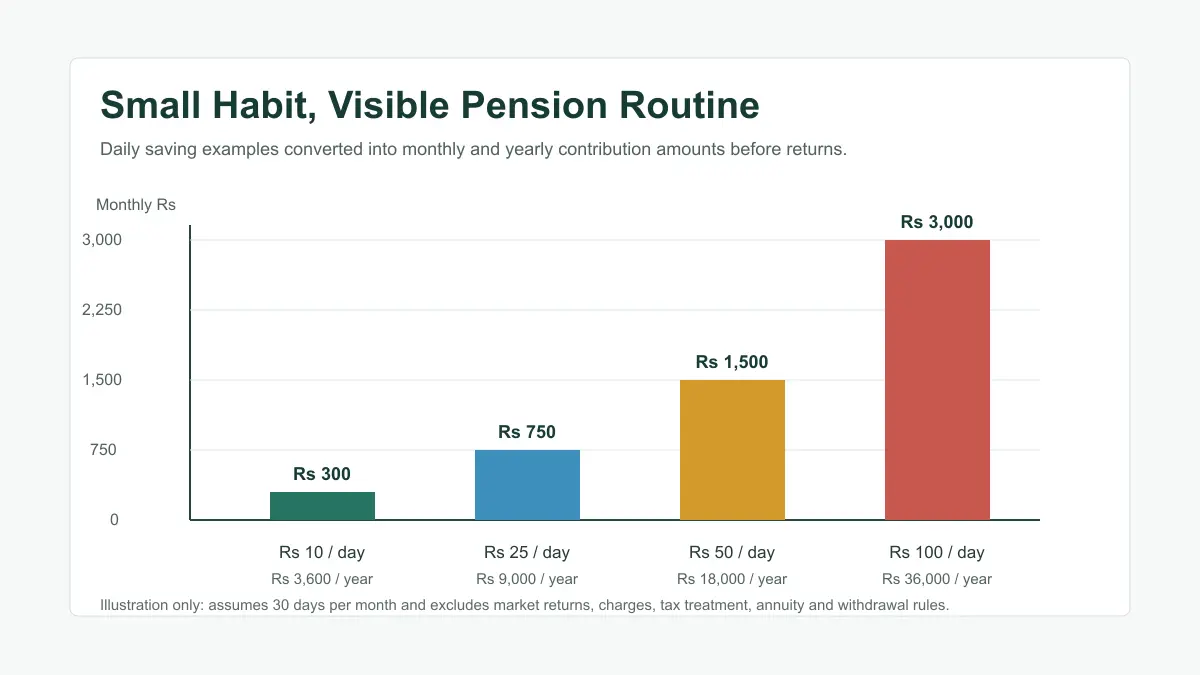
The examples below are simple arithmetic. They assume 30 days per month and do not include market returns, charges, taxes, annuity rules or withdrawal outcomes.
| Daily pension habit | Monthly amount before returns | Yearly amount before returns | Practical use |
|---|---|---|---|
| Rs 10 per day | Rs 300 | Rs 3,600 | A starter rule for building pension awareness and account discipline. |
| Rs 25 per day | Rs 750 | Rs 9,000 | A realistic habit for many small cash-flow businesses during normal months. |
| Rs 50 per day | Rs 1,500 | Rs 18,000 | Can work as a monthly contribution target after business expenses are under control. |
| Rs 100 per day | Rs 3,000 | Rs 36,000 | A stronger pension routine for traders with steady surplus across seasons. |
How To Make The Habit Survive Bad Months

- Start with the smallest amount you can continue even in a weak month.
- Keep business working capital, emergency money and pension money separate.
- Use good cash-flow days for top-ups instead of increasing lifestyle spending immediately.
- Review the account statement and contribution record at least once every quarter.
- Recheck scheme rules, charges and withdrawal conditions before making large decisions.
The right pension habit is not the highest number you can announce. It is the number you can actually continue, review and increase over time.
NPS, APY Or Both?
Some low-income and unorganised-sector workers may also evaluate Atal Pension Yojana, which is designed for old-age income security and offers defined pension slabs based on contribution. NPS and NPS Sanchay are market-linked defined contribution routes, while APY has a different design. The choice should depend on income level, age, risk comfort, liquidity needs, tax situation and whether the subscriber wants a market-linked retirement corpus or a defined pension structure.
How Abhipra Can Help
Abhipra has acted as an NPS Point of Presence for 17 years. For workers, traders and families who want support, Abhipra can help with NPS registration guidance, contribution support and service requests. You can read more on Abhipra's NPS and pension services page, open an NPS account online, or set up SIP in NPS.
FAQs
Should daily earners wait until income becomes stable?
Not necessarily. A small pension habit can begin before income becomes regular, provided emergency needs and business cash flow are not ignored.
Does NPS Sanchay guarantee pension returns?
No. NPS Sanchay is part of the NPS framework and should be treated as a market-linked retirement product. Contribution discipline is important, but returns are not guaranteed.
What is the smallest current contribution reference?
The PFRDA common-scheme circular dated 10 March 2026 states Rs 250 at onboarding and Rs 10 for subsequent contributions for NPS All Citizen, NPS Vatsalya and NPS Lite. Rules can change, so subscribers should verify the latest circular or ask their Point of Presence.
Can a small trader contribute more in good months?
Yes. NPS allows flexible contributions, and the amount can be increased when cash flow is stronger. The subscriber should still evaluate liquidity, market risk, charges and retirement goals.
Source Links / Disclaimer
- PFRDA circular: Introduction of NPS Sanchay
- PFRDA circular: Charge structure for Common Schemes under NPS All Citizen, NPS Vatsalya and NPS Lite
- PFRDA: NPS All Citizen Model
- PFRDA home page pension-system milestones
- PM India: APY continuation up to FY 2030-31
- NCAER: India's majority of workers do not have social security
This article is for educational and informational purposes only. It is not investment, tax, legal or retirement-planning advice. NPS is market-linked and subject to PFRDA rules, charges, investment risks, tax provisions and exit conditions. Investors should evaluate their income stability, liquidity needs, age, risk appetite and latest applicable rules before acting.