Why Pension Coverage Matters For India’s Informal Workers

Retirement planning is easy to postpone when income is irregular. A salaried employee may see a payroll deduction every month, but many workers in India earn through self-employment, daily work, small businesses, contract assignments, or seasonal income.
That is why pension coverage is not only a personal finance issue. It is a financial-resilience issue for families whose income may not come with an automatic retirement benefit.
The Workforce Reality
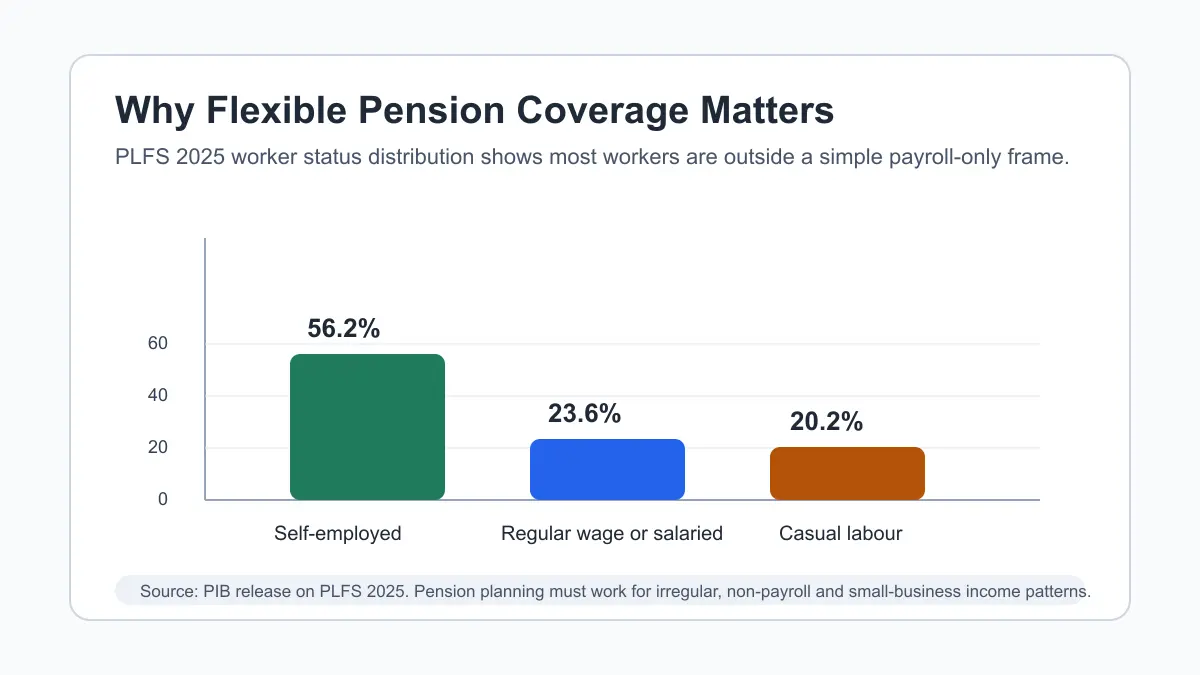
The Periodic Labour Force Survey 2025 release reported that self-employed workers formed 56.2% of workers, regular wage or salaried workers formed 23.6%, and casual labour formed 20.2%. This mix shows why retirement products and advisory support must work beyond a conventional monthly salary.
| Worker status in PLFS 2025 | Share of workers | Retirement planning challenge |
|---|---|---|
| Self-employed | 56.2% | Income may be uneven, so the pension habit has to be self-created. |
| Regular wage or salaried | 23.6% | Some may have payroll-linked benefits, but coverage and adequacy still need review. |
| Casual labour | 20.2% | Short work cycles can make long-term saving feel optional unless a simple routine is built. |
Why A Pension Gap Becomes A Family Risk
An informal worker may support children, parents, loan obligations, health expenses, and business working capital at the same time. If every surplus rupee stays in the same bank balance, retirement money is easy to spend during the next emergency or slow business month.
A pension account creates a separate purpose. It does not remove market risk or life uncertainty, but it can make retirement saving visible, trackable, and harder to ignore.
Where NPS Fits
NPS is a voluntary, market-linked, defined contribution pension system regulated by PFRDA. Under the All Citizen Model, eligible Indian citizens can open an individual pension account after meeting applicable age and KYC requirements.
In 2026, PFRDA introduced NPS Sanchay as a simplified NPS variant under the All Citizen Model and Multiple Scheme Framework for informal-sector pension inclusion. The practical message is clear: pension planning must be simple enough for people whose income is not always monthly, fixed, or employer-administered.
NPS should still be evaluated carefully. Contributions, charges, investment choice, withdrawal rules, tax treatment, and platform workflow should be checked before acting.
A Simple Coverage Routine

For workers with irregular income, the pension routine can be simple:
- Keep emergency money separate before investing.
- Decide a minimum contribution amount that can continue even in a slow month.
- Add extra contributions in stronger income months instead of waiting for year-end.
- Review the NPS statement, nominee, contact details, and asset allocation every quarter.
- Increase the contribution when income becomes more stable.
This approach keeps retirement planning practical. It respects cash-flow reality while still creating a long-term habit.
How Abhipra Can Help
Abhipra has acted as an NPS Point of Presence for 17 years. Eligible subscribers can use Abhipra’s NPS support for account-opening guidance, contribution assistance, service requests, and ongoing pension-account workflows.
Start here: Abhipra NPS & Pension Services
Online account opening: Open NPS through Abhipra
Contribution setup: Set up NPS contribution through Abhipra
FAQs
Is NPS only for salaried employees?
No. Eligible individuals can use the All Citizen Model, subject to current NPS rules and KYC requirements.
Can irregular income earners contribute to NPS?
Yes, but the contribution amount should be chosen carefully. The routine should protect household liquidity, emergency money, tax obligations, and business working capital first.
Is NPS risk-free?
No. NPS is market-linked. The final corpus depends on contribution discipline, asset allocation, pension fund performance, charges, and exit or annuity decisions.
Why not keep retirement savings only in a bank account?
A bank account is useful for liquidity, but retirement money also needs structure and a long-term purpose. Many people use separate buckets so short-term spending does not consume every surplus.
Source Links
PIB: PLFS 2025 worker-status data release
PFRDA: NPS All Citizen Model
NPS Trust: About NPS
PFRDA: NPS Sanchay circular dated May 6, 2026
PFRDA: PoP charge structure for common schemes under NPS
This article is for investor education only. NPS is market-linked and subject to applicable PFRDA rules, scheme documents, charges, taxation, and platform processes. Please verify current terms before acting.