Stock Market Basics for New Investors: What To Understand Before Buying Your First Share
Buying a share is easy. Understanding what happens before and after the buy button is more important. A new investor should know the basic market workflow, the role of a broker, how shares are held in demat form, and why risk management matters before chasing stock tips.
The stock market can help investors participate in business growth, but it also carries price risk, liquidity risk, behaviour risk and fraud risk. Start with the basics before trying to predict the market.

A Share Is Ownership, Not A Lottery Ticket
When you buy equity shares, you are buying ownership interest in a listed company. The share price can move because of company performance, sector outlook, market sentiment, liquidity, interest rates, news flow and broader economic conditions.
That is why a stock should not be bought only because it is popular on social media or has moved sharply in recent days. A responsible investor first understands the company, the risk, the time horizon and the reason for investing.
The Basic Trade Journey
A stock-market transaction involves more than the investor and the company. The order travels through regulated market infrastructure. The simplified journey is: investor places an order, broker routes it, exchange matches it, clearing corporation handles settlement, and depository records the securities in demat form.
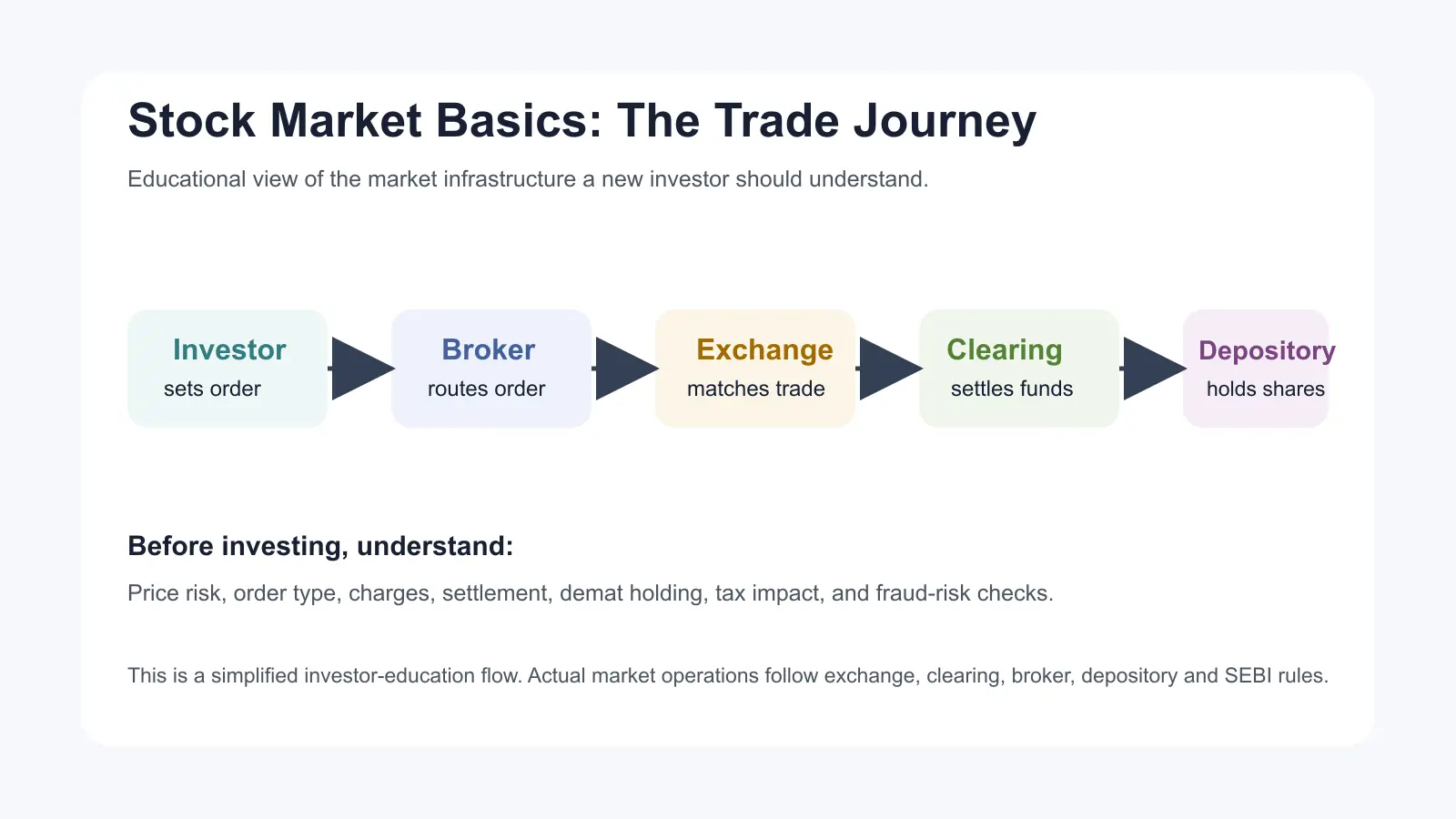
| Step | What happens | Investor check |
|---|---|---|
| Investor | Decides what to buy or sell, order quantity, order type and price limit. | Know why the trade is being placed and how much loss is acceptable. |
| Broker | Provides the trading platform and routes the order to the exchange. | Check charges, account security, contract notes and risk disclosures. |
| Exchange | Matches buy and sell orders according to market rules. | Understand that market price can change quickly. |
| Clearing and settlement | Funds and securities are settled through market infrastructure. | Keep funds ready and review settlement obligations. |
| Depository | Securities are held in demat form after settlement. | Track demat holdings and verify statements regularly. |
Terms Every New Investor Should Know
- Demat account: Holds securities electronically.
- Trading account: Used to place buy and sell orders.
- Market order: Executes at available market price, which can change.
- Limit order: Executes only at the chosen price or better, subject to availability.
- Delivery investing: Buying shares to hold beyond intraday movement.
- Diversification: Avoiding excessive dependence on one stock, sector or theme.
What To Check Before The First Trade
Before buying a share, write down the reason for purchase. Is it based on business fundamentals, long-term goal, valuation comfort and risk capacity, or only a recent price move?
Also check whether the investment amount is affordable. Money needed for rent, loan EMI, emergency fund, insurance premium or near-term family expenses should not be exposed to equity volatility.

The desk review represents a practical first-investor checklist: verify KYC and demat details, understand order type, review charges, read risk disclosures, avoid borrowed money, and keep investment records for review and taxation.
Common Mistakes
The first mistake is investing only because a stock is trending. Popularity is not research.
The second mistake is putting too much money into one company or sector. Concentration can magnify both gains and losses.
The third mistake is confusing trading with investing. A long-term investor and a short-term trader need different rules, time commitments and risk controls.
Investor Checklist
- Open and operate accounts only through regulated intermediaries.
- Read contract notes, statements and risk disclosures.
- Avoid guaranteed-return claims and unsolicited tips.
- Start with money that can remain invested through volatility.
- Review company basics before buying shares.
- Keep emergency money separate from equity investments.
For demat account support, stock market education or research-led investing queries, connect with Abhipra through Abhipra's contact page.
Source Links
Reviewed by Abhipra Research / Compliance Team.
Disclaimer
This article is for educational and informational purposes only. It is not investment advice, stock recommendation, trading advice, tax advice or a promise of returns. Equity investments are subject to market risks. Investors should evaluate suitability, risk appetite, investment horizon, liquidity needs, tax position and all applicable charges before making investment decisions.