Intraday Trading vs Investing: Know The Difference Before You Place The Order

Intraday trading and investing both use the securities market, but they are not the same activity. Intraday trading is a short-horizon decision where entry, exit, costs and discipline matter immediately. Investing is a longer-horizon decision where business quality, asset allocation, goals and patience matter more.
The mistake is treating one as the other. A trade should not become an "investment" only because it has gone into loss. A long-term investment should not be judged only by one day's price movement.
The Real Difference Is The Job Of The Money
Before placing an order, ask what job the money is doing.
If the money is for intraday trading, the first questions are about risk per trade, liquidity, stop-loss logic, trading costs and emotional discipline. The holding period is short, so one bad execution or one oversized position can hurt quickly.
If the money is for investing, the first questions are different: goal, time horizon, asset allocation, business or scheme quality, diversification, taxation and whether the product is suitable. The investor is not trying to win every market hour.
| Review point | Intraday trading | Investing |
|---|---|---|
| Main objective | Short-term trade execution with predefined risk. | Goal-linked wealth creation or income planning over time. |
| Primary risk | Speed, leverage, liquidity, costs and emotional reactions. | Business risk, market cycles, concentration, inflation and unsuitable products. |
| Useful documents | Trade plan, contract note, ledger, order record and risk journal. | Company filings, scheme documents, account statements and goal plan. |
| Bad habit to avoid | Averaging a losing trade without a plan. | Selling a suitable investment because of daily noise. |
SEBI Data Shows Why Intraday Needs Discipline
SEBI's July 2024 study on individual intraday traders in the equity cash segment found that 7 out of 10 individual intraday traders incurred net losses in FY 2022-23. The study also said the number of individual intraday traders rose from about 15 lakh in FY 2018-19 to about 69 lakh in FY 2022-23, and that loss-makers spent an additional 57% of their trading losses as trading costs in FY 2022-23.
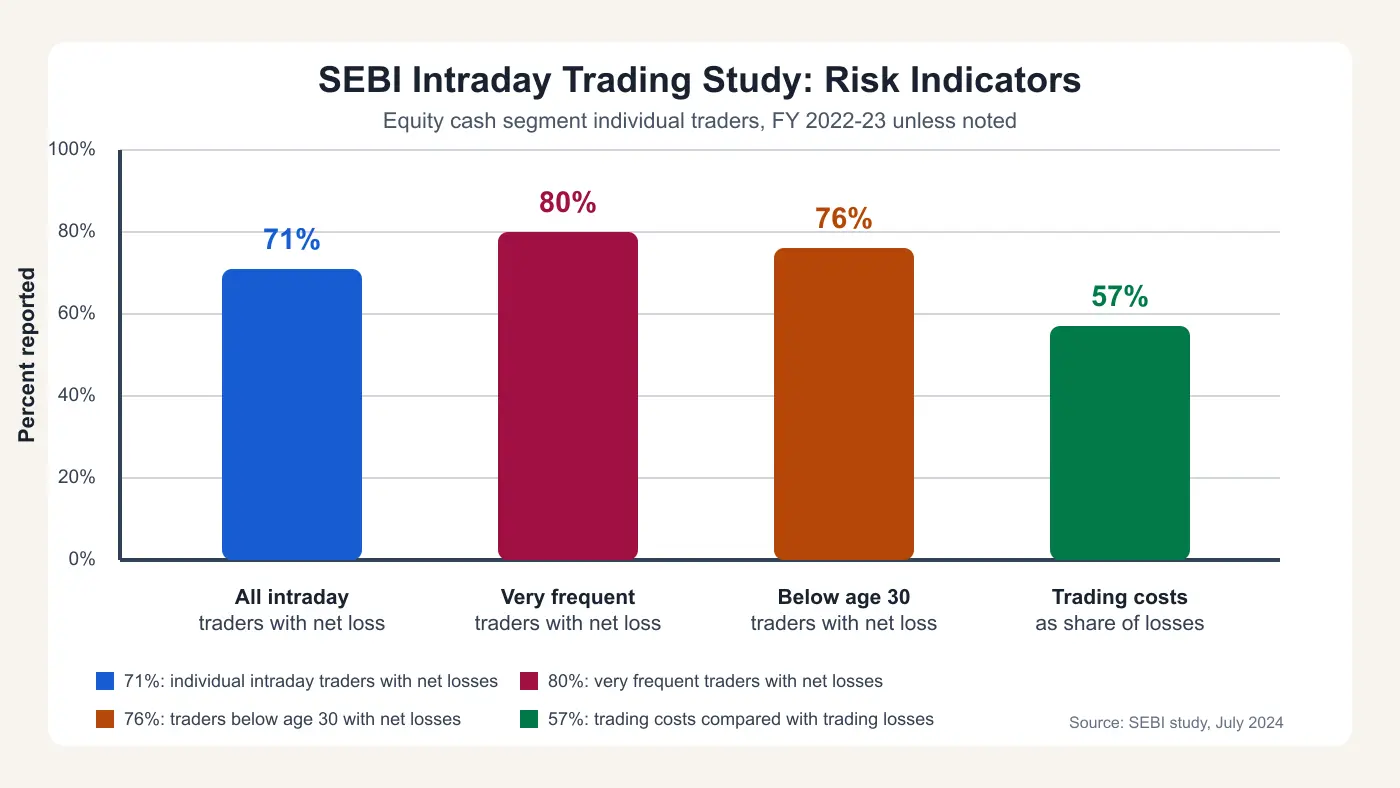
| Indicator from SEBI study | Value reported | Investor lesson |
|---|---|---|
| Individual intraday traders with net losses in FY 2022-23 | 71% | Intraday trading should be treated as high-risk activity, not easy income. |
| Loss-makers among very frequent traders | 80% | More trades do not automatically mean better outcomes. |
| Loss-makers among traders below age 30 in FY 2022-23 | 76% | New and young traders should focus on risk education before activity. |
| Trading costs compared with trading losses for loss-makers in FY 2022-23 | 57% | Costs, taxes and charges can deepen losses even when position size looks small. |
These figures do not mean every investor must avoid markets. They mean an intraday order needs a written risk plan, cost awareness and the ability to stop. Investors should not rely on hot tips, borrowed money or unregistered advice.
What An Intraday Trader Should Write Before The Trade
An intraday trade should have a short written plan:
- Why is the trade being taken?
- What is the entry, stop level and planned exit?
- How much rupee loss is acceptable if the trade fails?
- How will brokerage, securities transaction tax, exchange charges, GST and other costs affect the result?
- What happens if the price moves too quickly or liquidity is poor?
- Will the trader stop after the risk limit is reached?
NSE's trading-system page explains how orders are time-stamped, matched on price-time priority and how stop-loss orders are triggered only when the market reaches or crosses the specified threshold. That is useful context because a stop loss is a tool, not a guarantee of the exact exit price.
What A Long-Term Investor Should Review Instead
An investor should not copy an intraday trader's dashboard. The long-term review should ask:
- Is the product linked to a specific goal and time horizon?
- Is the portfolio diversified across suitable assets?
- Is the company or fund being reviewed through official documents?
- Are account statements, contract notes, demat records and nominee details up to date?
- Are taxation, liquidity and exit costs understood before acting?
- Is the decision based on suitability rather than social media noise?
SEBI's investor education material asks investors to understand risk, read documents carefully, keep records, review portfolios periodically and avoid hot tips. That is a better foundation for investing than reacting to every market move.
Use Two Separate Buckets

A practical way to avoid confusion is to keep two separate buckets.
The investing bucket is for goals, asset allocation and long-term planning. It should be reviewed calmly and periodically.
The trading bucket, if used at all, should be limited to risk capital, written rules and strict loss limits. It should not be funded from emergency money, borrowed money or funds needed for near-term family goals.
Common Mistakes
The first mistake is calling every loss-making trade a long-term investment. If the original decision was a trade, it needs a trade exit rule.
The second mistake is judging a long-term investment only by intraday price movement. A business, fund or asset allocation decision needs deeper review than one market session.
The third mistake is ignoring costs. Frequent activity can make brokerage, taxes and charges a material part of the outcome.
The fourth mistake is using tips without checking registration, documents and suitability.
Bottom Line
Intraday trading is about execution discipline under time pressure. Investing is about suitability, patience and evidence. Both require risk awareness, but they require different rules.
Before placing the next order, decide which activity it is. Then use the correct checklist.
Source Links
- SEBI study: Analysis of Intraday Trading by Individuals in Equity Cash Segment
- SEBI press release: 7 out of 10 individual intraday traders in equity cash segment make losses
- SEBI Investor: Do's and Don'ts of Investing in Securities Market
- SEBI Investor Charter
- NSE Equity Market Trading System
- SEBI Investor: Key Risks in Investing in Securities Market
Disclaimer
This article is for investor education only and is not investment advice, trading advice, research recommendation, solicitation or an offer to buy or sell securities or derivatives. Intraday trading and market-linked investments involve risk, costs, taxation, liquidity risk and possible loss of capital. Please consult a SEBI-registered investment adviser or other qualified professional before taking investment or trading decisions. Reviewed by Abhipra Research / Compliance Team.