
Capital Gains Tax on Equity and Mutual Funds: Start With What You Sold
Capital-gains tax is not determined by a headline rate alone. Before looking at a percentage, an investor needs to identify the asset, the transfer date, the holding period, the transaction conditions and the records that support the calculation. That matters especially when a portfolio contains both listed equity and mutual-fund units.

Begin with the asset, not the tax rate
The Income Tax Department explains that profit or gain on transfer of a capital asset is charged under the head “Capital Gains.” It also identifies several different forms of transfer, not only a simple sale. Read the Department’s ITR-2 capital-gains FAQ.
For the specific listed-equity framework, the return guidance asks for Schedule 112A details for equity shares, units of equity-oriented funds and units of business trusts where securities transaction tax (STT) is paid. A mutual fund must therefore not be treated as “equity” merely because it is a mutual fund; the fund type and the applicable scheme/return documentation matter. See the Department’s ITR-2 user guidance.
The 12-month checkpoint is useful—but not enough on its own
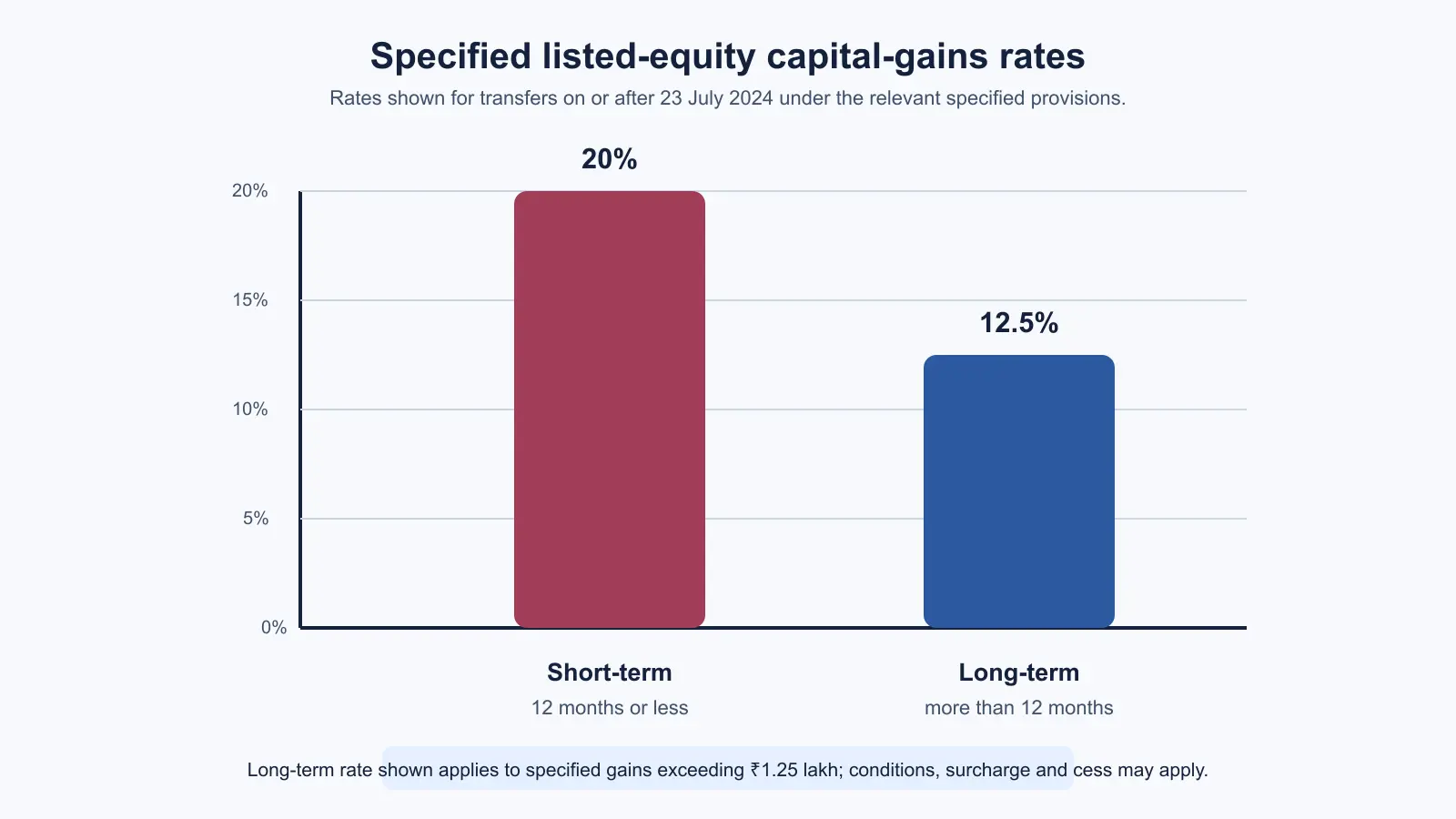
For listed equity shares and units of equity-oriented mutual funds, the Department’s current FAQ describes a 12-month holding-period test for long-term classification. The chart below displays the Finance (No. 2) Act, 2024 rates for the specified listed-equity provisions on transfers on or after 23 July 2024: 20% for specified short-term gains and 12.5% for specified long-term gains exceeding ₹1.25 lakh. The vertical axis is the tax rate; the horizontal axis is the holding-period classification.
| Checkpoint | Source-backed context | What an investor should verify |
|---|---|---|
| Asset type | Schedule 112A guidance covers specified equity shares, equity-oriented fund units and business-trust units where STT is paid. | Scheme category, listing status, transaction route and supporting statement. |
| Holding period | The Department describes 12 months for listed equity shares and equity-oriented fund units in this context. | Actual acquisition and transfer dates, including switches/redemptions where relevant. |
| Specified rates shown | Finance (No. 2) Act, 2024: 20% specified short-term rate; 12.5% specified long-term rate above ₹1.25 lakh for transfers on or after 23 July 2024. | Whether all statutory conditions are met; surcharge, cess, losses, exemptions and taxpayer facts can alter the final result. |
The inference is not “hold merely for a tax rate.” The holding period is one classification input. Suitability, risk, goal horizon, portfolio allocation and cash needs should drive an investment decision; tax is one consequence of a later transfer.
Keep the trail from purchase to return

The Department’s filing guidance notes that Schedule 112A can require details of the relevant shares or units, including identifiers and transaction values. For assets acquired on or before 31 January 2018, the guidance notes additional scrip-wise details. Review the ITR-2 Schedule 112A guidance.
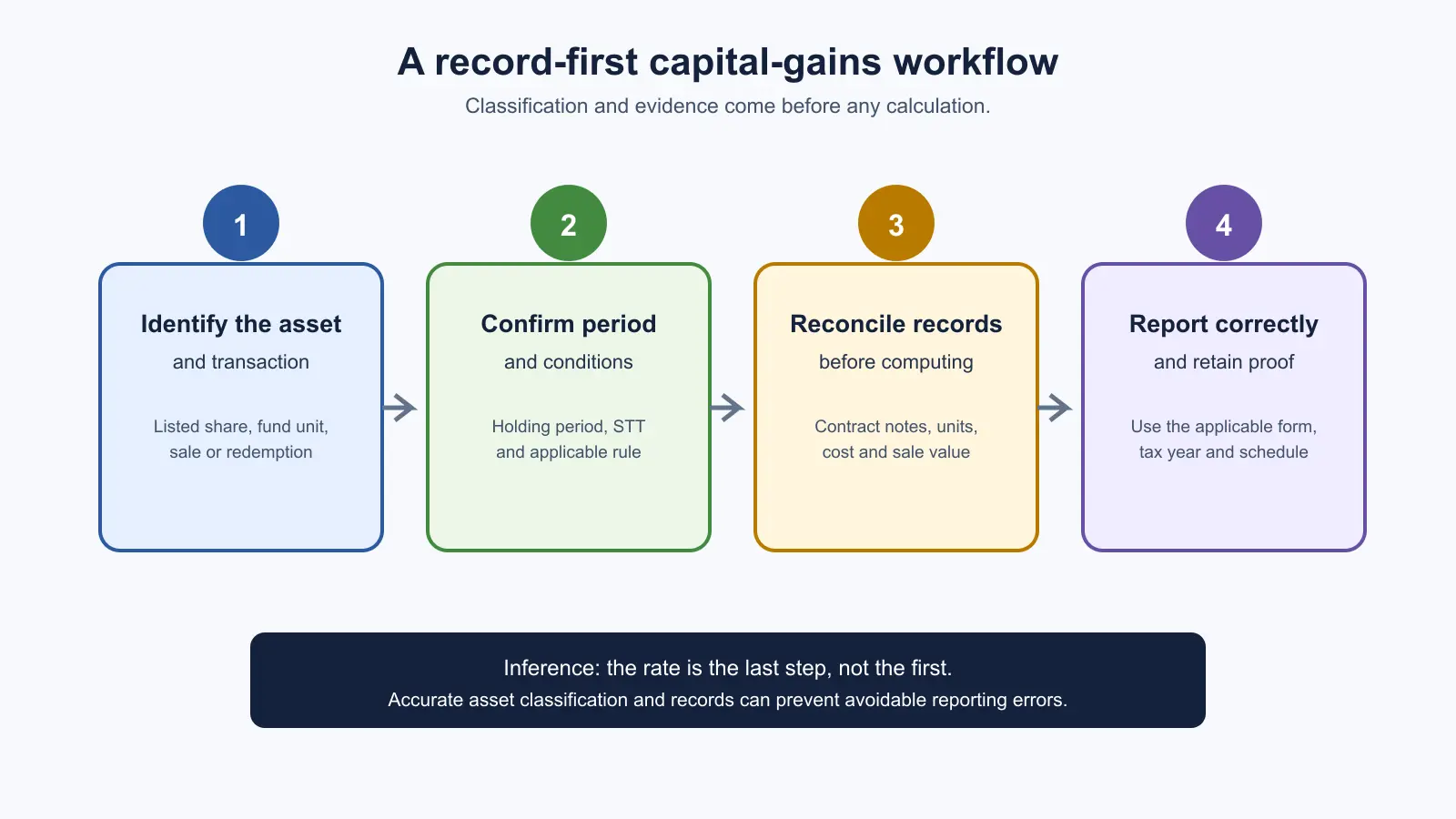
- Identify the asset and transaction. Separate listed shares, equity-oriented fund units and other assets; note whether the event is a sale, redemption, switch or another transfer.
- Confirm the period and conditions. Check acquisition and transfer dates, the relevant STT/other conditions and the tax-year rules.
- Reconcile records before computing. Retain contract notes, consolidated account statements, unit details, acquisition cost, expenses where applicable and sale/redemption value.
- Report correctly and retain proof. Use the applicable return, tax-year framework and schedule. The Income Tax Department says “Tax Year” applies from 1 April 2026 for income earned in FY 2026–27, while earlier-year returns continue under the earlier Act. Read the transition FAQ.
Mistakes that can make a simple transaction harder
- Assuming every mutual-fund unit has the same capital-gains treatment.
- Using the investment date from memory instead of the statement or contract note.
- Looking at a rate before checking whether the specified statutory conditions apply.
- Forgetting a redemption or switch when compiling the annual record.
- Applying a Tax Year 2026–27 label to an earlier-year return without checking the transition rules.
- Treating a tax outcome as a reason to buy, hold or sell an unsuitable investment.
Investor checklist before filing
- Download the broker capital-gains statement and mutual-fund consolidated account statement early.
- Reconcile each sale/redemption with acquisition details and unit quantities.
- Check the applicable return instructions and schedules—not an old social-media post or a generic calculator.
- Review whether capital losses, exemptions, residency, surcharge, cess or other facts need professional advice.
- Never share PAN, e-filing passwords, OTPs, contract notes or account statements through unverified calls or links.
Source Links
- Income Tax Department: ITR-2 FAQ on capital assets, transfers and holding periods
- Income Tax Department: ITR-2 user manual and Schedule 112A guidance
- Finance (No. 2) Bill, 2024: specified capital-gains rates
- Budget 2024–25 memorandum: capital-gains rate and ₹1.25 lakh threshold changes
- Income Tax Department: Tax Year transition FAQ
Disclaimer
This article is for investor education only and is not tax, legal, investment or product advice. Capital-gains treatment depends on the applicable law, tax year, asset, dates, transaction conditions, residency, records and other facts. Verify current rules with the Income Tax Department and consult a qualified tax professional for a personalised calculation. Investments in securities are subject to market risks; read all related documents carefully. Reviewed by Abhipra Research / Compliance Team.