SEBI’s Direct Demat Credit Process: What Replaced the Letter of Confirmation?
Reviewed on: 3 October 2026. Reviewed by Abhipra Investor Education Team.
Since 2 April 2026, eligible investor service requests for physical securities follow a direct demat credit process. After the issuer or its Registrar and Transfer Agent (RTA) verifies the request, it initiates dematerialisation to the investor’s account; a new Letter of Confirmation (LOC) is no longer part of the route. The investor must have a demat account and submit the required request documents, including a recent DP-attested Client Master List (CML).

What changed on 2 April 2026?
SEBI Circular HO/38/13/(3)2026-MIRSD-POD/I/3763/2026, dated 30 January 2026, removed the LOC step for covered service requests. The change took effect on 2 April 2026. RTAs and listed companies now complete due diligence and initiate the demat conversion request in the depository system for direct credit to the holder’s or claimant’s account.
The circular covers service requests including duplicate securities, transmission, transposition, claims from unclaimed suspense accounts and corporate actions. The exact documents depend on the request type, the security holding and the issuer/RTA’s current checklist.
Documents and the current route
For the relevant physical-securities service requests, the investor or claimant should:
- Open or maintain a demat account in the holder’s or claimant’s name, as applicable.
- Complete the applicable investor service request form and demat conversion request form.
- Obtain the latest CML for the demat account. It must be DP-attested and no older than two months when submitted.
- Submit the request and supporting documents to the issuer or its RTA using the contact and delivery method listed on the issuer/RTA’s official website.
- Respond promptly if the issuer/RTA raises an objection or asks for clarification.
- After verification and processing, the issuer/RTA initiates the demat conversion request. Once confirmed, an intimation is sent about successful dematerialisation.
A valid, complete request is important: SEBI’s 30-day processing limit runs from receipt of the request after removing objections, not necessarily from the date an incomplete package is first sent. The applicable form and evidence can differ by request type. Check the issuer/RTA’s current checklist before sending original certificates or other supporting records.

Which requests are covered?
The revised framework addresses the demat credit leg of several shareholder-service processes, including duplicate securities, transmission, transposition, eligible claims from an unclaimed suspense account and corporate actions. For example, the circular directs RTAs/issuers to credit securities directly to the claimant’s demat account for the specified case of transmission of securities held in physical form in a single name after the holder’s death.
This does not mean every shareholder query follows one identical form or document list. A company’s current instructions and the exact facts of the holding determine the evidence required. Investors should use official issuer/RTA and depository-participant channels and retain an acknowledgement and copies of their submission.
If you already hold an older LOC
SEBI’s transition clause allows an LOC issued before 2 April 2026 to be submitted to the investor’s Depository Participant for dematerialisation within 120 days from its issue date. The transition is limited to those earlier LOCs; the circular removes issuance of new LOCs under the covered process.
From an LOC handoff to direct credit
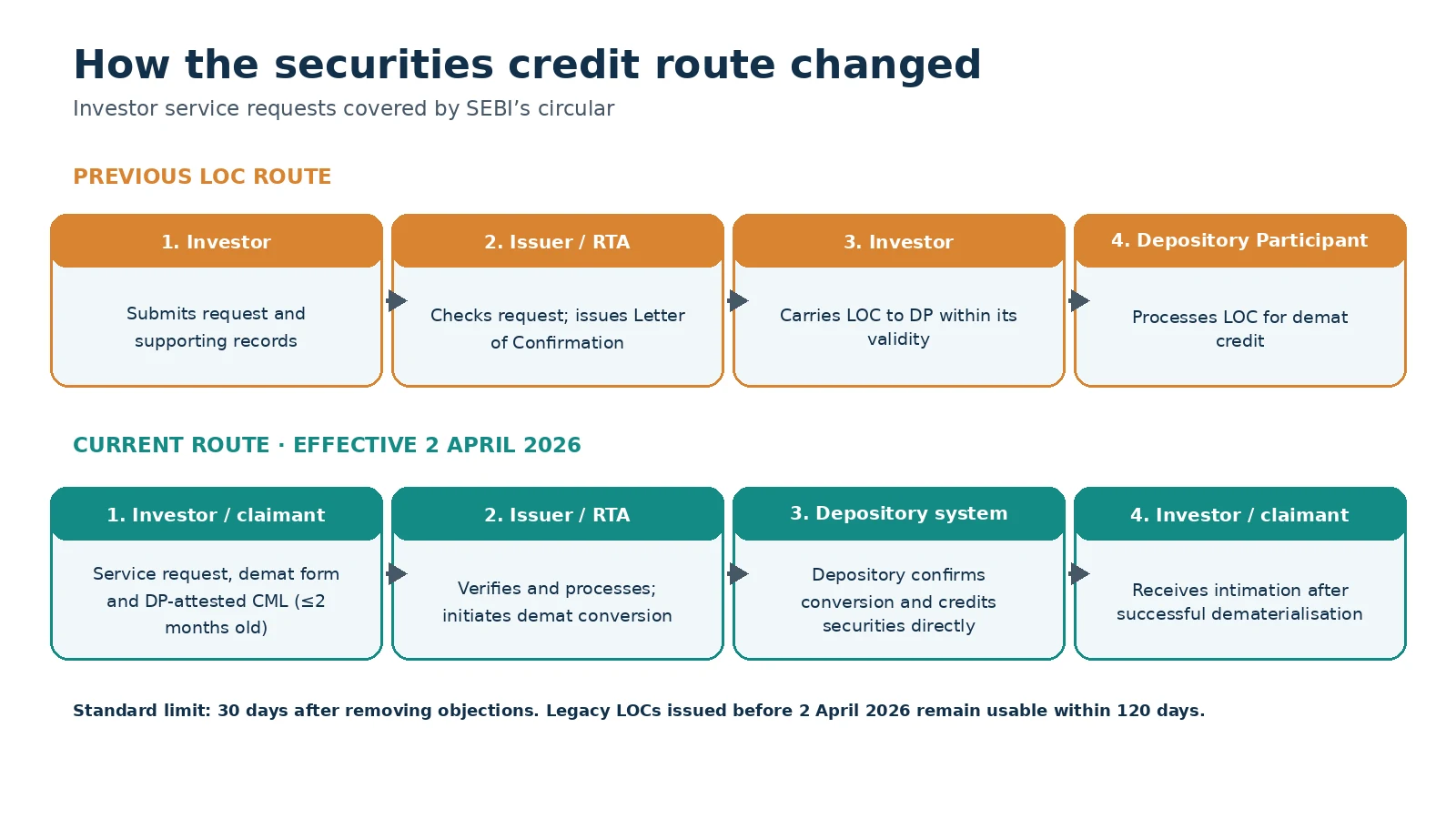
The earlier route passed from the investor to the issuer/RTA, back to the investor with an LOC, and then to the DP for demat processing. Under the current route, the issuer/RTA initiates the demat conversion in the depository system after verification. The investor supplies a DP-attested CML no older than two months, and the depository/RTA/issuer sends an intimation after successful dematerialisation.
What the timeline figures mean
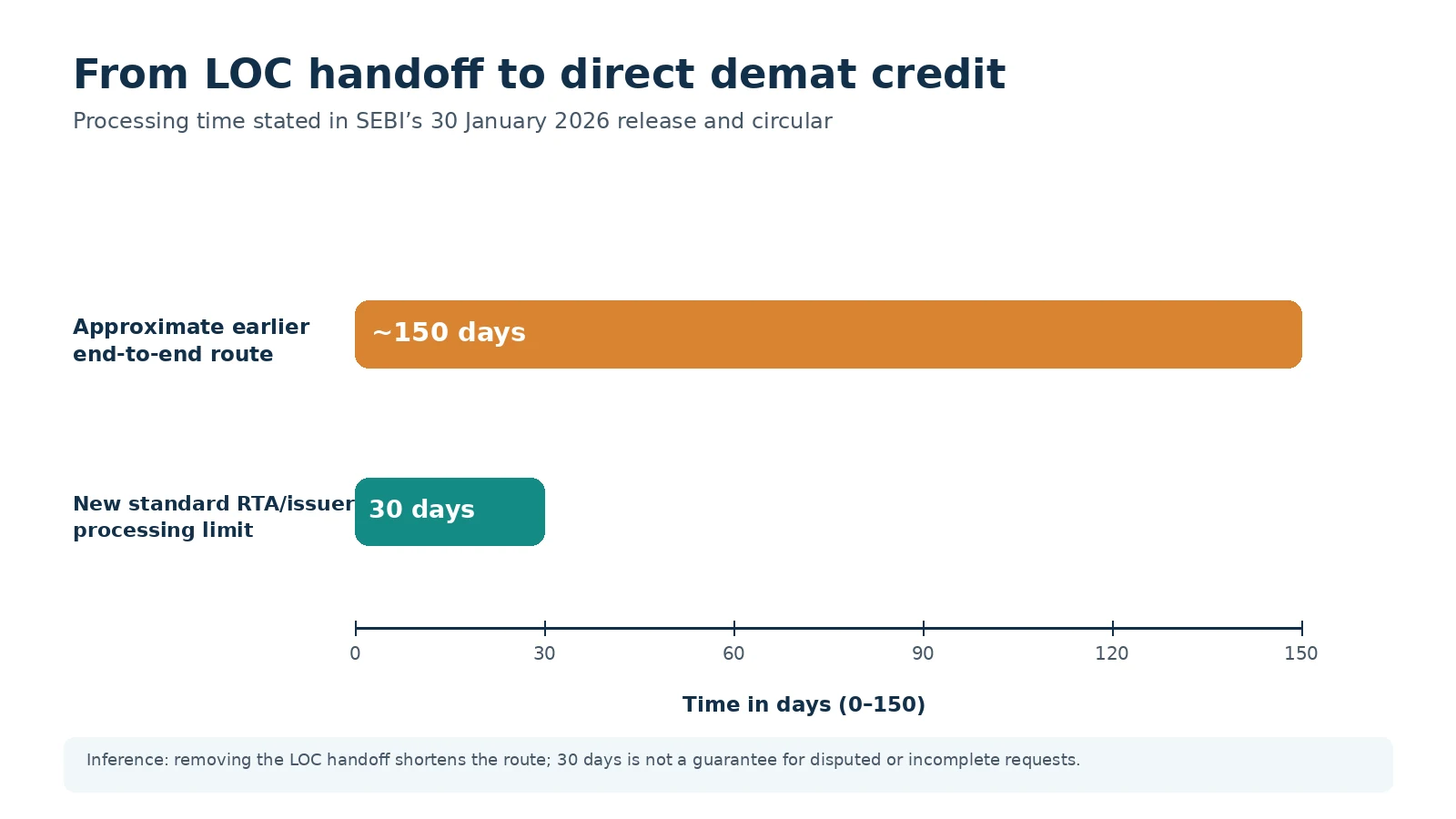
The horizontal axis is elapsed time in days from 0 to 150; each bar is a stated duration, not a monthly data series. SEBI’s January 2026 press release described the earlier end-to-end route as typically around 150 days and said the change was expected to reduce the timeline to 30 days. The circular sets a 30-day processing limit for the relevant issuer/RTA steps after objections are removed. The comparison explains why removing the LOC handoff can shorten the route; it does not guarantee that every request will finish within 30 days if documents are incomplete, objections remain or facts need additional checks.
Practical checks before submitting a request
- Confirm the issuer and RTA named for the security using an official company or exchange source.
- Match the account holder name and details with the request documents; ask the DP for an updated, attested CML if needed.
- Confirm the CML is no older than two months on submission.
- Use the current request forms and the issuer/RTA’s official submission instructions.
- Keep proof of delivery and the acknowledgement or reference number.
- Do not share passwords, OTPs or unmasked sensitive documents over an unverified channel.
- If an objection is raised, ask what needs correction and keep the revised submission record.
How Abhipra can assist
Need help with dematerialisation, transmission, correction of records or an RTA service request? Write to rtaservices@abhipra.com with the company name, holder name, folio/DP details and a brief description. Do not email passwords, OTPs or unmasked sensitive documents until a secure submission method is provided.
Source links
- SEBI Circular HO/38/13/(3)2026-MIRSD-POD/I/3763/2026, 30 January 2026
- SEBI press release 10/2026: LOC removal and direct credit
- CDSL RTA communiqué index, including direct-credit communiqués issued in March and April 2026.
Disclaimer
This article is for general educational information and does not constitute legal, tax, investment or transaction advice. Applicability depends on the company’s and investor’s facts and on the law, circulars and depository instructions in force on the relevant date. Check the issuer/RTA and DP’s current instructions for the specific request.