From Private Company to Public Company: Corporate-Law Preparation Before an IPO
Reviewed on: 14 September 2026. Reviewed by Abhipra RTA Team.
An IPO is not simply a fund-raising event. Before an Indian private company can pursue a public issue, it generally needs a carefully sequenced corporate-law conversion, clean capital and shareholder records, and an IPO-readiness review under the current Companies Act, SEBI and stock-exchange framework. Converting to a public company does not itself make the company eligible for an IPO; it is one legal and governance step in a wider transaction.

Start With The Legal Difference Between Conversion And An IPO
A private company has restrictions in its articles that are characteristic of private-company status, including restrictions on transfer of shares and limits on the number of members, subject to the Companies Act framework. A public company is a different class of company. Under section 14 of the Companies Act, 2013, a company may alter its articles by special resolution; where a private company removes the required private-company restrictions, it ceases to be a private company from the date of that alteration. Section 18 provides for registration after conversion and preserves the company’s existing debts, liabilities, obligations and contracts.
The practical distinction matters. The board must not treat a new public-company name as a substitute for offer-document readiness, SEBI eligibility, exchange requirements, merchant-banker due diligence, investor protection controls or listing approval.
The Corporate-Law Preparation Sequence
The exact sequence and filings must be confirmed by the company secretary and legal advisers for the issuer’s facts. A sensible control path is:
| Stage | Principal decision or evidence | Why it needs attention before an IPO |
|---|---|---|
| Strategic board review | Reasons for public capital, proposed timetable, adviser appointments and risk ownership | Aligns the transaction objective with the company’s capacity for disclosure and listed-company governance. |
| Articles and shareholder arrangements | Review private-company restrictions, transfer clauses, investor rights, nominee arrangements, drag/tag provisions and any conflicts | The articles and agreements should not contradict the intended public-company and offer structure. |
| Shareholder approval | Special resolution for the articles alteration/conversion, with proper notice, voting and minutes | Section 14 is the core corporate approval gateway for the alteration. |
| MCA filing and registration | Complete the applicable filing process, including INC-27 where required, with attachments and supporting resolutions | The MCA instruction kit identifies INC-27 in the section 14 / rule 33 conversion process. Do not assume that filing alone resolves every related change. |
| Capital and record cleanup | Reconcile authorised, issued, subscribed and paid-up capital; allotments; transfers; ESOPs; convertibles; pledges and charges | Inconsistent records can surface in due diligence, offer-document disclosures, ISIN/demat work and post-listing servicing. |
| IPO and exchange review | Test the issuer against current ICDR, Companies Act, SCRA and exchange requirements with appointed advisers | IPO eligibility is assessed separately and must remain satisfied at the relevant filing/registration stages. |
Conversion Controls That Are Often Missed
Articles Cannot Be Reviewed In Isolation
Before shareholders vote, map the articles against shareholders’ agreements, financing documents, ESOP documentation, option/convertible terms, pledge arrangements and any investor consent rights. This is not about removing protections casually. It is about identifying what needs consent, amendment, waiver, disclosure or a transaction-specific legal opinion.
Capital History Must Reconcile Before Due Diligence Intensifies
Build one evidence-backed capital history covering incorporation, every allotment, transfer, split, consolidation, bonus issue, conversion, ESOP event and cancellation. Reconcile that history to statutory registers, board/shareholder resolutions, filings, financial statements, the cap table and depository/ISIN records where applicable. The RTA, company-secretarial and finance workstreams should work from controlled versions and preserve an audit trail for changes.
Demat And ISIN Planning Should Start Early
Public-offer and listing processes rely on accurate security-holder and depository records. Do not defer dematerialisation, ISIN mapping, shareholder identity correction, promoter/group and employee holding checks until the issue period. The appropriate requirement depends on the issuer, instrument, route and current regulation; obtain issuer-specific advice before setting a deadline.
Current Primary-Market Context
SEBI’s Annual Report 2025-26 records that IPO count, including SME platform activity, rose from 320 in 2024-25 to 366 in 2025-26, while IPO fund-raising rose from Rs 1,72,328 crore to Rs 1,88,616 crore. The data is market context, not a forecast or a reason to proceed without readiness.
| SEBI Annual Report 2025-26 indicator | 2024-25 | 2025-26 | Inference |
|---|---|---|---|
| IPO count, including SME platform | 320 | 366 | More issuers used public markets, reinforcing the value of early records and governance preparation. |
| IPO amount raised | Rs 1,72,328 crore | Rs 1,88,616 crore | Public markets remained a significant capital-raising route, but each issuer still requires an independent suitability review. |
| SME listings | 241 | 257 | SME activity continued; SME listing is not a light-touch alternative to governance and disclosure discipline. |
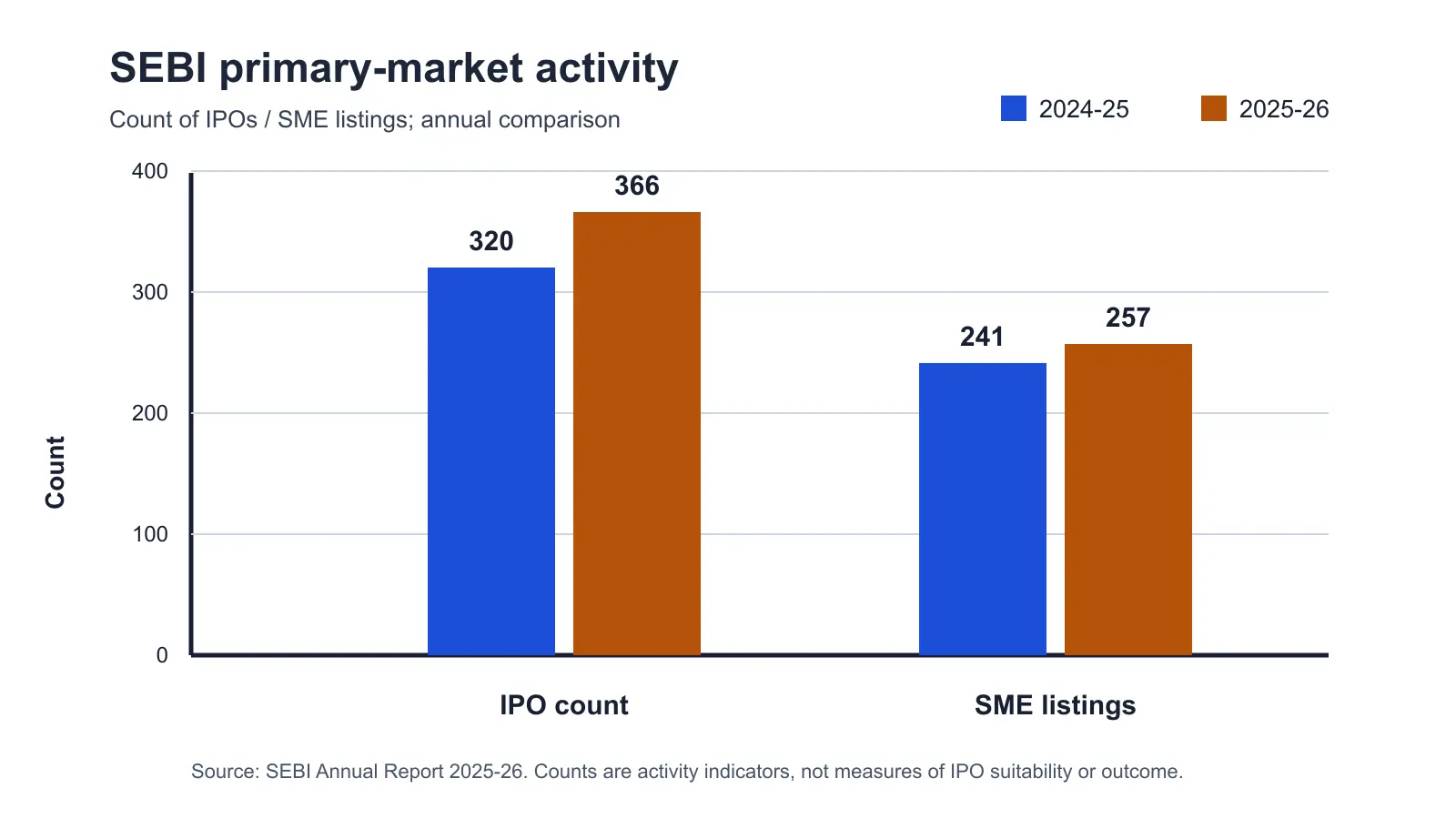
Chart interpretation: the horizontal axis identifies the two SEBI-reported activity measures and the vertical axis counts IPOs/listings. Both series increased in 2025-26. It does not measure IPO success, valuation, returns, or an individual company’s eligibility.
A Workflow For Controlled Public-Company Readiness

- Establish a board-approved IPO-readiness programme with an accountable owner, adviser map, decision log and secure document room.
- Perform a legal and corporate-record diagnostic before changing the articles: review company status, capital history, shareholder rights, contracts, charges, disputes and material approvals.
- Obtain shareholder approval and complete the applicable MCA conversion/registration actions with the statutory evidence retained.
- Run in parallel: financial/restatement readiness, governance and committee preparation, capital reconciliation, demat/ISIN readiness, and offer-document data collection.
- Ask the merchant banker, legal counsel, company secretary, auditors, RTA/registrar and exchange-facing teams to reconcile their dependencies before a draft offer document is filed.
The control inference is simple: an early discrepancy costs less to investigate than a late discrepancy in an offer-document or issue-period timetable.
IPO Eligibility Is A Separate Gate
The current SEBI ICDR Regulations, 2018 are listed by SEBI as last amended on 21 March 2026. They apply conditions at specified stages of the public-issue process. NSE’s main-board eligibility guidance also sets out exchange-level prerequisites, including paid-up-capital and capitalisation signals, track-record and other conditions. Neither source should be reduced to a one-page eligibility checklist: the applicable route, issue structure, financial record, securities history, promoter/group position, litigation, compliance record and disclosure facts require professional assessment.
Keep an explicit issues register for unresolved points. Examples include an old share transfer without complete evidence, an unexercised option, a pledge or charge, a mismatch between statutory and finance records, a shareholder-agreement conflict, or an instrument that may convert after the proposed IPO. Mark the owner, evidence required, decision-maker and closure date; do not simply overwrite the discrepancy.
How Abhipra Can Assist
Abhipra can support companies, promoters, company secretaries and advisers with RTA and registrar planning, shareholder-record reconciliation, ISIN and depository readiness, corporate-action data checks and investor-servicing workflow design. For a preliminary discussion, share only non-sensitive summary information through an authorised secure channel. Do not send passwords, OTPs, unmasked PAN, bank details, signatures or sensitive KYC documents through unsecured email or messaging.
Source Links
- Companies Act, 2013 on India Code: sections 14, 18 and public-offer provisions
- MCA instruction kit for eForm INC-27
- SEBI ICDR Regulations, 2018, last amended 21 March 2026
- SEBI Annual Report 2025-26, including Chapter 3: Primary Markets
- NSE main-board public-issue eligibility criteria
Disclaimer
This article is for general educational and operational awareness. It is not legal, tax, accounting, merchant-banking, valuation, investment or FEMA advice. The correct conversion route, articles amendments, filings, IPO eligibility, offer structure, disclosure, dematerialisation, listing and post-listing obligations must be confirmed against current law and the issuer’s facts by its company secretary, legal counsel, merchant banker, auditor, tax adviser, RTA/registrar and other appointed professionals.